Custom Vocabulary
Peerdom uses a set of terms throughout its interface (circles, roles, peers) but your organization may use different language. Custom vocabulary lets you replace these terms with words that fit your culture and framework.
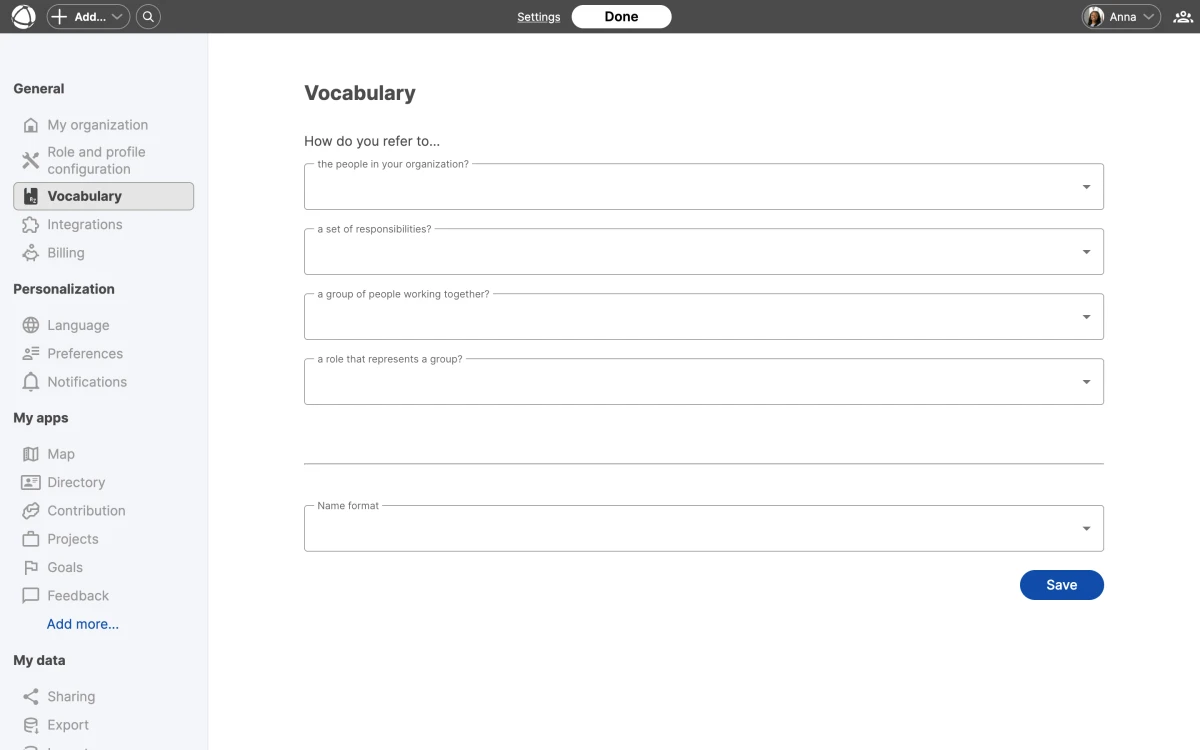
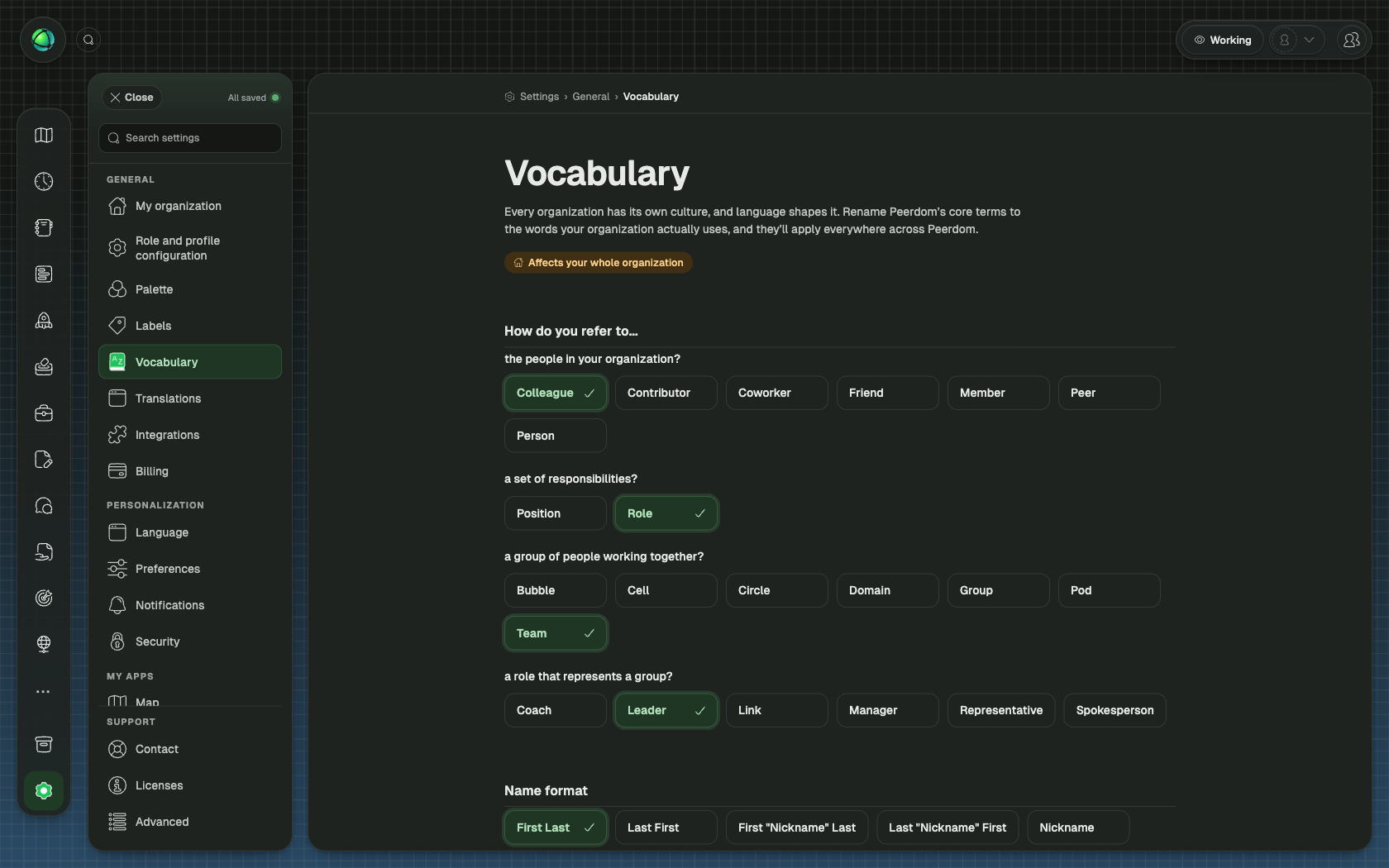
Customize your terms
- Go to Settings > Vocabulary
- Select your preferred term for each concept
- Save
Your choices apply across the entire Peerdom interface: the map, the Inspector, profiles, apps, and exports.
Available terms
- Peers can be called: peer, colleague, contributor, coworker, member, or person
- Circles can be called: group, circle, team, domain, cell, bubble, or pod
- Roles can be called: role or position
- Representatives can be called: representative, leader, link, coach, manager, or spokesperson
- Goals can be called: goal, SMART goal, objective, epic, initiative, outcome, and more
- Subgoals can be called: subgoal, task, key result, KPI, user story, and more
Fixed terms
Some terms cannot be changed. These remain consistent regardless of your vocabulary settings:
- Map (the main visualization)
- Owner, Editor, Member, Guest (access levels)
- Draft (unpublished changes)
- Journal (the activity log)
Common framework defaults
Different organizational frameworks tend to use specific terminology. Here are common configurations:
- Holacracy typically uses “circle” for groups, “role” for roles, and “link” for representatives
- Sociocracy typically uses “circle” for groups, “role” for roles, and “representative” for representatives
- Agile typically uses “team” for groups, “role” for roles, and “leader” for representatives