Most people remember Cybersyn as a socialist dream: a futuristic control room where a few people make perfect decisions for a whole country. That image is half wrong, and the wrong half is the interesting one.
Its designer, Stafford Beer, was not building a central brain that decides for everyone. He was building something closer to a nervous system: the operational units steer themselves as far as they can, and a central level steps in on the problems they cannot solve. With AI speeding up every loop we have, that distinction is the most useful idea I know for organization design.
I’ll be honest about why this matters to me. Cybersyn, together with Ricardo Semler’s Maverick, inspired me more than any movement that came after it, Teal included. Cybernetics, and second-order cybernetics in particular, showed me how far today’s org structures are from how organizations actually live. And in the age of AI, we don’t have decades to close that gap. That conviction is why we took the org chart further, into the Bubble Map.
What Cybersyn actually was
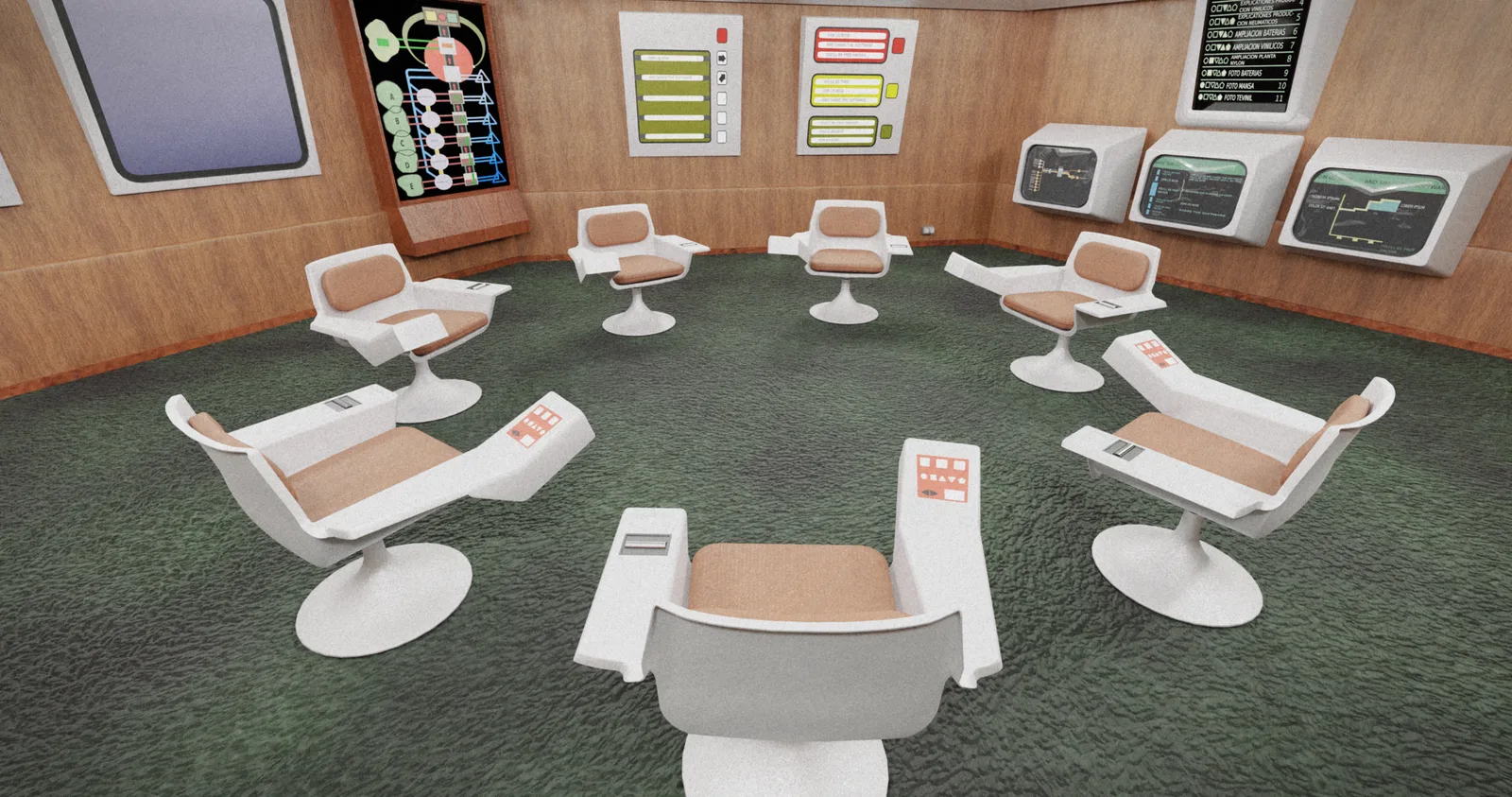
Project Cybersyn ran in Chile from 1971 to 1973, under President Salvador Allende. The British cybernetician Stafford Beer led it with an interdisciplinary Chilean team (Medina, 2006; Wikipedia). The aim: steer a newly nationalized economy without Soviet-style central planning.
It had four parts:
- Cybernet: a telex network carrying daily production data from factories to Santiago.
- Cyberstride: software that watched those numbers and flagged deviations.
- CHECO: a simulator to test economic decisions before taking them.
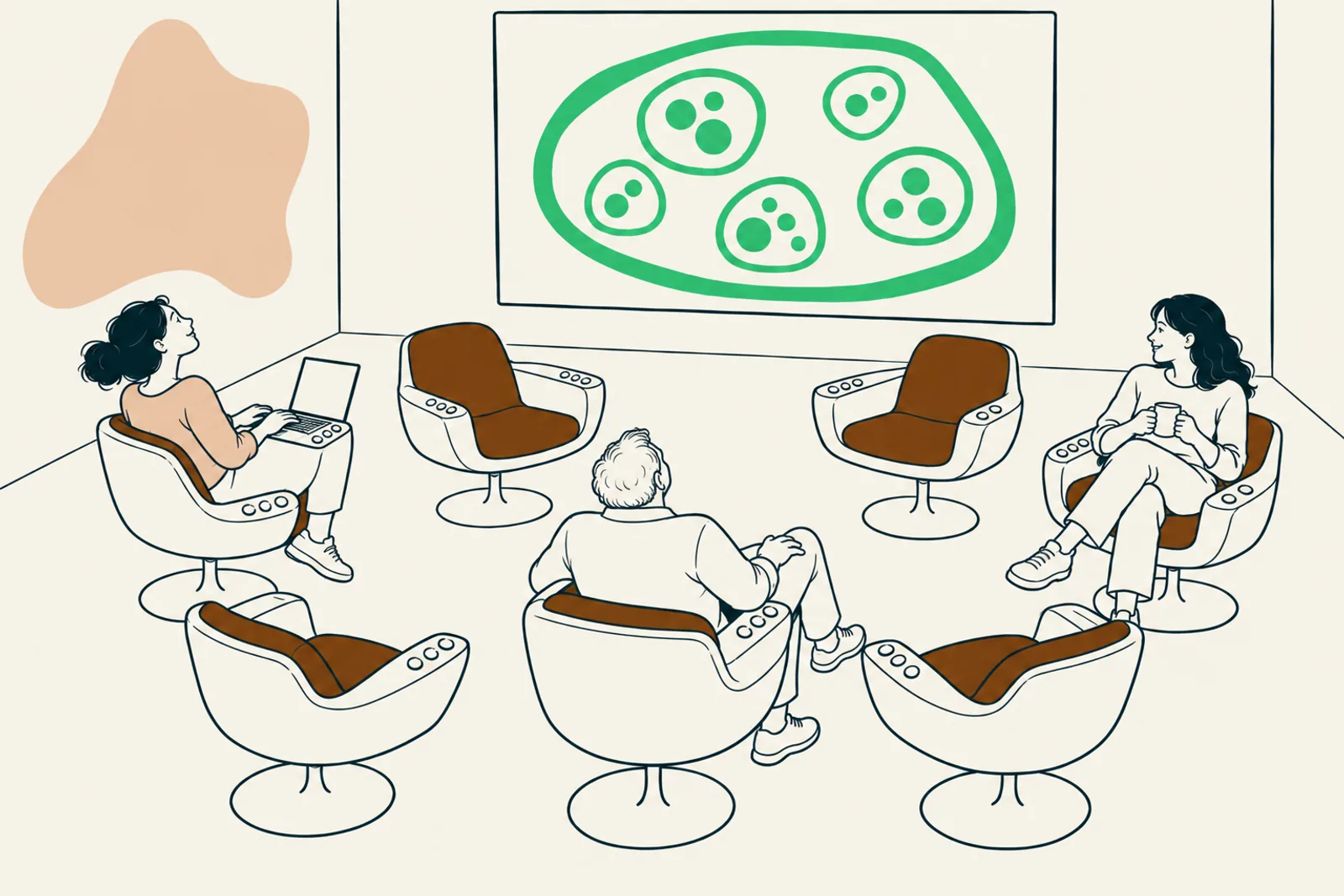
- The opsroom: seven swivel chairs facing wall screens, designed by a team led by Gui Bonsiepe. This is the image everyone remembers.
A fifth part, Cyberfolk, was never built: citizens would have sent live feedback on policies announced on television.
During the October 1972 truckers’ strike, the telex network helped coordinate distribution; Gustavo Silva recalled moving goods with about 200 trucks. By May 1973, 26.7% of the nationalized industries, representing half of the sector’s revenue, were connected to some degree. The coup of 11 September 1973 ended the project, and the military destroyed the opsroom.
The misreading: a nervous system, not a brain
The opsroom suggests command and control. Beer’s theory points elsewhere. One of Cybersyn’s stated goals was to “devolve decision-making power within industrial enterprises to their workforce” (Wikipedia; Medina, 2006).
Requisite variety. W. Ross Ashby showed in 1956 that a regulator can only handle as many situations as it has responses: “only variety can destroy variety” (Ashby, 1956, §11/11). A few people at the top can never match the variety of the world outside. So variety is best absorbed where it arrives: at the edge.
The Viable System Model. In Brain of the Firm (1972), Beer described every viable system as five interacting subsystems (Wikipedia):
- Operations: the units that do the work.
- Coordination: keeps those units from colliding.
- Control: resources and rules for the units, today.
- Intelligence: the environment and the future.
- Policy: identity and purpose, balancing now against later.
The model is recursive: each operational unit can itself be seen as a viable system with the same five functions. Units get as much autonomy as possible; the level above steps in only when a unit cannot absorb a problem itself.
Cyberstride followed this logic. It alerted the people concerned to deviations and escalated a problem to a higher level only if it stayed unresolved for a set time. Cybersyn also linked every factory to a central level in Santiago, and critics have pointed to those centralizing risks ever since. But its design put autonomy first and central intervention second.
Second-order cybernetics: we are inside the system
First-order cybernetics observes a system from outside, like an engineer tuning a thermostat. Second-order cybernetics, which took shape from the late 1960s around Heinz von Foerster, with Margaret Mead among its inspirations, puts the observer inside. Von Foerster called it “the control of control and the communication of communication” (Wikipedia). Biologists Humberto Maturana and Francisco Varela added that living systems constantly remake themselves.
For organizations, this means:
- No one stands outside. The manager who draws the structure is part of it, and so are the consultant and the software.
- Models shape behavior. How we draw an organization is not neutral; people act on the picture in their heads.
- Organizations remake themselves. People renew the structure every day, whatever the official chart says.
The org chart fails here most clearly: a fixed tree, drawn from above, by someone who claims to stand outside.
Semler’s Maverick: the same principles, found in practice
Ricardo Semler reached similar answers by running a real company. He took control of Semco, his father’s industrial firm in São Paulo, around 1980 (Semler). He described what followed in “Managing Without Managers” (Harvard Business Review, 1989) and in Maverick (Brazil 1988, English 1993) (HBR; Wikipedia).
The practices Semler describes read like the Viable System Model put into daily work:
| Semco practice | Cybernetic principle |
|---|---|
| Workers set their own hours and production quotas | Operations absorb variety where it arrives |
| Employees vote on many company decisions | Feedback flows upward, not only down |
| Open books and profit sharing down to the factory floor | Every unit sees the data it needs to steer itself |
| Managers set their own salaries and bonuses | Trust replaces approval chains |
| A short “Survival Manual” sums up the company’s policies | Few rules, so units keep their own variety |
As far as I know, Semler never framed this as cybernetics, which makes the overlap all the more convincing to me. A company that must adapt fast ends up with autonomy, transparency and feedback. Cybersyn explains why; Semco shows how.
What later movements kept, and what they lost
Sociocracy has the clearest cybernetic roots: electrical engineer Gerard Endenburg built it on a “circular causal feedback process” (Wikipedia). Holacracy drew on sociocracy, among other influences, and developed its own formal rule set (Holacracy). Frederic Laloux’s Reinventing Organizations (2014) then popularized self-management as “Teal”, tied to a supposed next stage of human consciousness (Laloux).
Each step made the ideas easier to sell, and thinner:
- From variety to values. Teal asks whether people are evolved enough. Cybernetics asks whether the structure can absorb what the world throws at it. To me, the second question is the one we can actually test.
- From feedback to procedure. Holacracy turned feedback into meetings and rules. Cyberstride fed live numbers to the people who could act on them.
- From recursion to flat. Self-management is often read as “no hierarchy”. The Viable System Model says each level has a different job, and higher levels exist to serve lower ones.
Research supports the caution. Michael Lee and Amy Edmondson define self-managing organizations as decentralizing authority formally and systematically throughout the organization, and conclude that our understanding of such radical decentralization is still limited (Lee & Edmondson, 2017). The question is not whether to have hierarchy, but how to decentralize authority by design. Beer’s model was built for exactly that.
Why AI makes this urgent
AI changes both sides of Ashby’s equation. The world gets more variety: markets, competitors and tools shift monthly, not yearly. And every team gets more capacity to respond: a small group with AI can sense, analyze and act on what once needed a department.
That is a fork in the road:
- AI as central brain. Feed all data to the top and let models decide. This repeats the popular misreading of Cybersyn. In a 2014 New Yorker essay, Evgeny Morozov argued that it anticipated today’s data-driven monitoring. Ashby’s law warns against it: a center with less variety than the world it steers cannot handle it all, however smart.
- AI as nervous system. Give each autonomous unit its own Cyberstride: live signals, early warnings, simulation. Escalate only exceptions. This is Beer’s design, finally affordable for every team.
Research points the same way:
- Burns and Stalker (1961): organic structures, with fluid roles and lateral communication, fit changing conditions; mechanistic ones fit stable conditions (Oxford Academic).
- Teece, Pisano and Shuen (1997): the ability to reorganize quickly keeps a company ahead in fast markets (Strategic Management Journal).
- Raisch and Krakowski (2021): automating and augmenting work can’t be cleanly separated, and pushing hard on either one backfires (Academy of Management Review).
- Puranam (2021): human–AI collaboration is an organization design problem: who does what, and who learns from whom (Journal of Organization Design).
The advantage now lies in how fast the structure can change, and how well everyone sees it change.
From org chart to Bubble Map, on the same data
If models shape behavior, the picture of the organization matters. The org chart shows reporting lines: boxes, lines, one boss per box. That is still useful; people need to know who to turn to. On its own, though, it hides how work actually moves.
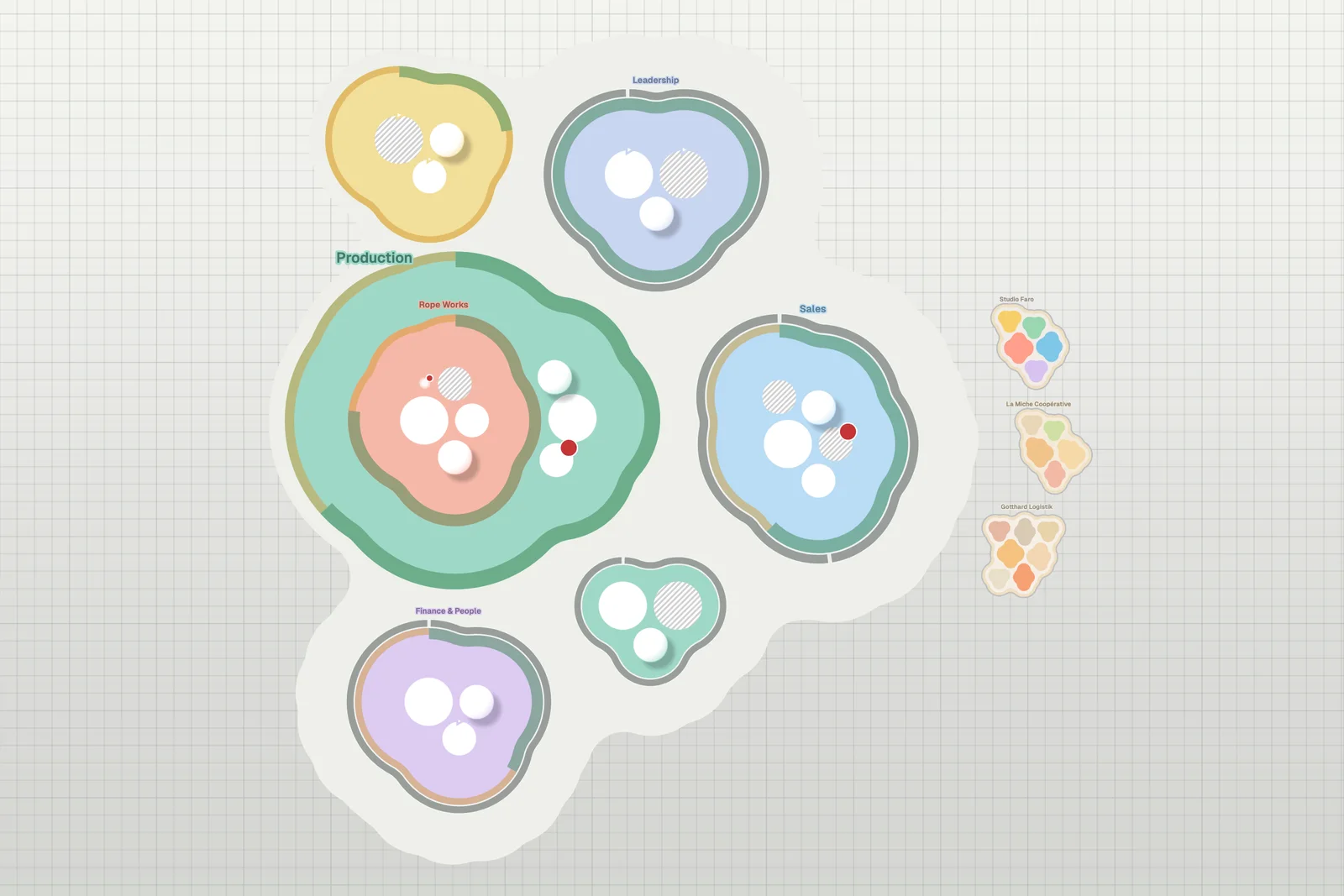
So we keep the org chart. In Peerdom, the same data shows both ways: as a classic Org Chart and as the Bubble Map. Nothing has to be rebuilt: one setting switches between the familiar picture and the Bubble Map, and back.
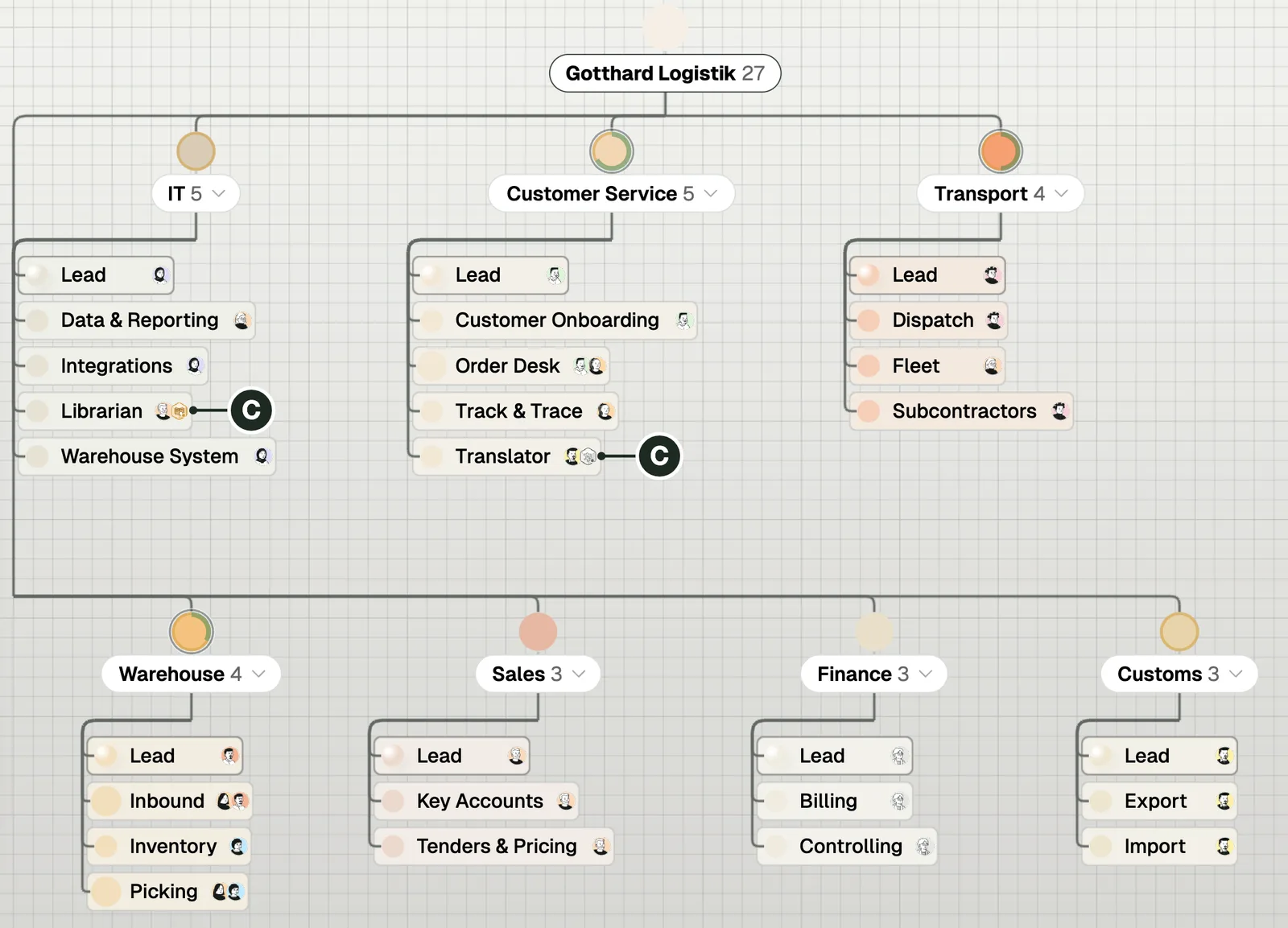
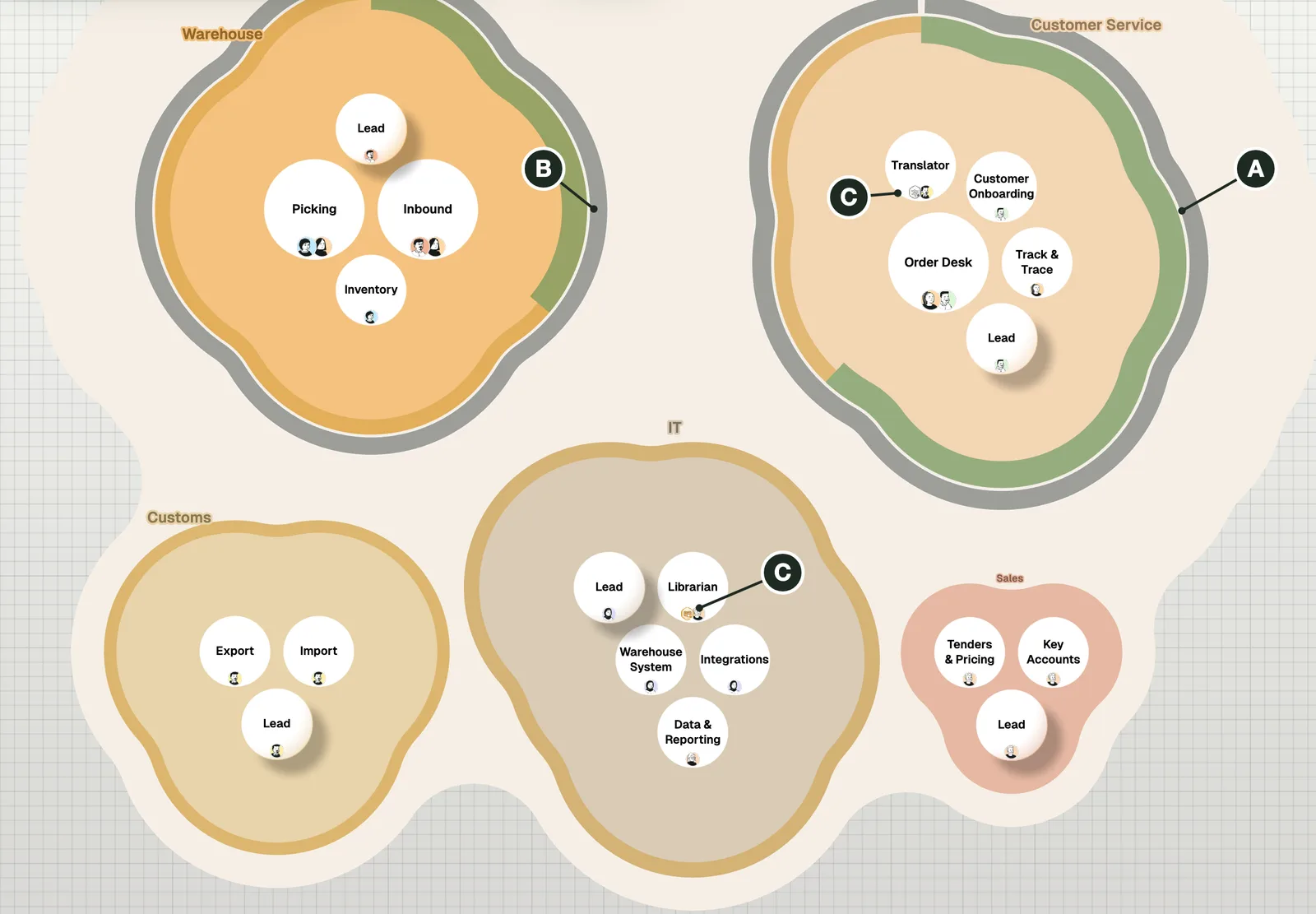
The Bubble Map gives everyone a picture that matches the cybernetic view:
| Principle | Classic org chart | Bubble Map |
|---|---|---|
| Recursion (Beer) | A tree of boxes; only the top sees the whole | Bubbles inside bubbles, each a whole with its own purpose |
| Autonomy at the edge (Ashby) | Authority sits with positions higher up | Authority sits in roles, held where the work happens |
| Purpose and direction (Policy) | Goals live in separate documents | Goals (A) and projects (B) run along the edge of the bubble that owns them |
| Many roles per person (Semler) | One person, one box, one boss | One person holds roles across several bubbles |
| AI as nervous system | Not shown | Digital colleagues (C) hold roles inside teams, next to people |
| Observer inside (second order) | Drawn by HR, updated yearly | Edited by the people in it, as the work changes |
Like Cyberstride, the Bubble Map leaves decisions to the people. It makes the system visible to itself, so they can steer. Goals (A) show where a team is heading, projects (B) show the work in motion, and digital colleagues (C) show where AI already holds a role, with a person responsible beside it.
Trust matters when a map holds who does what. Peerdom is a Swiss company, and all data is stored exclusively in Switzerland.
Right about feedback, wrong about the center
Cybersyn was right that organizations need live feedback to survive. Popular memory got the rest wrong: the answer was never a room that decides for us. It was a structure in which teams decide as much as they can themselves, see the whole, and call in the level above when they need it.
Beer gave us the theory, Semler showed it works in a real company, and AI makes it affordable for every team. What most organizations still lack is the picture. As long as we carry a pyramid in our heads, we will build pyramids.
Sources
Checked against each source on 14 October 2026.
History of Cybersyn
- Eden Medina, “Designing Freedom, Regulating a Nation: Socialist Cybernetics in Allende’s Chile”, Journal of Latin American Studies 38 (2006): 571–606.
- Eden Medina, Cybernetic Revolutionaries, MIT Press, 2011. The standard book on Cybersyn.
- Project Cybersyn, Wikipedia.
- Evgeny Morozov, “The Planning Machine”, The New Yorker, 2014.
- Opsroom render by Rama, Wikimedia Commons, CC BY-SA 3.0 FR.
Cybernetics
- W. Ross Ashby, An Introduction to Cybernetics, 1956, §11/11 on requisite variety.
- Stafford Beer, Brain of the Firm (1972) and The Heart of Enterprise (1979). Overview: Viable system model.
- Second-order cybernetics, Wikipedia.
Semler and self-management
- Ricardo Semler, “Managing Without Managers”, Harvard Business Review, September–October 1989.
- Ricardo Semler, Maverick (1993; Brazil 1988 as Virando a própria mesa). Overview.
- Sociocracy, Wikipedia; History of Holacracy; Frederic Laloux, Reinventing Organizations, 2014.
- Michael Y. Lee and Amy C. Edmondson, “Self-managing organizations: Exploring the limits of less-hierarchical organizing”, Research in Organizational Behavior 37 (2017): 35–58.
Organization design and AI
- Tom Burns and G. M. Stalker, The Management of Innovation, Tavistock, 1961.
- David Teece, Gary Pisano and Amy Shuen, “Dynamic Capabilities and Strategic Management”, Strategic Management Journal 18(7) (1997): 509–533.
- Sebastian Raisch and Sebastian Krakowski, “Artificial Intelligence and Management: The Automation–Augmentation Paradox”, Academy of Management Review 46(1) (2021): 192–210.
- Phanish Puranam, “Human–AI collaborative decision-making as an organization design problem”, Journal of Organization Design 10 (2021): 75–80.