Distributing Authority in Organizations: What Actually Changes
Nathan Evans
Shared governance transformations fail when structure changes faster than behavior. Insights from Loyco's six years working with organizations on distributed decision-making.
Companion Perspectives · with Loyco

Loyco didn’t start as a governance consultancy. Before accompanying other organizations through structural change, they had to first confront challenges in their own house.
While going through a period of strong growth, the classical symptoms appeared: unclear decision-making, duplicated work, invisible responsibilities, coordination friction, and a “waiting for orders” hierarchical culture. Yet, rather than adding management layers, they chose to make roles, responsibilities, and authority explicit and distributed. They called their operating model Loycocracy.
Their own internal transformation is what eventually attracted other organizations to come to them for transformation support.
What resonates
One line from Lucie Mauron’s article stood out:
Changing a structure is relatively fast. Changing behaviors, habits, and ways of collaborating takes much longer.
We see this constantly. Organizations redesign structures, redefine roles, introduce processes and governance rather quickly. Yet, old patterns quietly continue behind the scenes: implicit validation, hidden authority, unclear ownership, political workarounds, and zombie hierarchies.
The structural work is the “easy” part. The behavioral layer is where transformations either take root or silently implode.
Why visibility matters
In many organizations, the real structure is only partially visible. People carry informal responsibilities. Decision boundaries remain implicit. Coordination work goes unrecognized. Critical knowledge lives in people’s heads rather than in shared systems.
Making those dynamics explicit doesn’t magically solve everything. But it creates the conditions for healthier collaboration, stronger autonomy, and more coherent decision-making over time. That’s the premise behind Peerdom, and it’s the same premise Loyco has been working from for six years.
Loyco describes a wide variety of behavioral work that needs to take place, including shifting habits, rebuilding trust in new decision-making patterns, and letting go of old authority. These shifts in mentality are difficult and deserve attention, but this work doesn’t happen in a vacuum. People can’t change how they navigate an organization they can’t see. Conversations about ownership, authority, and collaboration are easier to have, and harder to avoid, when roles and responsibilities are visible to everyone. Peerdom maps that structure not as an end in itself, but as the surface on which behavioral change can actually take hold. Structure and behavior are each necessary. Neither is sufficient without the other.
Read the original
In her article, Lucie shares five lessons drawn from both Loyco’s own transformation and years of accompanying other organizations through similar changes. It’s particularly worth reading if you’re in the middle of a governance transition, or thinking about starting one.
Read the full article: Gouvernance partagée, 5 leçons tirées de notre expérience
Loyco is a Swiss organization specializing in HR and shared governance, accompanying companies through structural and cultural transformation. Learn more at loyco.ch.
Peerdom is an interactive organizational map that helps teams visualize roles, responsibilities, and decision-making authority across the whole organization. Learn more at peerdom.com.
Answer six questions and get your org chart, free
Originally published on Gouvernance partagée, 5 leçons tirées de notre expérience
Keep reading
insights
Jelco de Jong from Peoples on invisible work, the lack of a clear lineup, and why most teams have never had the one conversation that would change everything.
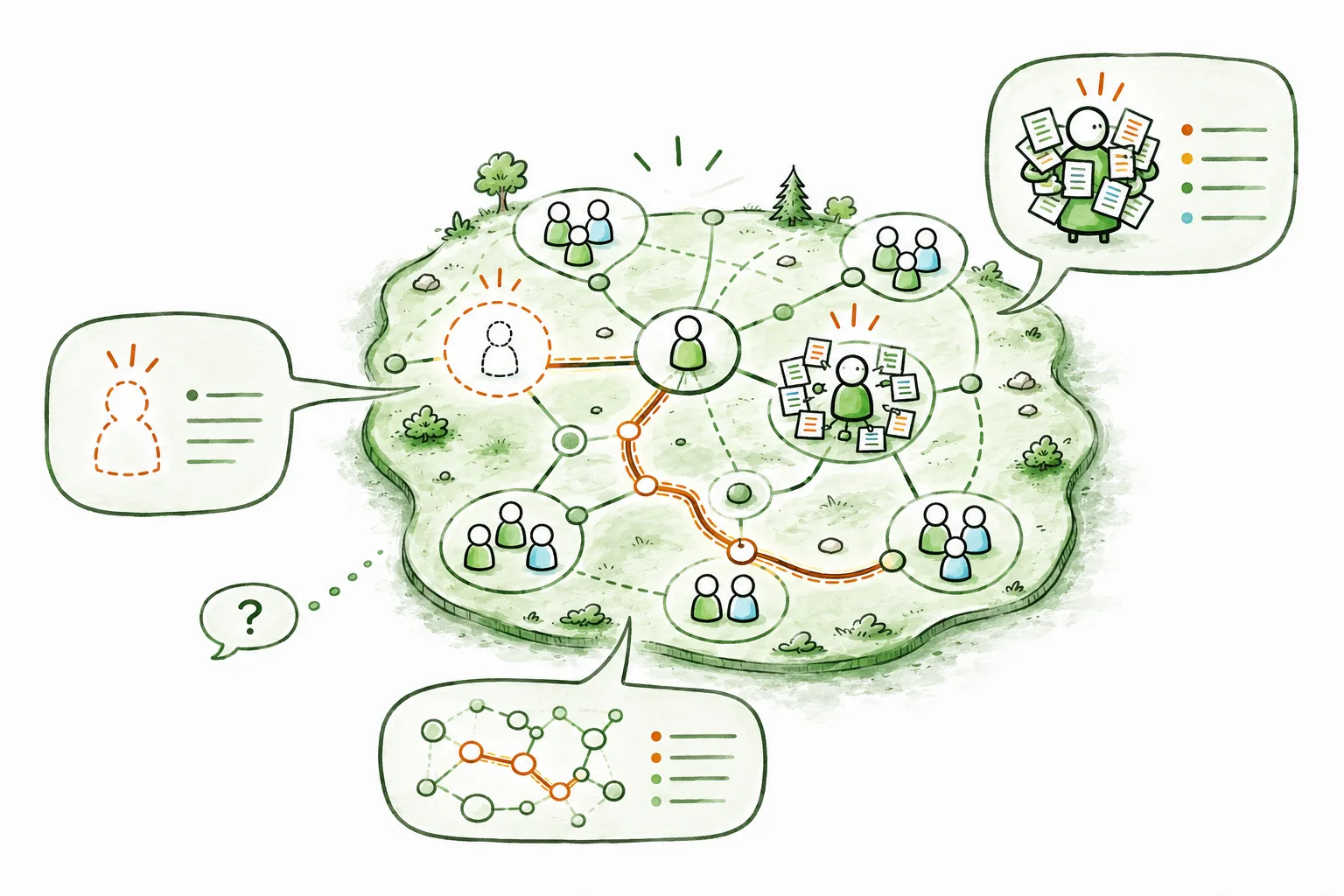
insights
Talk to your organization in plain language, with any AI you trust. Introducing the Peerdom MCP server: vendor-independent, set up in a minute, and entirely under your control.
insights
How Company Companions went from building Dynamogramm™ to partnering with Peerdom, and what it means for organizations navigating transformation.