At Work, Nobody Knows What They're Actually Supposed to Be Doing
Jelco de Jong from Peoples on invisible work, the lack of a clear lineup, and why most teams have never had the one conversation that would change everything.
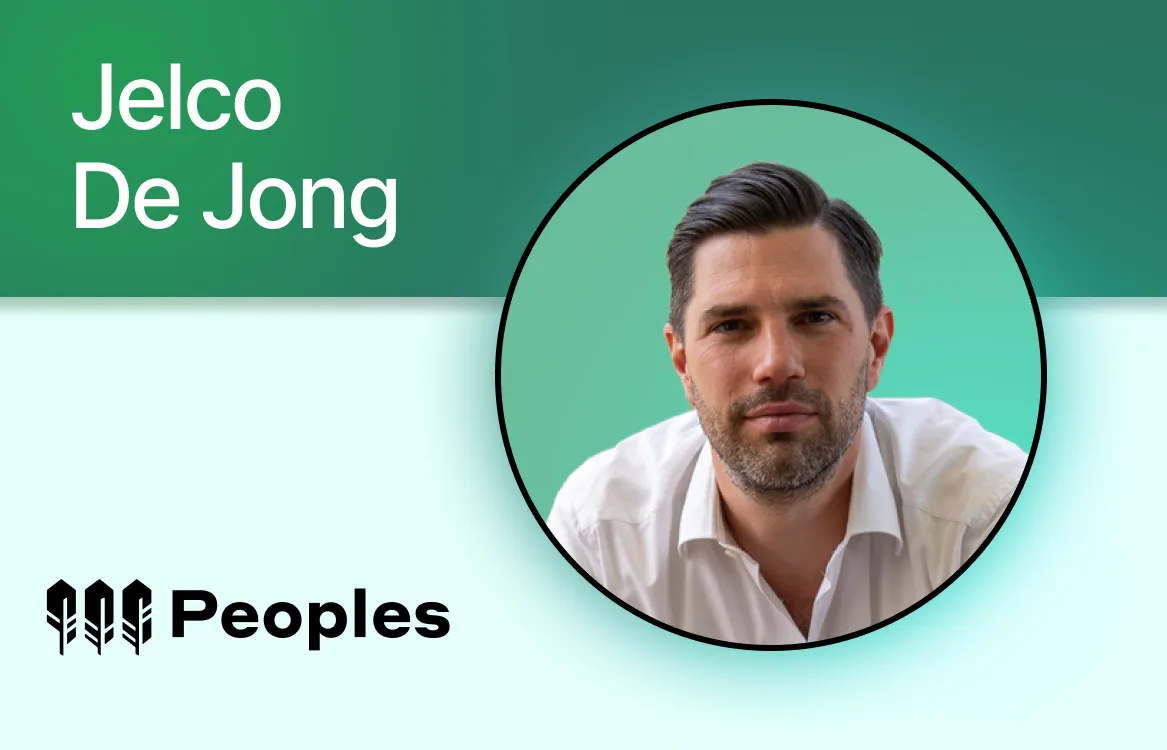
Peoples is a Dutch HR and organizational consultancy based in Rotterdam. They don’t write thick reports or sell pre-packaged solutions. They simply show up, sometimes for years, to help teams figure out what’s actually going on. They use different tools that evoke conversations. And through human conversations, they eventually achieve fundamental change.
Jelco de Jong is one of the partners at Peoples, and one of Peerdom’s earliest and longest-standing companions. He first reached out in February 2019, looking for a tool to support a client’s shift to role-based working. Seven years later, he’s still using Peerdom because the combination of personal coaching and innovative tooling keeps unlocking benefits that neither could have alone.
We sat down for what was supposed to be a short interview. It turned into a two-hour conversation about sports lineups, invisible work, a meeting that exploded when two colleagues discovered they’d been doing the same job in completely different ways, and what still makes him angry about how organizations treat people.
Most organizations say they want to change how they work. Do you believe them?
At least once a month, I’m surprised by the long list of reasons that organizations give for not having basic conversations about who does what.
Successful teams say: we don’t need that conversation because our dashboard is green. Unsuccessful teams say: we don’t have time for that conversation because our dashboard is red. Small organizations say: we’re completely fluid and intuitive, no need to be explicit. Family businesses say: those conversations feel really corporate; we are a family here. And corporate or governmental organizations say: we’ve already talked so much about job descriptions and salary scales that we’re simply tired of it.
In the end, I believe these are all excuses to avoid difficult questions: Is what I’m doing what I’m supposed to be doing? Do you like how I’m doing it? Do you agree with how I spend my time? At a very basic human level, these are courageous conversations.
You use a sports analogy a lot: the “lineup.” Can you explain it?
In football, the lineup is everything. It says who is where, what you’re expected to do, and at what level. You practice in your role five or six days a week. If you act in a way that doesn’t conform with your agreed upon responsibilities, you get immediate feedback. The boundaries are crystal clear, and the locker room is a safe place where players and coaches simply tell each other the truth about one another’s performance and whether teammates are meeting expectations.
Now compare that to most organizations. There’s no time for practice in your role. Everyone is always on. Most meetings and working sessions are concerned with progress in projects — not about why we’re organizing the work in the way we’re doing it. Maybe once or twice a year we hold a performance review, which focuses mostly on output and past mistakes. Not very effective.
So, when someone in a team tells me things aren’t going well, I often suspect that one of their basic psychological needs isn’t being met; they need confirmation that they are meeting expectations. Because if that’s missing, they are likely doubting their purpose: is what I’m doing what I’m supposed to be doing?
What’s the most common lie organizations tell themselves?
That everybody with the same job title does the same job. They don’t.
Take a sales team with 20 account managers. They all have the same job description. But one of them also helps communications write the brochure, meets with marketing to collaborate on campaigns, chairs the team meeting, and built the Excel spreadsheet everyone uses to calculate discounts. She spends maybe 80% of her time on actual account management, but the rest of the things (that she’s good at!) are completely invisible.
She doesn’t get credit for any of it. She doesn’t even fully acknowledge it herself. And she’s uncertain: am I supposed to be doing this? Is it cheating? Should my sales target be lower because I only spend 80% of my time selling, while my colleague spends 100%?
Almost nobody has that conversation. So eventually she thinks: why would I bother? It’s not in my job description, nor my performance review, because that is mainly based on output. And the organization loses all that extra value simply because it wasn’t acknowledged.
Can you give me a specific example of what happens when you make this visible?
I had a case a couple of years ago. Two people in the same organization, working in the same role. Both were supporting families in situations where a child no longer attends school due to complex learning needs. One works three days a week, the other works four. The woman working three days had 24 active cases. The man working four days, he had only three active cases. Because he was much older, his salary was much higher.
When they saw this discrepancy, the meeting exploded; we made explicit facts that were there all along. She was naturally outraged; he was getting paid significantly more for only a fraction of the work. How could this be a fair and reasonable division of the work?
Later, more details pour in. She’s very protective about the scope of her work, very aware of the limits of her role. By contrast, he goes all-in to emotionally support the families in need, organizing meetings with other organizations, answering calls in the evenings, visiting families on Saturdays, and coaching mothers while “off duty”. He’s been doing it that way for 15 years. He thinks everything is in scope. She thinks almost nothing beyond the core of the role is in scope.
In this case, neither is wrong and neither has bad intentions. Yet somehow, they’d been working in the same organization for years and had never achieved this level of clarity about what their shared role actually means, how they’re supposed to solve cases.
We drew the role in Peerdom. We added three or four clear responsibilities. He said: “yeah, but I have 25 more.” She said: “no, this is the job.” And suddenly everyone could see the gap — visually, transparently, on screen. After the revelation, we had some beautiful and courageous conversations. We were able to sort it out in a way where everyone’s doing what they’re supposed to be doing according to the resources they have.
So where does Peerdom come in? Is it the thing that creates the clarity, or is it more like a trigger for the conversation?
It’s a conversation starter. A safe exchange place. To be clear, using Peerdom doesn’t create problems or complexities. It reveals them. It makes a problem explicit, specific, and visible. We can now confidently know when there’s a mismatch in how a role is being held, and this mismatch was already there.
That said, the tool isn’t a solution. If you think you can avoid difficult conversations because a tool is going to fix it for you, you’re wrong. Simply entering data in the tool may have unintended consequences. But what the tool does brilliantly is give you a workaround for those difficult conversations. Instead of saying “let’s talk about whether you’re doing a good job,” you say “let’s draw the map.” And then you’re talking about teams and roles, and suddenly someone says: “wait, you and I both have this responsibility?” And the conversation happens naturally. This is done through a shared vision of the structure, not through confrontation.
I was in a brainstorm with a client yesterday. They had a back office with five roles. A new person joined. In 20 minutes, we rearranged responsibilities, created a new role, deleted two, moved one to another circle. The guy looked at his new setup and said: “yes, that is exactly how I would organize this team.” In 25 minutes, we had a well-distributed, owned set of responsibilities matching people’s actual skills and desires. It was completely fluid.
You’ve been using Peerdom for seven years now. Why haven’t you gotten bored of it?
Ha! Who says I’m not bored of it? No, but jokes aside, the real answer is two things. First, the tool evolves. It can do things now it couldn’t do seven years ago, so it has more long-term potential for clients. It’s much more than just a drawing board.
But the bigger reason is our relationship. We somehow met at the right time; I was figuring out how organizational transformation works in real life. Peerdom was figuring out what the tool should be able to do. We’ve had conversations with other tools, but there was no possibility to co-create.
With Peerdom, something different happens. I hear a client say something — some need I couldn’t quite articulate yet — and I bring it up. And more than ten times now, the response has been: “that’s interesting, we’ve already brainstormed something up in that direction.” We find the common ground and figure out whether there’s something the tool could do to meet my client’s particular needs.
That’s extremely powerful. What keeps our relationship alive is the fact that our two-hour philosophical ramblings sometimes connect directly to something on a product roadmap.
Some organizations just want the software and say “We’ll figure it out ourselves.” What happens to them?
If you are buying the tool and you realize it’s not about the tool but about fundamental organizational transformation, you could be very successful and I wish you the best of luck.
But if you think a tool is going to fix something for you, then you’ll have a more challenging time. The map is a mirror. And mirrors can be confronting. The tool surfaces the truth, it doesn’t manage the potential fallout.
How about the other side? Consulting without a tool?
Sometimes it works fine. I had a team last year where the underlying issue wasn’t structural at all. Rather, it was two leaders who couldn’t protect their team from the rest of the organization’s demands. One morning was enough to describe what everyone does. The clarity was already there, and the problem was clearly interpersonal.
But in most cases, if you’re doing transformation work without a shared, living visualization, you produce theatrical paperwork. Big-picture slides. And you can’t go deep enough to create certainty. You can’t answer all the questions people have during a transformation. With a tool, people can dive in and explore it themselves — see their role, see how it connects, discover things you never would have surfaced in a workshop. They can even come up with their own design of how it could work better in the future by rearranging roles, teams, and responsibilities as desired.
The real power is to combine the two: great conversations and a tool to capture the essence. If you change something but visualize it poorly, people don’t understand what has changed. If you change nothing but visualize it nicely, people say: “that’s just the same thing with new colors.” When you change something and represent it well through visualization, change becomes tangible.
What pisses you off about how organizations treat their people?
One of the simplest and deepest insights I’ve gathered in ten years of doing this: people simply must want to work for you. For you as a leader or leadership team. Because even if they show up every day, wanting to be there makes them give you their best work and ideas.
As an example, we were supporting an organization putting together learning and development talks for their employees. In the first couple of meetings, employees show up with “standard answers”: I want to increase my performance in my current role, I want to grow in my current position. Because they think that’s what they’re supposed to say or what their manager wants to hear.
Slowly, we created a safe space for people to share their hopes and dreams about the future. To talk about where they dreamed of ending up years in the future. And we’d help them grow in that direction, even if it seems counterintuitive in the short term. This had massive impact, because people felt seen and acknowledged for who they are and what their potential is, even if this may mean they outgrow the organization. In the end, you see more smiles, and short-term benefits. Sick leave goes down. Performance goes up, because they want to work for you. And if they eventually leave, they talk about your organization like it was the best place they were ever part of.
So, what gives you hope?
The idea that we, with our small consultancy team, contribute to this on our micro scale. It makes me proud. It motivates me every day to help people see that work can be fulfilling and rewarding. A career consumes about 75,000 hours of your life, so you might as well have a blast!
Ask anyone: what was the best team you were ever part of? Watch their face light up. They always say the same thing: we were on the same mission, we worked our asses off, and had so much fun. We learned so much. We achieved great things. And if we talk to each other now, it’s like we never broke up.
That’s what work can be. Why would we settle for less?
What our partnership looks like
Jelco and Peoples have been a Peerdom companion for seven years. They are one of the earliest and most active consulting partners in the network. They bring Peerdom into client engagements not as a product to sell, but as a tool that makes transformation conversations possible.
For organizations working with Peoples, Peerdom becomes the shared map that makes the invisible visible: who does what, where work overlaps, where clarity is missing. For Peerdom, Peoples represents exactly the kind of partnership we believe in: practitioners who push the tool forward by using it in the hardest conversations, with the most human stakes.
If you’re looking for a Dutch consulting partner who won’t sugarcoat it, and a tool that can hold the truth of how your organization actually works, get in touch.
More from our companion network: Marc Wethmar’s three lessons from assisting organizational transformations and Sebastian Jensen on building, then burying, Company Companions’ own tool to partner with Peerdom.
Peoples is an organizational transformation consultancy based in Rotterdam, helping organizations make work more human. Learn more at peoples.hr.
Peerdom is an interactive organizational map that helps teams visualize how they really work together. Learn more at peerdom.com.