You Bought a Company. Now Whose Org Chart Wins?
Nathan Evans
An acquisition brings two organizations together, and usually two very different ways of working. Force one onto the other and you lose people. Leave them apart and you never integrate. There is a calmer middle path.

Imagine a Swiss company called Roncieux. It machines high-precision parts and runs on roles: the work is split into small, clearly owned responsibilities, and people hold several of them across teams. Last year it acquired a German firm, Gebrüder Haldner, a family business making precision parts for surgical instruments, run the same way for three generations.
Haldner is organized the traditional way. There is a managing director at the top, a couple of department heads below, and the workshop below them. A clean pyramid. Everyone knows their box and their boss. It has worked for the family for decades.
So now there are two companies under one roof, and two completely different ways of organizing. The obvious question, the one that decides whether the deal actually pays off, is a blunt one: whose org chart wins?
The two ways this usually goes wrong
Force the new company into your structure on day one. You bought Haldner, so Haldner now works the Roncieux way, effective immediately. New teams, new titles, new vocabulary. The trouble is that the people who have made those surgical parts for thirty years suddenly cannot find themselves on the map. The thing you paid for, their know-how, walks out the door with the third person to quit.
Leave them completely alone. The other reflex is to promise you will integrate “later.” Later rarely arrives. Two years on there are still two companies, two systems, and none of the shared strength the deal was supposed to create. You own Haldner on paper and nothing has actually joined up.
Both mistakes come from the same missing thing: nobody can see the two organizations side by side, so every integration decision is made in the dark.
Start by looking at what you actually bought
Before you change anything, put the acquired company on a map exactly as it is today. Do not tidy it. Do not translate it. Just make its real structure visible.
Haldner’s map is a tree, because Haldner is a hierarchy, and forcing it to look like anything else would only hide how the place really works. The managing director sits at the top. Underneath sit Production, Quality, Purchasing and Administration, each with its lead and its people.
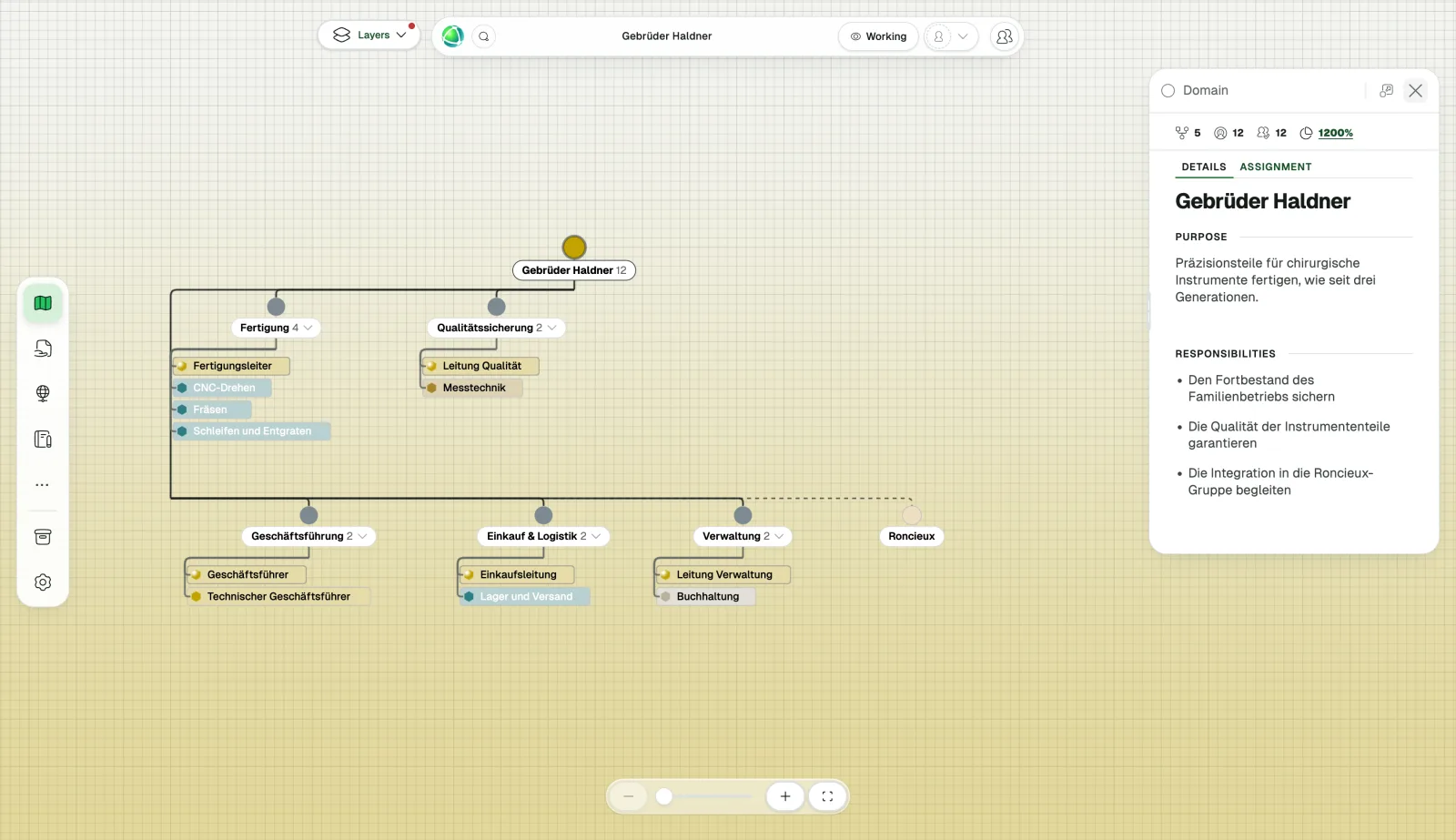
Two useful things happen the moment you can see it. Nobody at Haldner feels erased, because their structure is on the map as they know it. And you now have something concrete to compare against the parent company, instead of two mental models that never quite line up.
For contrast, here is Roncieux, the parent, organized as roles inside circles instead of a pyramid.
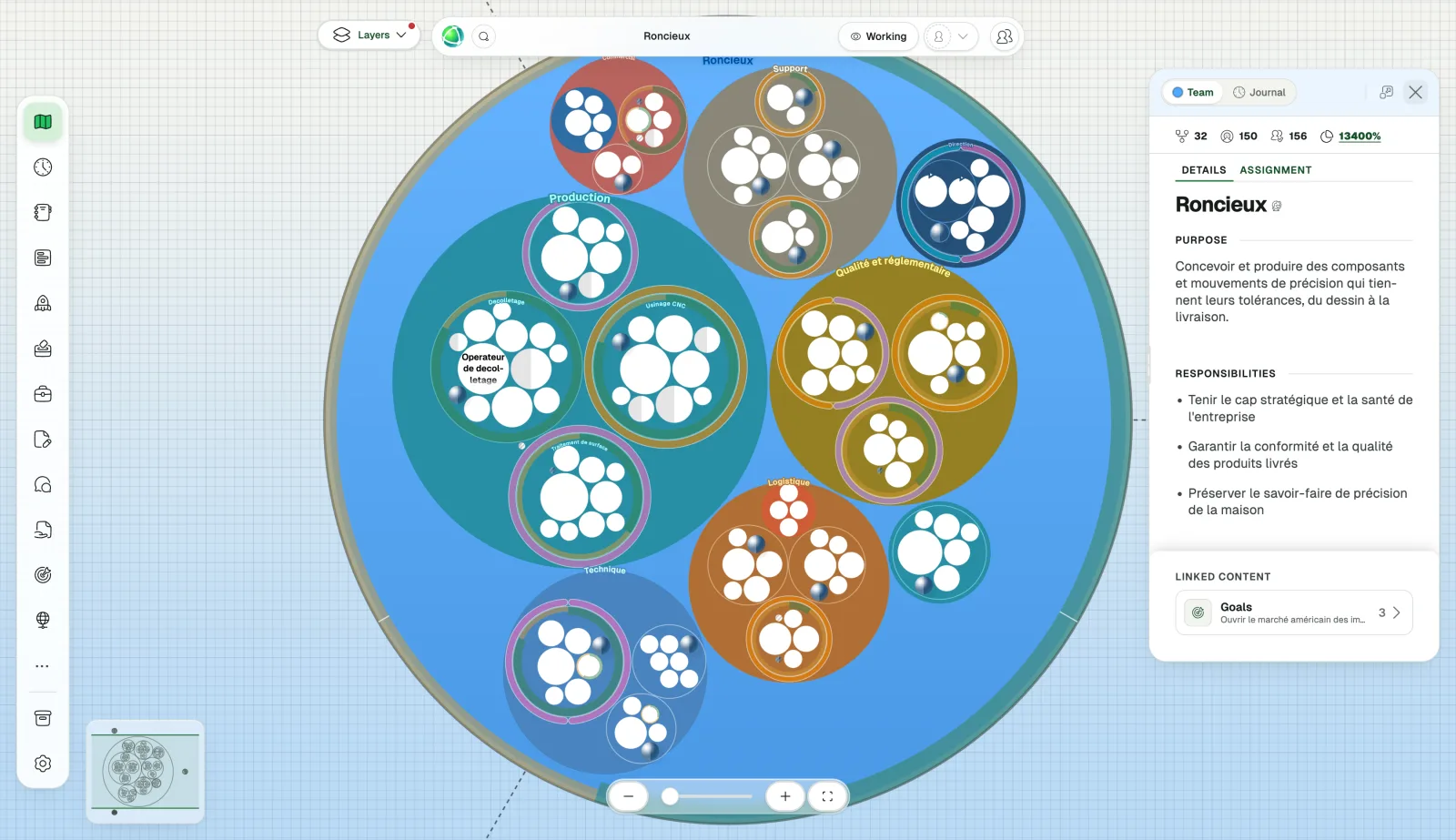
You do not have to pick one of these pictures and impose it on everyone. The same tool can show the family firm as the tree it is and the parent as the circles it is. That alone takes a lot of the heat out of the “whose way wins” fight.
Integrate role by role, not company by company
With both structures visible, integration stops being one enormous decision and becomes a series of small, obvious ones.
You can see where the two overlap. Both companies have quality control. Both do purchasing. Those are the places to decide, deliberately, whether to merge, keep separate, or share. You can see what is unique to Haldner, the parts of the craft worth protecting exactly as they are. And you can see the seams, the handful of roles where the two companies actually need to connect: a shared quality standard, a joint purchasing arrangement, one person who links the two.
Connect the two as a group so they are genuinely one organization, without flattening either into the other. Then move one role at a time, at a pace the acquired team can absorb, keeping the know-how you paid for while the structures slowly grow together.
You can explore both maps yourself, the acquired firm at peerdom.org/haldner and the parent at peerdom.org/roncieux.
Model the change before you commit to it
Reorganizing a company you have just bought is a nervous business, and it is easy to get wrong when you are guessing. It helps to sketch the integrated structure as a draft first, a proposed map that nobody works from yet, and look at it before anyone’s job actually moves. You can try merging the two quality functions on paper, see who ends up accountable for what, and adjust, all before a single real change lands on a real person.
What to do if you are integrating an acquisition
- Map the acquired company as it is today, in the shape that fits it. Change nothing yet.
- Put it next to the parent so you can compare the two structures directly.
- Find the overlaps, the unique strengths, and the few real seams between them.
- Connect the two as one group, and move one role at a time at a pace people can absorb.
- Draft big changes as a proposal first, and look at them before they touch anyone.
The goal is not to decide whose org chart wins. It is to keep what you bought while the two companies genuinely grow together, and you can only do that if you can see both of them clearly.
Common questions
Should the acquired company adopt our structure? Eventually, in the parts where it makes sense, and gradually. On day one, no. Forcing an overnight change is the fastest way to lose the people and the know-how you just paid for. Start by making both structures visible, then integrate role by role.
The two companies organize completely differently. Isn’t that a problem? Only if you hide it. A hierarchy and a role-based organization can sit in the same group, each shown in the view that fits it, a tree for one and circles for the other. Seeing the difference honestly is what lets you decide what to merge and what to leave.
How do we avoid losing key people during integration? Keep their world recognisable while things change. When people can still find themselves and their responsibilities on the map, a reorganization feels like careful adjustment instead of erasure. Moving one role at a time, visibly, beats a single overnight redesign.
What is a living org chart? It is a map of your organization that shows roles and responsibilities, not just names and titles, and that teams keep up to date themselves. In an acquisition it lets you hold two structures side by side, compare them honestly, and integrate them one clear step at a time.
Roncieux and Gebrüder Haldner are illustrative examples, not real Peerdom customers. They stand in for the kind of acquisition where a role-based company takes on a traditional family firm, so the pattern is easy to follow.
Keep reading
insights
When nobody is full-time and everyone wears several hats, a job-title org chart falls apart. Sharing the work as small, clear roles keeps a tiny team steady, even as volunteers come and go.

insights
Most of the stress around an audit comes from scrambling to prove who owns what. When every role and its responsibilities are written down and kept current, the answer is already sitting there.

insights
Fast growth rarely fails with a bang. It fails when a few people end up holding five jobs and no one ever adds it up. Here is how to see the load before it costs you someone good.