Why Peerdom Goals is the Best Alternative to Viva Goals
Nathan Evans
Viva Goals is shutting down. Find out why Peerdom Goals is the top alternative. Flexible goal frameworks, transparent ownership, secure EU/Swiss hosting, and seamless migration for OKRs, KPIs and more.
On 31 December 2025 Microsoft will permanently retire Viva Goals, ending all support and leaving customers only five months to export their data and find a replacement. Feature development already stopped in late 2024, so what you use today is the last version you will ever get.
If you run OKRs or other goal frameworks inside Viva Goals, now is the moment to choose a successor that will still serve you in 2026 and beyond. This time, you can choose a goal tracking platform that does not trap your data in another vendor silo, one that actually connects your goals to the people and teams responsible for them.
What Exactly Is Happening to Viva Goals?
Microsoft announced the end-of-life timeline in two stages. First, on December 5, 2024, a permanent feature freeze took effect: no new Viva Goals capabilities have shipped since, and none will. Second, on December 31, 2025, the product will shut down entirely. Access, support, and data hosting will all end on that date.
This means every organization still running Viva Goals faces a hard deadline. You must export your data before the shutdown, evaluate alternatives, and migrate, all before the end of the year. Waiting until Q4 risks losing historical goal data and disrupting your next planning cycle.
The retirement also raises broader questions about relying on bundled enterprise tools for mission-critical workflows. Viva Goals was folded into the Microsoft 365 ecosystem, but it never became a standalone product with its own development roadmap. When Microsoft’s priorities shifted, the tool was the first to be cut.
What You Should Look for in a Post-Viva Goals Tool
Not every goal management platform is a suitable replacement. The market ranges from simple OKR trackers to full strategy execution suites, and the right choice depends on how your organization actually uses goals. Here are the criteria that matter most when evaluating alternatives.
- Fast, risk-free migration: CSV or API import with a clear, documented data model. You should be able to move your existing goals, key results, and historical periods without rebuilding everything from scratch.
- Framework flexibility: OKR, KPI, SMART, MBO, or custom frameworks. How you track goals may evolve as your organization matures, and your tool should not lock you into one methodology.
- Organizational context: Goals should not float in an isolated dashboard. They should live where work happens, connected to the roles and teams that own them.
- People-centric design: Intuitive for non-technical users, with transparent ownership and accountability visible to everyone, not just managers.
- Data sovereignty and compliance: GDPR-ready hosting, ideally in the EU or Switzerland, with clear data processing agreements and certifications.
- Open ecosystem: APIs, webhooks, and integrations rather than lock-in. Your goal data should be accessible to the rest of your toolchain.
Head-to-Head: Viva Goals vs. Peerdom Goals
The following comparison covers the features and capabilities that matter most when evaluating a migration from Viva Goals to Peerdom Goals.
| Feature | Viva Goals | Peerdom Goals |
|---|---|---|
| Product status | Shutting down 31 Dec 2025; feature-frozen since Dec 2024 | Actively developed with regular feature releases |
| Goal frameworks | OKR only | OKR, KPI, SMART, MBO, and custom frameworks |
| Progress tracking | Percentages and key result metrics | Percentages, target amounts, binary milestones, and custom metrics |
| Organizational context | Separate dashboard, disconnected from org structure | Goals attach directly to roles and teams on a live org map |
| Views | List and board views | Circle map, tree view, list view, and spatial canvas |
| Role-based ownership | Goals assigned to individuals or teams | Goals owned by specific roles, visible in organizational context |
| Transparency | Manager-controlled visibility settings | All goals visible across the organization by default; color-coded progress on the map |
| Analytics and insights | Basic reporting dashboard | Goal progress overlaid on org map; filterable by team, role, period, and status |
| API and integrations | Microsoft Graph API; limited to Microsoft ecosystem | GraphQL API, webhooks, Zapier, Pipedream, n8n |
| SSO providers | Microsoft Entra ID only | Microsoft Entra, Google Workspace, Okta |
| Data hosting | US-based Microsoft Azure data centers | Swiss-hosted, GDPR compliant |
| Pricing | Bundled with Microsoft Viva suite (Enterprise license required) | Free up to 10 people; Peerdom+ from CHF 5/user/month; Goals App add-on +CHF 1/user/month |
Why Peerdom Goals Stands Out
Goals live inside your org map
Peerdom is often described as the “Google Maps of the workplace”: your roles, teams, and links to digital tools appear on a real-time, interactive map. The Goals App attaches goals directly to the teams and roles that own them, with progress color-coded on the canvas. No more flipping between disconnected dashboards and static org charts. You can track goal progress in context, from a single role all the way up to an organization-wide birds-eye view.

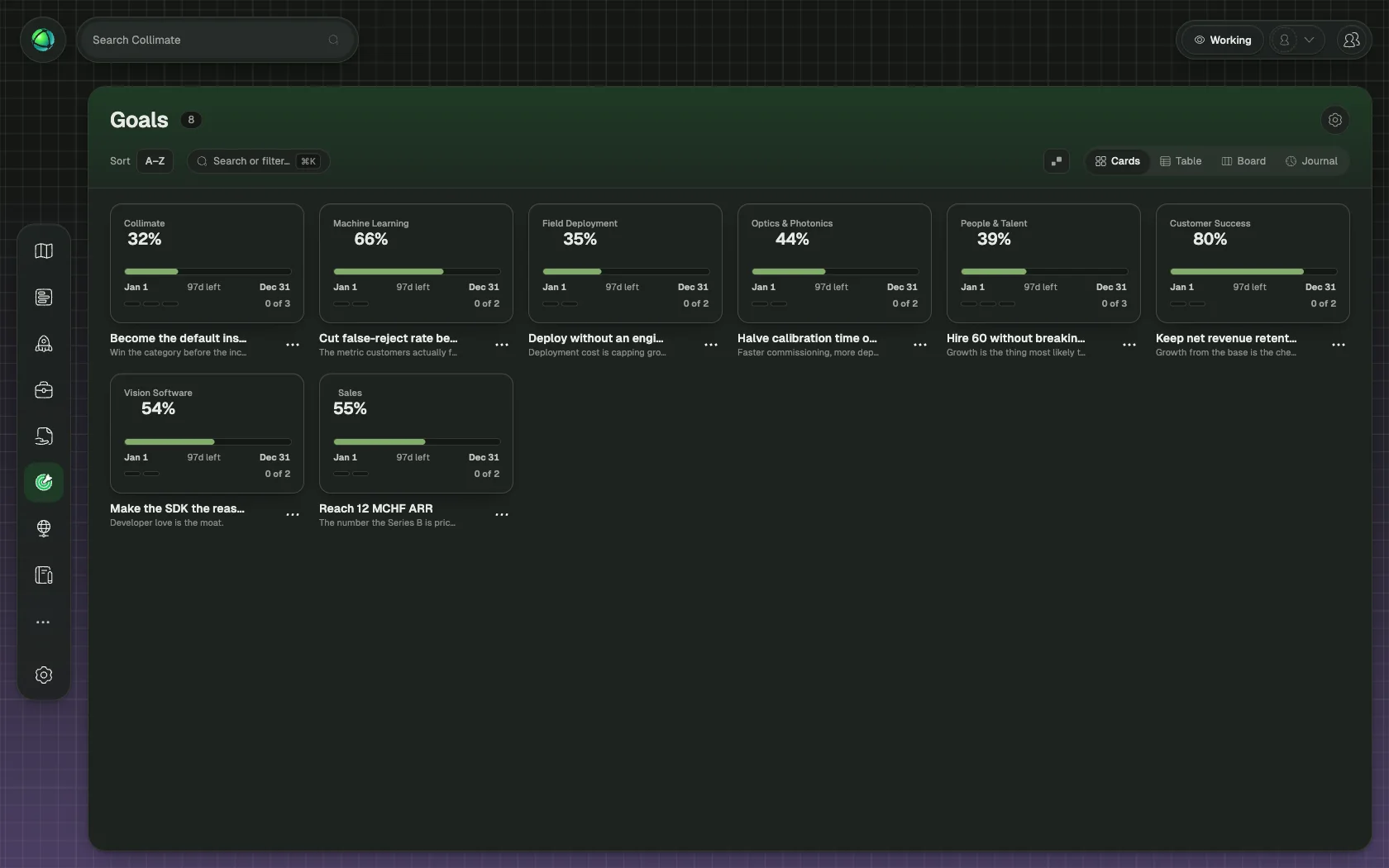
This is a fundamentally different approach from tools that treat goals as standalone records in a database. When a goal is attached to a role on the map, anyone in the organization can see who owns it, how it connects to the team’s other objectives, and whether it is on track, without requesting access, opening a separate app, or asking a manager for a status report.
Framework-agnostic goal tracking
Viva Goals was built exclusively around the OKR methodology. If your organization uses a mix of OKRs, KPIs, and project milestones, as most do in practice, you were forced to fit everything into the OKR structure or track some goals outside the tool entirely.
Peerdom Goals supports multiple tracking approaches out of the box. Track percentages for OKR-style key results. Set target amounts for revenue or hiring KPIs. Use binary milestones for project deliverables. Run OKRs alongside KPIs or narrative goals at the role, team, or whole-organization level. That flexibility supports mixed operating models, from Spotify-model tribes to Buurtzorg-style autonomous teams, and lets you evolve your goal framework without switching platforms.
Transparency and shared accountability
Because goals in Peerdom are visible to everyone by default, accountability becomes a shared practice rather than a top-down reporting exercise. Every person in the organization can see the goals attached to any role or team, understand how their own work contributes to broader objectives, and identify where progress is stalling, all without waiting for a quarterly review or requesting a dashboard export.
“Smart, simple, flexible and transparent. A game-changer for truly agile organizations.” — Germain Augsburger, BKW
Privacy-first, Swiss-hosted infrastructure
All Peerdom production data is hosted in Swiss data centers. For organizations that need to comply with GDPR, FADP (Swiss Federal Act on Data Protection), or internal data residency policies, this matters. Your goal data, organizational structure, and user information never leave Switzerland, a meaningful difference from US-based cloud hosting where data may be subject to foreign jurisdiction requests.
Interoperability by design
Peerdom provides a GraphQL API, webhooks, and native integrations with Zapier, Pipedream, n8n, Microsoft Teams, and Slack. You can connect your goals to the rest of your toolchain, syncing progress updates to Slack channels, triggering workflows when goals are completed, or pulling goal data into your BI dashboard. This is the opposite of the lock-in that Viva Goals customers experienced within the Microsoft ecosystem.
Browse all available integrations and apps to see how Peerdom fits into your existing workflow.
More than just goals
Peerdom is not a single-purpose OKR tool. It is an organizational mapping platform with a library of data layers, goals being one of them. You can also map roles and accountabilities, track skills and competencies, visualize team structures, and connect to your existing HR and project management tools. If you outgrow the Goals App, your data stays in one comprehensive organizational map rather than becoming another orphaned dataset.
“Peerdom is my favourite tool to play in: map your current state to enable conversations about transformation and visualize multiple potential futures!” — Romina Farrell, Organizational Design Change Agent
Migration in Three Simple Steps
Migrating from Viva Goals to Peerdom does not require a lengthy implementation project. Most teams complete the process in under one afternoon.
- Export from Viva Goals: Use the built-in Excel export or the Microsoft Graph API to extract your goals, key results, and check-in history before the December 31 shutdown.
- Import into Peerdom: Use the CSV import wizard or the Peerdom GraphQL API to load your goals into the platform. Map your Viva Goals objectives to roles and teams on your Peerdom org map.
- Visualize and verify: Review your imported goals on the map canvas. Adjust ownership assignments, set up your goal periods, and confirm that historical data imported correctly.
We are here to help. Contact our customer success team and we will run the import for you, help build custom migration scripts, or walk your team through the setup process.
Who Uses Peerdom Today
Peerdom serves over 250 clients across 18 countries, from startups to large enterprises. Organizations use it to map their structures, track goals, manage roles, and support organizational transformations, whether they follow traditional hierarchies, agile frameworks, sociocracy, holacracy, Teal principles, the Peach model, or their own custom operating model.
If you want to understand more about how Peerdom works as an organizational platform, the getting started guide provides a comprehensive overview. For a broader look at how organizational management tools compare, see our self-management software guide.
Frequently Asked Questions
Can we keep our old goal history when migrating from Viva Goals?
Yes. You can import previous goal periods as archived goals in Peerdom, so your historical trends, check-in data, and completion records remain visible and accessible. This is important for organizations that need to reference past performance during annual reviews or strategic planning.
What goal frameworks does Peerdom Goals support?
Peerdom Goals is framework-agnostic. You can run OKRs (Objectives and Key Results), KPIs (Key Performance Indicators), SMART goals, MBO (Management by Objectives), or any custom framework. Track progress using percentages, target amounts, or binary milestones. Different teams within the same organization can use different frameworks simultaneously.
How is Peerdom Goals different from other OKR tools like Gtmhub, Lattice, or Perdoo?
The core difference is organizational context. Most OKR tools present goals in a standalone list or dashboard. Peerdom Goals attaches goals directly to roles and teams on an interactive org map, so you always see who owns a goal, where it sits in the organization, and how it connects to other objectives. This makes goal tracking a natural extension of your organizational structure rather than a separate workflow.
What if we outgrow the Goals App later?
Peerdom is a full organizational mapping platform, not a single-purpose goal tracker. The Goals App is one of several data layers you can activate. You can add role management, skills tracking, competency mapping, and more, all within the same organizational map. Your data stays connected and portable.
How much does Peerdom cost compared to Viva Goals?
Viva Goals required a Microsoft Viva suite license, which is bundled into Microsoft 365 Enterprise plans. Peerdom offers a free tier for up to 10 people. Peerdom+ plans start at CHF 5 per user per month, and the Goals App add-on costs an additional CHF 1 per user per month. See the pricing page for detailed plan comparisons and volume discounts.
Where is Peerdom data hosted, and is it GDPR compliant?
All Peerdom production data is hosted in data centers in Switzerland. The platform is fully GDPR compliant and also adheres to the Swiss Federal Act on Data Protection (FADP). Your data never leaves Switzerland, which provides stronger data sovereignty guarantees than US-based hosting alternatives.
Does Peerdom support SSO and enterprise authentication?
Yes. Peerdom supports Single Sign-On via Microsoft Entra ID (formerly Azure AD), Google Workspace, and Okta. This means your team can use their existing corporate credentials to log in without managing a separate set of accounts.
Can we integrate Peerdom Goals with our existing tools?
Peerdom provides a GraphQL API, webhooks, and native integrations with Zapier, Pipedream, n8n, Microsoft Teams, and Slack. You can automate goal updates, sync progress data to your BI tools, trigger notifications when milestones are reached, or build custom integrations using the API. See all available apps and integrations.
Ready to Migrate?
The Viva Goals shutdown deadline is approaching. The sooner you start your migration, the more time you have to set up your goal structure, train your team, and run a full planning cycle in your new platform before the December cutoff.
Start a free trial and import your first goal in five minutes, or book a 30-minute demo with our team to see how Peerdom Goals works for your organization.
Your goals deserve a home that will not disappear next December, and a platform that connects them to the people and teams that bring them to life.
Keep reading
integrations & tools
With Peerdom and Notion, you get an interactive org map to navigate responsibilities, teams, documents, tasks and more - all in one place. Compare strengths and learn quick integration steps.
integrations & tools
Comparing two approaches to organizational charts. A traditional org chart builder versus a dynamic organizational mapping platform. See how Peerdom and Organimi differ on features, philosophy, and pricing.
integrations & tools
Still managing your org chart in Excel or Google Sheets? Compare spreadsheet-based org management with a purpose-built organizational mapping platform and see what you are missing.