Self-Management Software: What It Is and How to Choose
Alexandre Margot
A practical buyer's guide to self-management platforms: what to look for, how they differ from traditional tools, and how to evaluate the right fit for your organization.
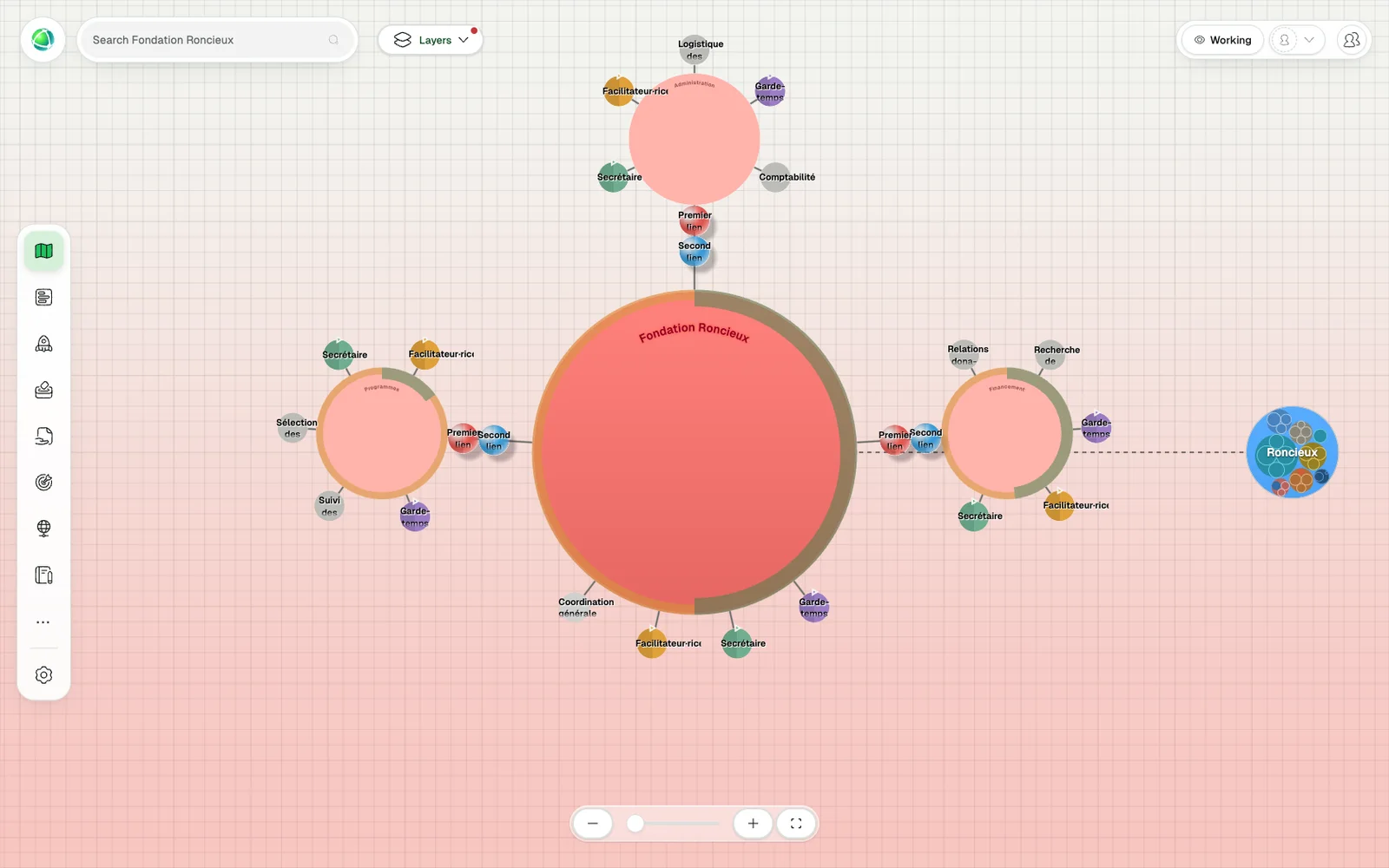
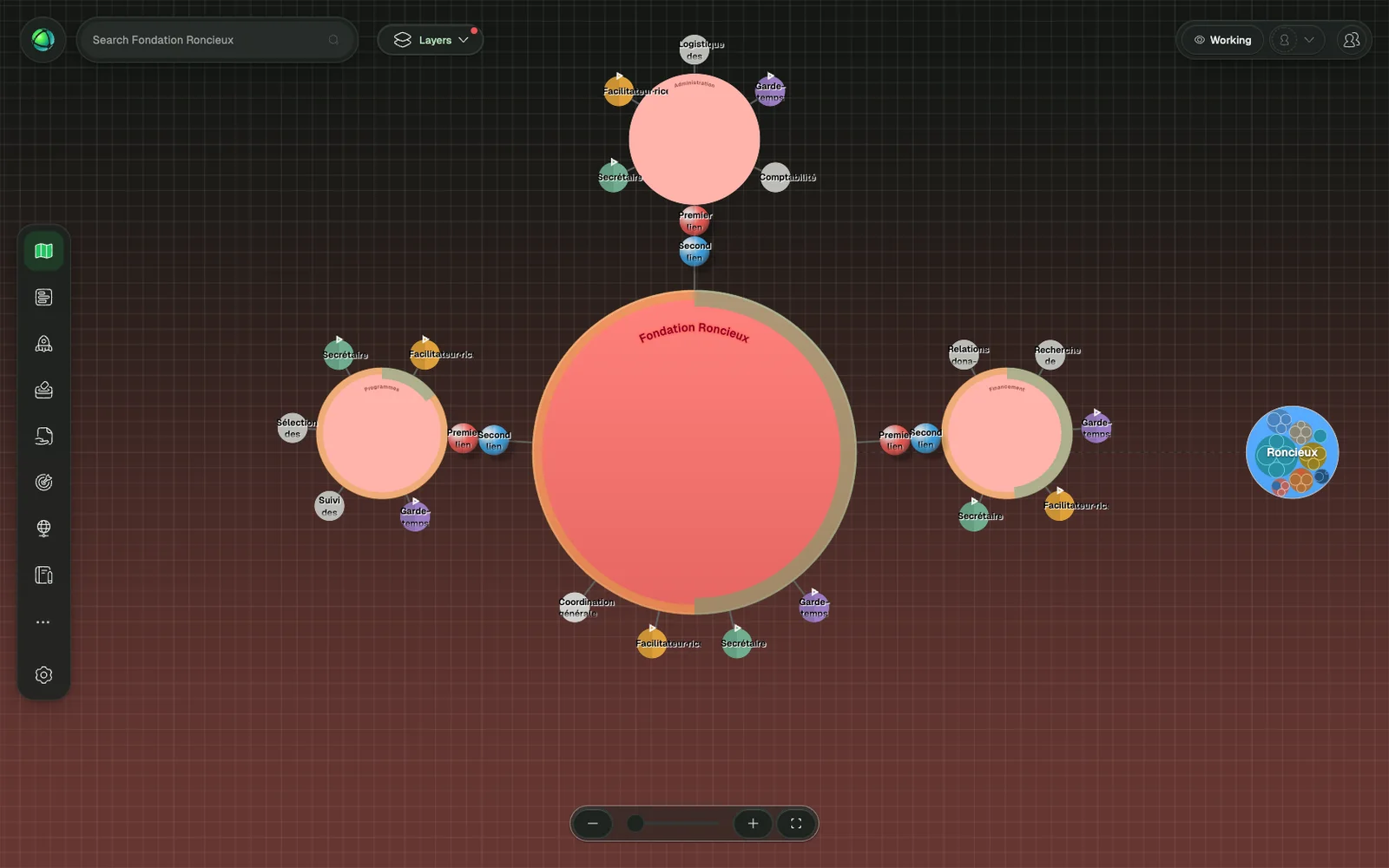
For decades, the default organizational model has been a pyramid: decisions flow downward, reporting flows upward, and a handful of people at the top hold most of the authority. That model worked well in predictable environments. It works less well when markets shift quarterly, talent expects autonomy, and the person closest to the problem is rarely the person with the authority to solve it.
A growing number of organizations are moving toward distributed authority: structures where decision-making is spread across roles, teams, and circles rather than concentrated in management layers. This shift is not about removing structure. It is about making structure explicit, dynamic, and transparent enough to keep up with reality.
If you are evaluating tools to support this kind of organizational model, you have likely discovered that most software was not built for it. Project management tools manage tasks. HRIS platforms manage employment records. Org chart tools produce static diagrams. None of them were designed to represent how authority, accountability, and governance actually flow through a living organization.
This guide covers what self-management software is, how it differs from adjacent categories, what features matter most, and how to evaluate whether a platform fits your needs. It is written to be useful regardless of which tool you ultimately choose.
What Is Self-Management Software?
Self-management software is a category of tools designed to help organizations operate with distributed authority rather than top-down hierarchy. At its core, it makes organizational structure visible, navigable, and governable, not as a static snapshot, but as a living system that evolves alongside the organization.
This is different from adjacent tool categories in important ways:
- Project management tools (Asana, Jira, Monday) manage tasks and workflows. They answer “what needs to get done?” but not “who has the authority to decide how?”
- HRIS platforms (BambooHR, Workday, Personio) manage employment records: contracts, payroll, time off. They model people as employees, not as holders of roles and accountabilities.
- Org chart tools (Visio, Lucidchart, PowerPoint) produce diagrams. They are documentation artifacts, not operational systems. The chart is outdated the moment someone’s role changes.
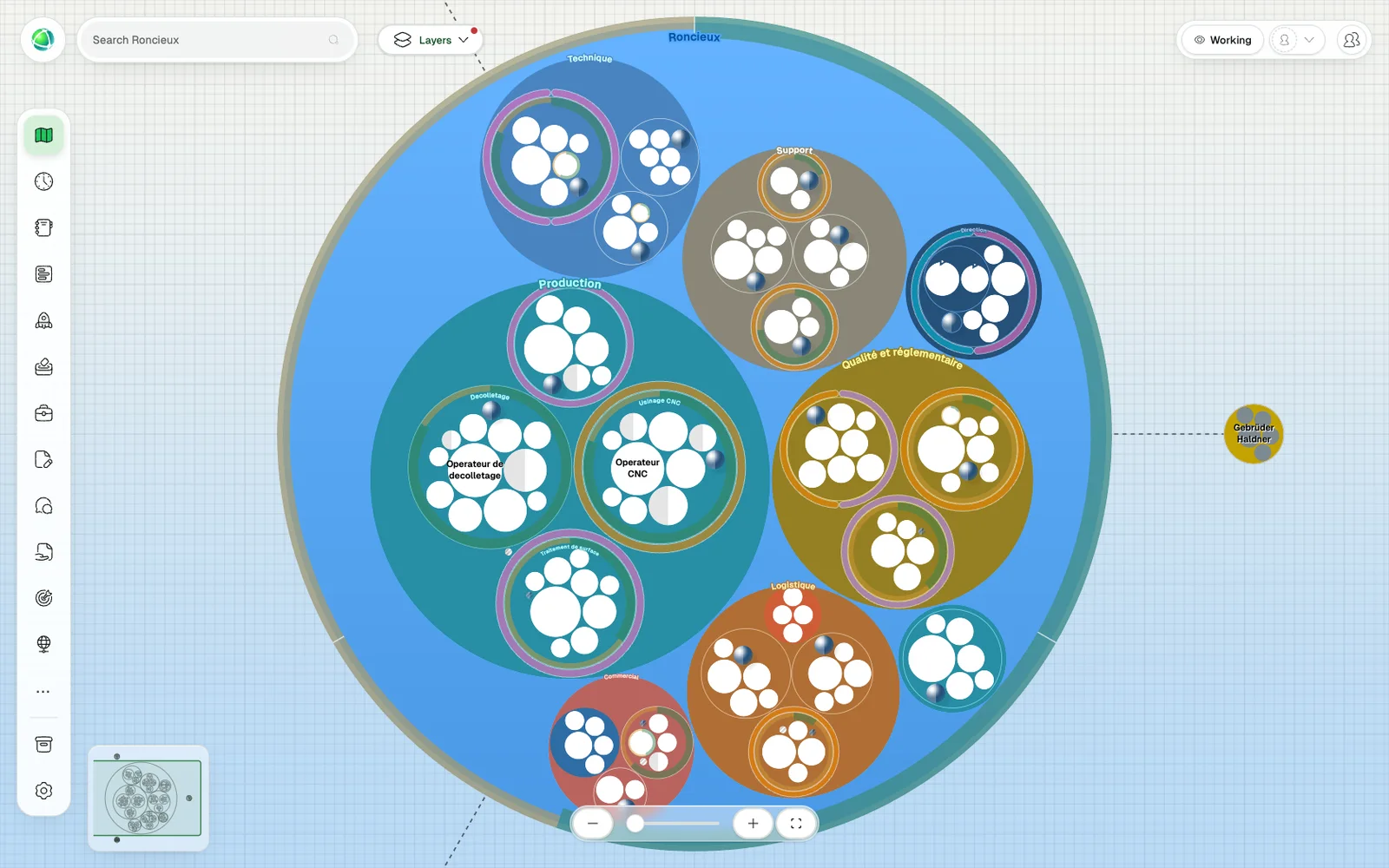
Self-management platforms sit in the gap between these categories. They model the organization not as a reporting hierarchy or a task list, but as a network of roles, teams, and decision rights that people can navigate, search, and update in real time.
The Spectrum of Capability
Not all platforms in this space offer the same depth. It helps to think of a spectrum:
- Basic org charting: Static or semi-dynamic visual maps. Better than PowerPoint, but still primarily a documentation layer.
- Role management: Explicit roles with defined accountabilities, separate from job titles. People hold portfolios of roles, not single positions.
- Full governance platforms: Elections, consent-based decision tracking, term limits, audit trails, organizational analytics. The structure is not just visible; it is governed.
The further right you move on this spectrum, the more the tool supports genuine self-management rather than visualizing hierarchy in a nicer format.
Why Organizations Adopt Self-Management
Organizations do not adopt self-management because it sounds modern. They adopt it because something in their current structure is creating friction they can no longer afford. The most common drivers:
Employee Engagement and Retention
Disengaged employees cost organizations roughly 20% of their annual salary in lost productivity, according to research from the Center for American Progress. Much of that disengagement stems from a lack of clarity about one’s role, limited autonomy, and the feeling that decisions happen somewhere else. Self-management addresses these directly by making roles explicit, distributing authority, and giving people ownership of their domain.
Speed of Adaptation
Rigid hierarchies break under pressure. When every decision requires approval from two levels up, the organization moves at the speed of its slowest bottleneck. Distributed authority lets the people closest to the problem act on it, without waiting for permission from someone who may not fully understand the context.
Better Use of Expertise
In traditional structures, expertise gets trapped in silos. The person best qualified to solve a problem might sit in a different department, invisible to the team that needs them. Self-management platforms with strong search and discovery features make it possible to find the right person by skill, role, or team, across the entire organization.
Reduced Single Points of Failure
When everything depends on one manager’s institutional knowledge, the organization is one resignation away from crisis. Role-based structures distribute knowledge and accountability, reducing the impact of any single departure.
Scaling Without Losing Clarity
What works informally at 30 people breaks down at 300. Verbal agreements about who does what become conflicting assumptions. Self-management software provides the explicit structure that lets organizations scale without losing the clarity and speed they had when they were small.
Key Features to Look For
Not all self-management platforms are built the same. Here are the capabilities that matter most, and why.
1. Dynamic Org Visualization
Static org charts are outdated the moment they are saved. A self-management platform should render your organizational structure in real time, reflecting every role change, team restructure, and new hire as it happens. The visualization should be interactive: clickable, searchable, and navigable. If your org chart lives in a PDF, it is not a tool; it is a liability. For a deeper look at why this matters, see dynamic org charts vs. static org charts.
2. Role-Based Structure
This is the foundational difference between self-management software and traditional tools. Instead of modeling people by their job title (“Senior Product Manager”), the system models granular roles with explicit accountabilities (“Product Strategy Lead,” “Sprint Coordinator,” “Customer Research”). One person can hold multiple roles. One role can be held by multiple people. Roles are transferable, composable, and transparent. If you are new to this concept, the guide on how to implement role-based governance covers the practical details.
3. Governance Support
Self-management is not just about structure; it is about how that structure changes. Look for tools that support governance processes: elections for roles, consent-based decision-making, term limits, and formal proposals. Without governance, distributed authority tends to drift back toward informal hierarchies where the loudest voices win.
4. Goal and OKR Integration
Objectives should be connected to the organizational structure, not floating in a separate spreadsheet. When goals are linked to specific roles, teams, and circles, accountability is clear and progress is visible in context. Disconnected goal-tracking tools create a parallel universe that nobody navigates.
5. History and Audit Trail
Organizations change constantly. A journal of all structural changes (who created a role, who was elected, when a team was restructured) provides institutional memory and accountability. This matters for compliance, for onboarding new members, and for understanding how the organization has evolved.
6. Search and Discovery
In a large organization, finding the right person for a question or decision should take seconds, not days. Search across roles, skills, teams, and accountabilities. This is one of the most underrated features in this category, and one of the most impactful for day-to-day operations.
7. Insights and Analytics
Organizational health is measurable. Look for platforms that surface metrics like role concentration (is one person holding too many roles?), vacancy rates, workload distribution, and structural changes over time. Without analytics, self-management becomes a matter of intuition rather than evidence.
8. Integration Ecosystem
Self-management software should work with your existing tools, not replace them. Look for integrations with the platforms your teams already use (Notion, Jira, Slack, Microsoft Teams, and others). The best organizational tools are connective tissue, not walled gardens.
9. Framework Agnosticism
Some tools are built exclusively for one methodology. That is fine if your entire organization follows that single framework. In practice, most organizations are hybrids: one department uses agile practices, another follows sociocratic governance, a third applies Beta Codex or Peach model principles, and a fourth maintains a traditional reporting structure. The most flexible platforms support multiple frameworks, or no specific framework at all, letting each part of the organization operate in the way that fits it best.
Self-Management Software vs. Traditional Tools
The following comparison highlights where self-management platforms provide capabilities that adjacent tool categories do not.
| Capability | Traditional Org Chart | HRIS | Project Management | Self-Management Platform |
|---|---|---|---|---|
| Dynamic structure | No | Partial | No | Yes |
| Role-based | No | No | No | Yes |
| Governance | No | No | No | Yes |
| Real-time collaborative | No | No | Yes | Yes |
| Visual-first | Basic | No | Partial | Yes |
| Insights/analytics | No | Partial | Partial | Yes |
| Framework agnostic | N/A | N/A | N/A | Varies |
| Integration-focused | No | Yes | Yes | Yes |
The key insight from this comparison is that self-management platforms are not competing with these other tools. They occupy a different layer of the organizational stack: the layer that defines who has the authority to do what, which no other category adequately addresses.
How to Evaluate Self-Management Software
Use this checklist when comparing platforms. Each question addresses a common pitfall in the evaluation process.
1. Does it support your organizational model, or impose one?
Some platforms are built for a single methodology. That works if your entire organization follows that one framework. If you run a hybrid model, or want the flexibility to evolve, look for a platform that is framework-agnostic. For an overview of how holacracy tools and practices intersect with software, that guide covers the landscape.
2. Can it handle hybrid structures?
In reality, different departments often operate under different models. Engineering might use agile. The executive team might use a traditional hierarchy. Operations might run on sociocratic principles. Your platform should support this diversity within a single organizational map, not force uniformity.
3. Is visualization a first-class feature?
Some tools treat the org chart as an afterthought, a diagram auto-generated from a database. Others treat it as the primary interface. The difference matters. If people cannot intuitively navigate the structure, they will not use the tool. Visualization should be interactive, explorable, and genuinely useful for daily work.
4. Does it integrate with your existing stack, or try to replace it?
The best self-management platforms are complementary. They connect to your project management tools, your communication platforms, and your documentation systems. Be cautious of platforms that try to be everything; they usually do nothing particularly well.
5. Can it scale from 10 to 10,000+ people?
Test this explicitly. Some tools work well for small teams but break down when the organizational map gets complex. Others are enterprise-only and overkill for a 20-person company. Look for platforms that serve a range. For example, Peerdom serves organizations from 3 to 30,000 employees across 18 countries.
6. Does it provide actionable organizational insights?
Dashboards are not insights. Look for analytics that surface patterns you would not otherwise see: role hoarding, uneven workload distribution, governance bottlenecks, or structural changes that correlate with engagement shifts. Data should inform decisions, not just decorate reports.
7. What is the onboarding investment?
Some platforms require weeks of training and a dedicated consultant. Others let teams start mapping their organization in minutes. Consider both the initial setup effort and the ongoing learning curve. If it takes six months to deploy, adoption will suffer.
8. Is pricing accessible and transparent?
Pricing models vary widely. Some platforms charge enterprise rates that exclude smaller organizations. Others offer transparent per-user pricing. Peerdom, for example, starts at 5 CHF per user per month (roughly the cost of a cup of coffee) with a free tier for small teams of up to 10 people. Whatever the platform, make sure the pricing model does not become a barrier to broad adoption within your organization.
Common Self-Management Frameworks
Self-management is not a single methodology. It is a category that encompasses several distinct approaches. Understanding these frameworks will help you evaluate whether a tool supports the one your organization uses, or plans to adopt.
Holacracy distributes authority through roles and circles, governed by a formal constitution. Roles have explicit purposes and accountabilities, and governance meetings follow a structured process for proposing and integrating changes. It is one of the most codified self-management frameworks, which makes it both rigorous and demanding to implement. See the holacracy tools and practices guide for a practical walkthrough.
Sociocracy uses consent-based governance with double-linking between circles, meaning each circle has representatives in both the circle above and the circle below it. This creates feedback loops that prevent decisions from being made in isolation. Organizations interested in sociocratic structures can explore setup guidance for sociocracy as a starting point.
Agile at scale frameworks (SAFe, LeSS, the Spotify model) extend agile principles beyond individual teams to entire organizations. They define cross-functional teams, chapters, guilds, and tribes, each with specific roles and coordination mechanisms. These frameworks focus heavily on delivery speed and alignment.
Teal organizations, as described by Frederic Laloux in Reinventing Organizations, are built on three principles: self-management, wholeness, and evolutionary purpose. Rather than following a specific structural template, teal organizations experiment with practices that embody these principles. The approach is more philosophical than prescriptive.
Beta Codex (formerly “Beyond Budgeting”), developed by Niels Pfläging, replaces the traditional top-down pyramid with a decentralized network model organized around center and periphery. Value creation happens at the edges of the organization, not in the middle. The related Peach model uses the metaphor of a peach: the outer flesh represents the periphery where customer-facing work and innovation happen, while the pit at the center provides support services. Organizations drawn to Beta Codex tend to emphasize market-pull over plan-push and decentralized decision-making over centralized control.
The Buurtzorg model, originating from the Dutch home-care organization Buurtzorg, demonstrates self-management at scale through small, autonomous nursing teams of ten to twelve people who manage their own scheduling, client intake, and administration. The model has inspired organizations far beyond healthcare to adopt small-team autonomy as a structural principle.
Hybrid approaches are the most common in practice. Most organizations combine elements from multiple frameworks: agile delivery in some teams, sociocratic governance in others, Beta Codex principles in a third, and traditional hierarchy where it still makes sense. The best self-management software accommodates this reality rather than forcing a single model.
The takeaway: the best self-management software does not force you into one framework. It provides building blocks for whichever approach fits your organization.
What Real Adoption Looks Like
The transition is rarely instant, but the right tooling significantly reduces friction.
“Peerdom is a user-friendly tool that helped us make our organizational model tangible. Our 100+ Loycomates got used to it in only a few days.” — Christophe Barman, Loyco
“Smart, simple, flexible and transparent. A game-changer for truly agile organizations.” — Germain Augsburger, BKW
“We base it on distributed leadership responsibility, agile principles, and a humanistic approach.” — Markus Meister, inova:solutions AG
These organizations differ in size, industry, and governance model. What they share is the recognition that organizational structure needs to be explicit, accessible, and adaptable. More customer stories illustrate how this plays out across sectors and scales.
The pattern across successful implementations is consistent: organizations that manage change thoughtfully and invest in making the new structure visible tend to see faster adoption and fewer reversions to old habits.
Frequently Asked Questions
What is the difference between self-management and no management?
Self-management is not the absence of management; it is the distribution of management. Roles, accountabilities, and decision-making authority still exist. They are spread across the organization rather than concentrated in a few management positions. Self-managed organizations often have more explicit structure than traditional ones, not less.
Do you need special software for self-management?
You can practice self-management with spreadsheets and whiteboards. Many organizations start that way. But as the organization grows past a few dozen people, maintaining clarity without dedicated tooling becomes increasingly difficult. Software helps by keeping the structure visible, searchable, and up to date, which is essential for distributed authority to work in practice.
Can large enterprises use self-management?
Yes. Organizations with thousands of employees use self-management models, often in hybrid configurations where different divisions operate under different frameworks. The challenge at scale is not the model itself but maintaining visibility and coherence across a complex structure, which is precisely what self-management platforms are designed to solve. Companies like Bayer, Lufthansa, and ETH Zurich use Peerdom to manage exactly this complexity.
How do you transition from hierarchy to self-management?
Gradually, in most cases. A full overnight transformation is risky and usually unnecessary. Many organizations start by piloting role-based structures in one department or team, learning from the experience, and then expanding. The transition involves defining explicit roles and accountabilities, establishing governance processes, and, critically, making the new structure visible to everyone. Tooling plays a significant role in that visibility.
What is role-based governance?
Role-based governance means that authority and accountability are assigned to roles, not to people. A person holds a portfolio of roles, each with defined responsibilities and decision-making scope. Governance processes (elections, proposals, consent rounds) determine how roles are created, modified, and assigned. This approach makes organizational structure explicit and reduces dependency on informal power dynamics.
How much does self-management software cost?
Pricing varies significantly across the category. Some platforms are enterprise-only, requiring annual contracts and implementation fees. Others offer transparent per-user pricing starting at a few dollars or francs per month, with free tiers for small teams. The key consideration is not just the sticker price but the total adoption cost, including onboarding time, training, and integration effort.
Can self-management work alongside traditional hierarchy?
Absolutely. Many organizations run hybrid models where some parts of the organization use distributed authority while others maintain traditional reporting structures. This is common during transitions, but it is also a valid long-term approach. The key is having a tool that can represent both models on the same organizational map, so that everyone, regardless of their department’s governance model, can navigate the full picture.
What happens if self-management does not work for us?
Adopting self-management software does not lock you into a specific organizational model. If you try a distributed approach and decide it is not the right fit, the roles, accountabilities, and structural clarity you built along the way still have value. The process of making organizational structure explicit is worthwhile regardless of the governance model you ultimately settle on.
Ready to explore?
- Compare self-management platforms: see how Peerdom stacks up against GlassFrog, Holaspirit, Nestr, Maptio, and more, with links to methodology guides for every major framework.
- Start mapping your organization for free: Peerdom supports traditional hierarchies, agile, sociocracy, holacracy, Teal, Beta Codex, the Spotify model, and hybrid models out of the box.
- Not sure which approach fits? Book a demo and we’ll walk through your specific needs.
Keep reading
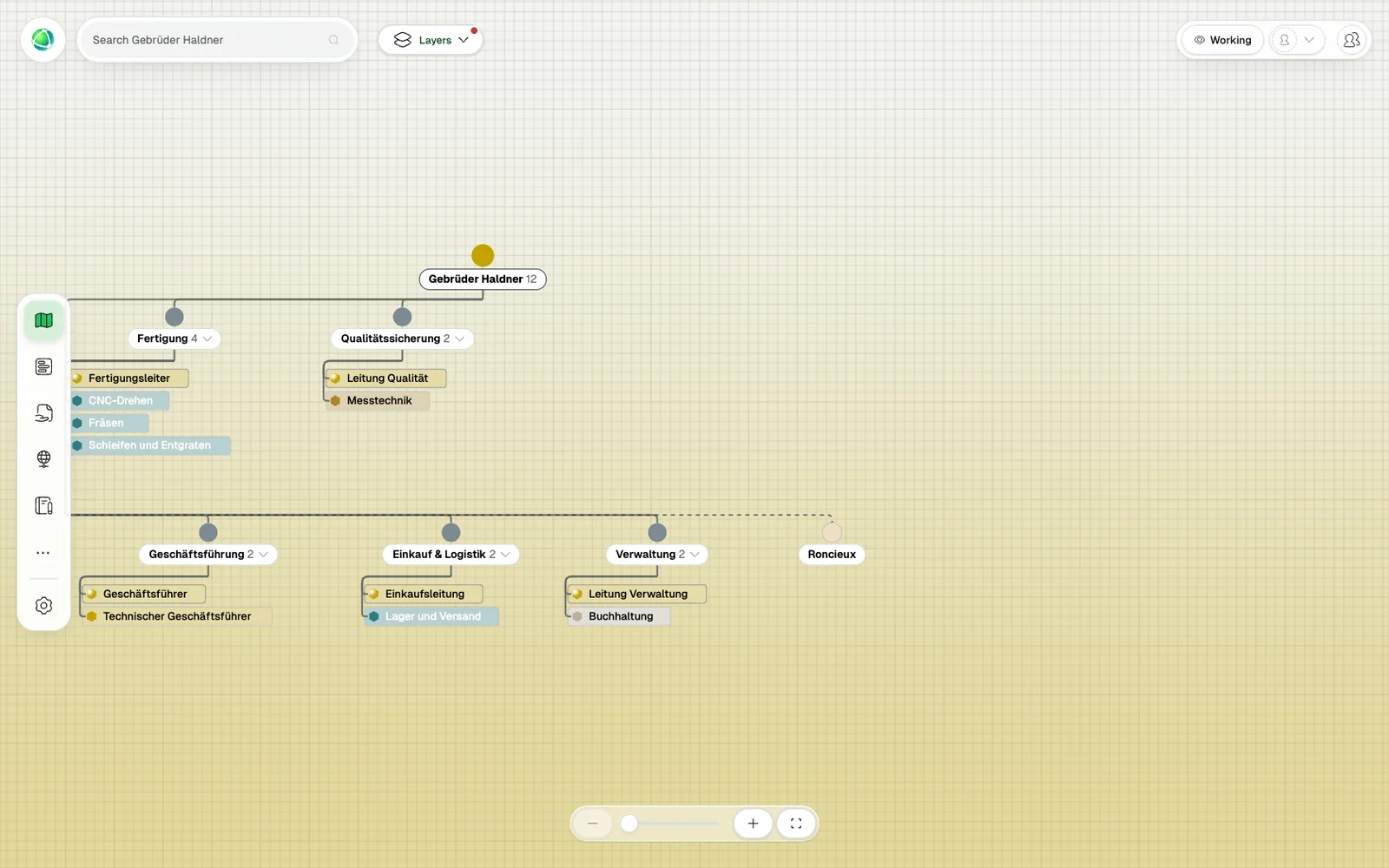
insights
The org chart was invented in 1855 and barely evolved since. Here's why dynamic, real-time organizational maps are replacing static diagrams, and what that means for your organization.
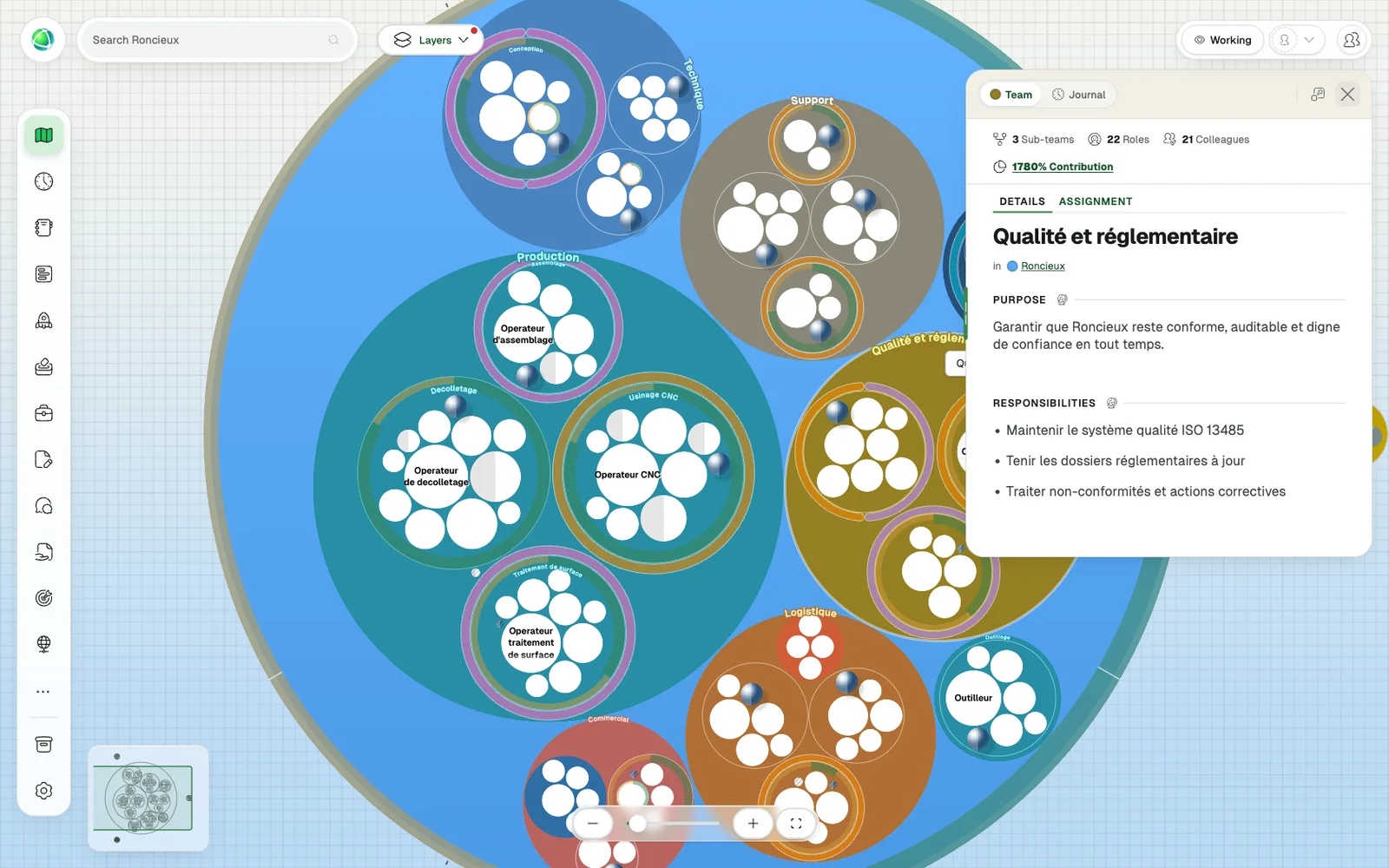
insights
A step-by-step guide to moving from job-title hierarchies to explicit, role-based accountability, with practical advice for every stage of the transition.
insights
Why most organizational change fails, and a practical framework to make transformation stick through visibility, role clarity, and continuous adaptation.