The Complete Guide to Organizational Change Management
Nathan Evans
Why most organizational change fails, and a practical framework to make transformation stick through visibility, role clarity, and continuous adaptation.
Every year, organizations around the world pour billions into transformation initiatives. The global HR consulting market alone is valued at over $32 billion. Yet the return on that investment is, by most accounts, dismal. Research from the Center for American Progress estimates that each disengaged employee costs the organization roughly 20% of their annual salary in lost productivity, turnover risk, and diminished output. Multiply that across an entire workforce navigating poorly managed change, and the numbers become staggering.
The uncomfortable truth is that most organizational change fails not because the strategy is wrong, but because the change never becomes real for the people living inside it. Leadership announces a new structure. A consultancy delivers a slide deck. Months later, nobody can tell you what actually changed, because the transformation was never connected to the daily experience of work.
Pyramidal org charts, the default blueprint for most companies, were designed for command-and-control stability. They were never built for the kind of continuous adaptation that modern organizations require. When change hits a rigid hierarchy, the result is predictable: confusion, resistance, and a slow return to the old way of doing things.
This guide offers a different path. It is a practical framework for making organizational change visible, role-based, and durable, so that transformation is not a one-time event but an ongoing capability.
What Is Organizational Change Management?
Organizational change management is the discipline of making structural transformation stick. Not just announcing it, not just planning it, but embedding it into the fabric of how people work together every day.
This means making responsibilities, decisions, and dependencies explicit. It means ensuring that when a role shifts, a team restructures, or a new function is created, everyone affected can see the change, understand it, and act on it.
How It Differs from Project Management
Project management governs a temporary initiative with a defined start and end. Change management governs how work itself is structured and evolves over time. A project might deliver a new software platform. Change management addresses what happens to the people, roles, and teams that need to reorganize around it.
The two overlap, but the distinction matters. Projects end. Organizations keep moving.
Why Change Fails
Most transformation efforts fail for a handful of recurring reasons:
- Fear and uncertainty. People resist what they do not understand. When change is communicated through vague memos or top-down mandates, anxiety fills the information vacuum.
- Rigid processes. Organizations built on static hierarchies struggle to absorb structural shifts. The old org chart fights the new reality.
- Lack of visibility. If people cannot see how the organization is changing, they cannot orient themselves within it. Change becomes abstract instead of actionable.
- Disconnection from daily work. When transformation lives in strategy decks but not in people’s actual roles and responsibilities, it never takes root. The consultant leaves, and the organization snaps back to its old shape.
The pattern is consistent: change fails when it is invisible, rigid, and disconnected from the lived experience of work.
Common Change Triggers
Organizational change is not one thing. Different triggers demand different approaches, but they all share a common requirement: structural clarity.
Structural Transformation
Redesigning how your organization works, whether shifting from a hierarchy to a network of teams, adopting sociocracy or holacracy, implementing a Beta Codex center-periphery structure, or decentralizing decision-making along Teal principles. This is the deepest form of change and requires the most visibility.
Mergers and Acquisitions
Integrating two organizations with different cultures, structures, and role definitions. The challenge is not just combining headcount but creating a shared understanding of who does what across the merged entity.
Scaling and Hyper-Growth
Maintaining role clarity while the organization doubles or triples in size. What worked at 30 people breaks at 150. Generalist roles need to specialize, new teams need to form, and accountability needs to remain clear throughout.
ISO and B-Corp Certification
Compliance frameworks like ISO 9001 or B-Corp certification require documented organizational structures with clear accountability chains. This is a practical trigger that also creates lasting value: the documentation process itself surfaces gaps and overlaps.
AI Workforce Adoption
As organizations introduce AI agents alongside human teams, the coordination challenge intensifies. Agents need the same structural clarity that humans do: defined scope, clear boundaries, and explicit accountability. This is a new category of change that most organizations are only beginning to grapple with.
The Role-Based Approach to Change
At the core of effective change management is a shift in how you define work. Traditional organizations are built around job titles: fixed, coarse-grained descriptions that attempt to capture everything a person does in a single label. Role-based organizations take a different approach, decomposing work into granular, transferable units of accountability.
The difference matters. A job title is a static identity. A role is a dynamic building block.
| Job Title | Role | |
|---|---|---|
| Granularity | One title per person, covering many responsibilities | Multiple roles per person, each with a specific accountability |
| Flexibility | Changing a title requires HR processes, renegotiation | Roles can be added, removed, or reassigned as needs evolve |
| Transferability | When someone leaves, the entire position must be refilled | Roles can be redistributed across existing team members |
| Transparency | Job descriptions are often private, between HR and the employee | Role descriptions are shared and visible to the whole organization |
| Resilience | Departure creates a single point of failure | Multiple people can hold the same role; impact is distributed |
| Growth | Career paths follow predefined ladders | Individuals craft their role portfolio based on strengths and interests |
One person can hold multiple roles across different teams. Roles persist when people leave. When someone departs, the organization does not lose a position; it redistributes a set of clearly defined responsibilities. This makes the entire structure more resilient and adaptable.
For a deeper exploration of why roles outperform job titles in practice, see how to implement role-based governance and the advantages of defining roles instead of positions.
Making Change Visible
Here is a principle that sounds obvious but is routinely violated: you cannot improve what you cannot see.
Most organizations manage their structure through a combination of static PowerPoint slides, scattered spreadsheets, and institutional memory. The org chart, if it exists, was last updated six months ago. It reflects the organization as it was, not as it is.
This creates a fundamental problem for change management. If nobody can see the current state of the organization, how can anyone orient themselves within a transformation? How can leadership identify bottlenecks? How can teams understand where they fit in the new structure?
The answer is that they cannot. And so change remains abstract.
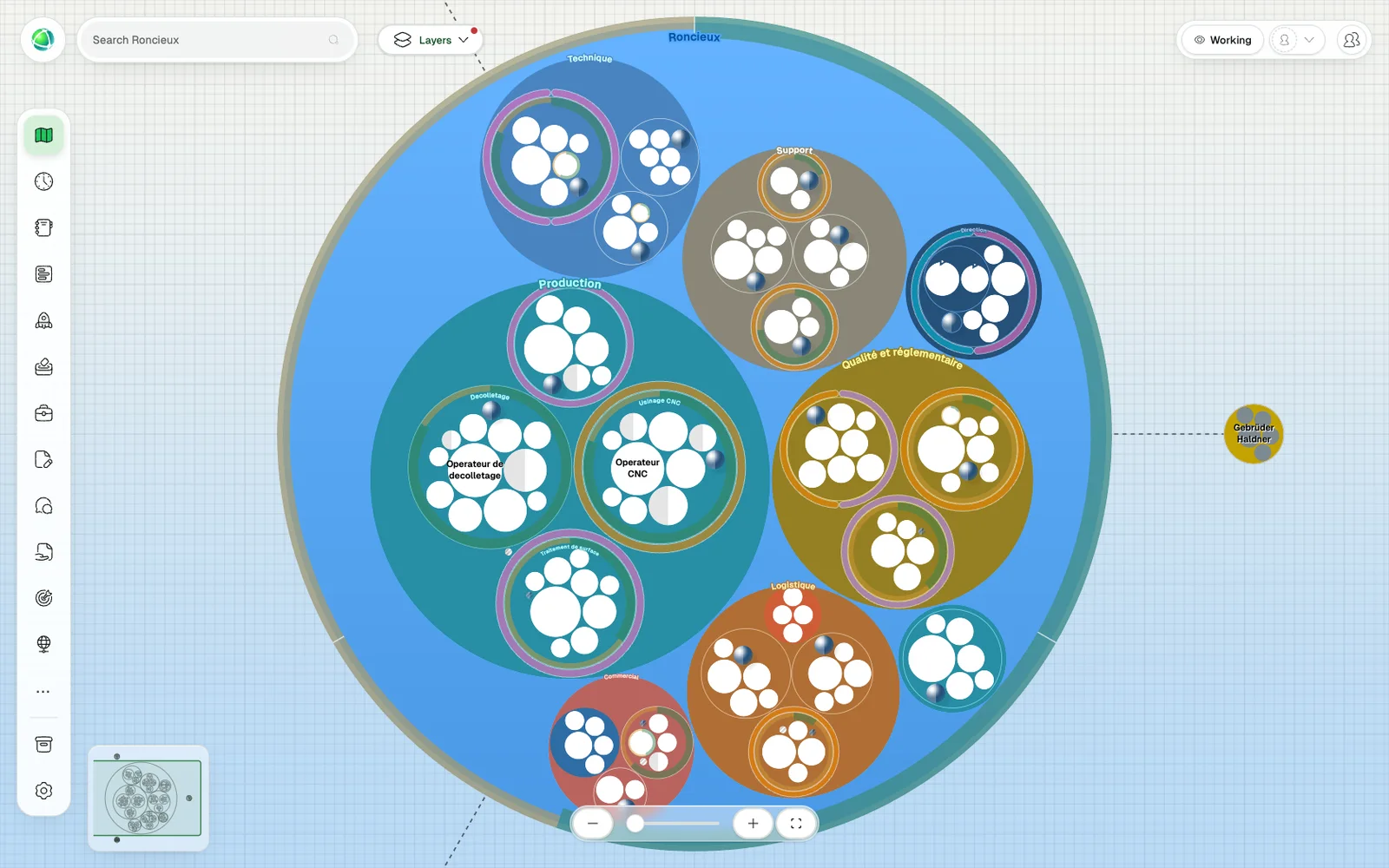
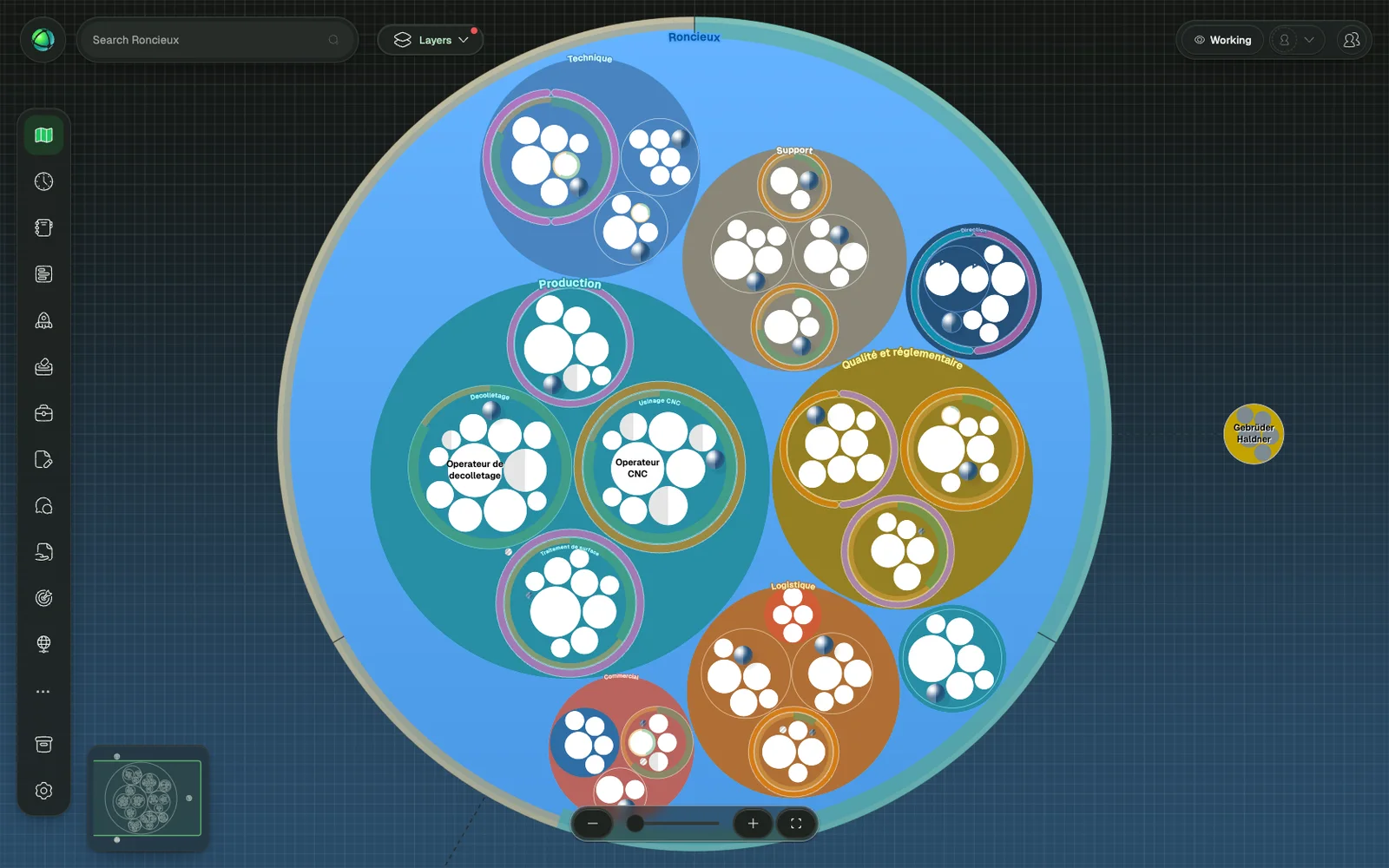
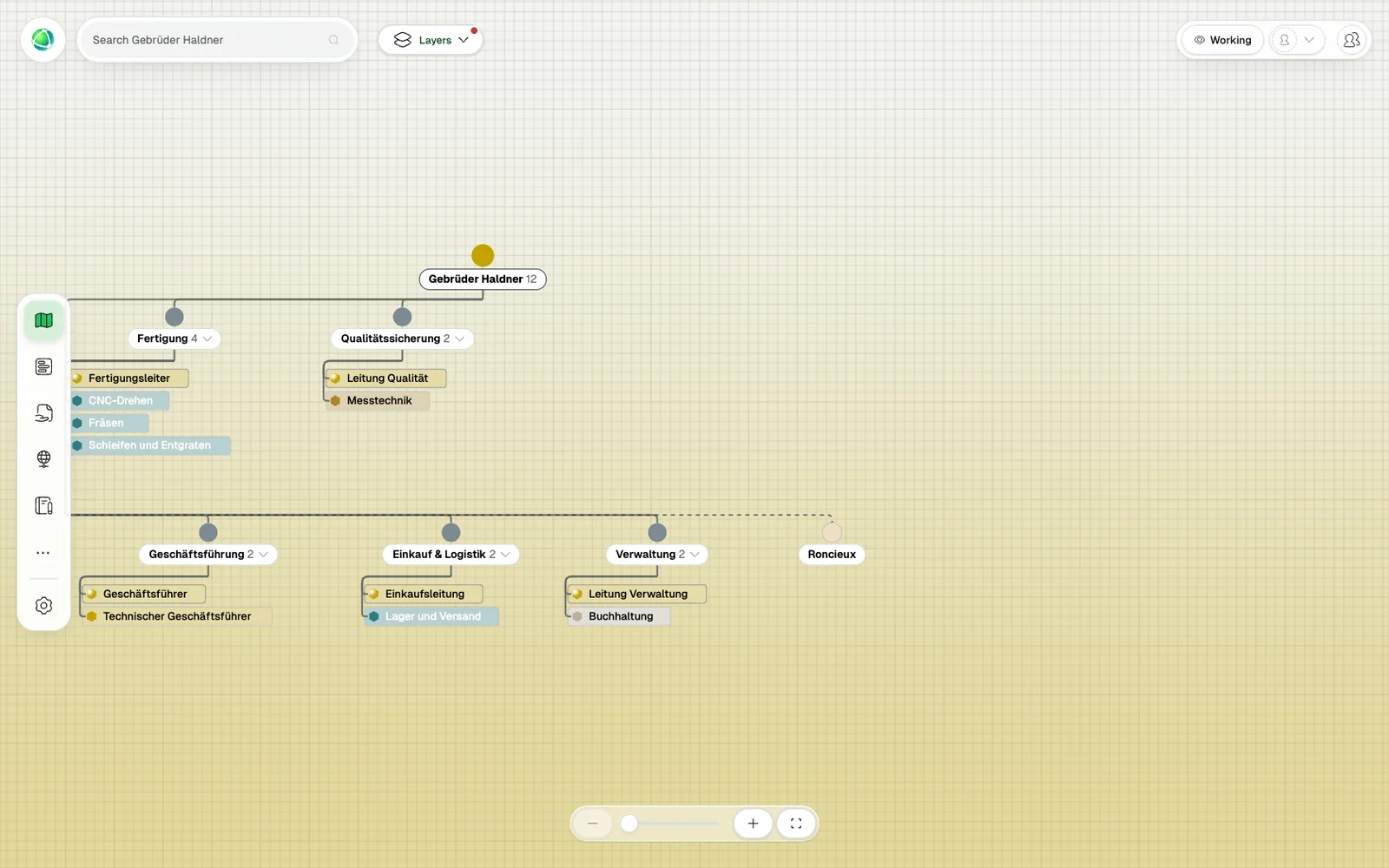
Dynamic, real-time organizational maps solve this problem by making structure visible and current. When every role, team, and accountability is represented in a shared, living map, change stops being something that was announced in a meeting and starts being something people can see, navigate, and respond to.
| Before | After |
|---|---|
| Static PowerPoint org charts | Dynamic, real-time visual maps |
| Scattered Excel spreadsheets | Unified organizational database |
| Expensive consultants | Self-service change management |
| Outdated documentation | Always-current structure |
| Siloed information | Transparent, connected view |
Transparency builds trust. When everyone in the organization sees the same picture, rather than relying on second-hand information or outdated documents, the politics around change diminish. People stop guessing and start orienting.
“New employees say they are immediately oriented, in contrast to what took them years in their previous organisations!” — Christophe Barman, Loyco
Real-time updates mean the whole organization sees change as it happens, not in a memo distributed three months later. This immediacy is critical. Change that is visible is change that is understood.
How to Implement Change That Sticks
Theory is necessary but insufficient. What follows is a practical, six-step framework for implementing organizational change that endures.
1. Map your current state
Before you can change anything, you need an honest picture of how work is currently structured. Not the official org chart, but the real one: who actually does what, who makes which decisions, and where the informal dependencies are. This is the diagnostic step, and skipping it is one of the most common and costly mistakes in change management.
Tools like Peerdom make this step significantly faster by allowing you to visually map roles, teams, and accountabilities in a shared, interactive format. What used to take weeks of interviews and spreadsheet wrangling can happen in days.
“During the process of mapping out the way our company currently worked with Peerdom, it was like a revelation…we learned things about our 20 year old company that we never saw before and were so much the richer for it.” — Sean Daly, Director, SOLID Structures & Infrastructure
2. Identify what needs to change
With the current state visible, patterns emerge. You can now identify bottlenecks where too much decision-making authority is concentrated in a single role. You can spot gaps where responsibilities are undefined. You can find overlaps where multiple people believe they own the same accountability.
Organizational insights and analytics help surface these patterns systematically rather than relying on anecdotal evidence.
3. Design the new structure collaboratively
The most durable organizational changes are not imposed from above. They are co-created with the people who will live inside them. This does not mean design by committee. It means involving team leads and key role holders in the design process so that the new structure reflects reality, not a consultant’s abstraction.
Workshop formats where teams define their own roles, accountabilities, and boundaries produce better results than top-down mandates, because the people doing the work understand the work better than anyone else.
4. Communicate transparently
Once the new structure is designed, make it visible to everyone immediately. Not through a 40-slide presentation, but through a shared, navigable map that anyone in the organization can explore. Transparency is not a nice-to-have; it is the mechanism through which change becomes real.
When everyone sees the same picture, alignment follows naturally. Questions shift from “What is happening?” to “How does this affect my work?” The second question is productive. The first is a symptom of failure.
5. Track the transformation over time
Change is not a light switch. It unfolds over weeks and months. You need a way to track it: what has changed, when it changed, and why. An audit trail, a change journal, and historical snapshots allow leadership to monitor progress and course-correct when needed.
This is also essential for compliance. If your organization is pursuing ISO certification or operating under regulatory requirements, a documented history of structural changes is not optional.
6. Continuously improve
The organizations that are best at change are the ones that never stop. They build regular reviews into their operating rhythm, quarterly structure reviews, role portfolio check-ins, and feedback loops that surface tension before it becomes a crisis.
“Peerdom is my favourite tool to play in, map your current state to enable conversations about transformation and visualize multiple potential futures!” — Romina Farrell, Organizational Design Change Agent
The goal is not to arrive at the perfect structure. The goal is to build the organizational muscle for continuous adaptation.
Change Management for AI-Native Organizations
The next wave of organizational change is already here, and it introduces a coordination challenge unlike anything most companies have faced. AI agents, software systems capable of autonomous decision-making, are entering the workforce not as tools but as participants.
This is not science fiction. Organizations are already introducing AI agents into customer support, data analysis, content generation, and operational workflows. The question is no longer whether AI agents will join your workforce, but how you will integrate them.
The challenge is structural. AI agents need the same clarity that humans need: defined roles, explicit scope, clear boundaries, and accountability for outcomes. An agent handling customer escalations needs to know what falls within its authority and what must be routed to a human. An agent generating reports needs to know which data sources it owns and which require approval to access.
This creates the concept of an organizational intelligence layer: a shared structural map that both humans and agents consult to understand who (or what) is responsible for what. Without this layer, you get the AI equivalent of organizational chaos: agents duplicating work, overstepping boundaries, or operating in silos that nobody can see into.
The organizations that will navigate this transition well are the ones that already have clear, visible, role-based structures. If your human teams operate with defined roles and transparent accountabilities, extending that framework to include AI agents becomes a natural step rather than a wholesale reinvention.
Organizations serving 250+ clients across 18 countries, from multinationals like Bayer and Lufthansa to mission-driven organizations like Greenpeace and MSF, are already using platforms like Peerdom to build the structural foundation that makes this kind of hybrid coordination possible.
“Smart, simple, flexible and transparent. A game-changer for truly agile organizations.” — Germain Augsburger, BKW
Frequently Asked Questions
What is the difference between change management and project management?
Project management governs a temporary initiative with a clear start and end date. Change management governs how the organization’s structure, roles, and ways of working evolve over time. A project delivers a specific outcome; change management ensures the organization can absorb and sustain that outcome.
How long does organizational change management take?
There is no universal timeline. A small team restructuring might take weeks. A company-wide transformation following a merger could take a year or more. The key factor is not speed but durability: it is better to take three months to implement a change that sticks than to rush a reorganization that reverts within six weeks.
What is the biggest reason organizational change fails?
Lack of visibility. When people cannot see what is changing, why it is changing, and how it affects their daily work, they default to the familiar. Change that exists only in leadership’s heads or in strategy documents never becomes real for the people who need to live it.
How is role-based governance different from traditional hierarchy?
In a traditional hierarchy, each person holds one job title and reports to one manager. In role-based governance, whether inspired by holacracy, sociocracy, the Peach model, or responsive organization design, each person holds a portfolio of roles, each with its own specific accountability. Roles can be shared, transferred, and evolved independently. This creates a more resilient, adaptable structure.
Do we need to abandon our hierarchy entirely to benefit from role-based approaches?
No. Many organizations adopt a hybrid approach, combining elements of traditional hierarchy with sociocratic circles, Spotify-model squads, or Buurtzorg-style autonomous teams, maintaining some hierarchical elements for legal or compliance purposes while introducing roles within teams and departments. The shift can be gradual. Even mapping your current structure as a set of roles, without changing anything else, produces immediate clarity.
Can change management tools replace consultants?
They can reduce the dependency. Consultants bring expertise and an outside perspective, which is valuable. But when the consultant leaves, the organization needs to sustain the change on its own. Self-service tools that make structure visible and editable by the organization itself, rather than locked in a consultant’s deliverable, are accessible at every budget level and create lasting capability rather than a one-time intervention.
How do AI agents fit into organizational change management?
AI agents are increasingly joining human teams as autonomous participants. They require the same structural clarity: defined scope, accountability, and boundaries. Organizations that already operate with visible, role-based structures are better positioned to integrate AI agents because the framework for coordination already exists.
Where can I see examples of organizations that have successfully managed change?
Real-world examples from organizations across industries and sizes, from NGOs to multinationals, are documented in customer stories that describe specific transformation journeys and outcomes.
Take the first step
Organizational change does not have to be a gamble. It starts with seeing your organization clearly.
- Start mapping your organization for free: see your structure in minutes, not months.
- Want to discuss your transformation? Book a demo with our team.
Keep reading
insights
Explore AI-native organizations: how automation, intelligent agents, and adaptive structures reshape New Work. Learn how forward-thinking teams harness AI to boost agility, clarity, and collaboration.
insights
The org chart was invented in 1855 and barely evolved since. Here's why dynamic, real-time organizational maps are replacing static diagrams, and what that means for your organization.

customer stories
Discover how a Swiss non-profit adopted a role-based organization to drive agility, innovation, and nationwide social impact.