AI Agents on the Org Chart: Governing the Hybrid Workforce
Alexandre Margot
As AI agents move from tools to teammates, organizations need a governance layer that makes human-agent collaboration legible, accountable, and safe. Here's how.
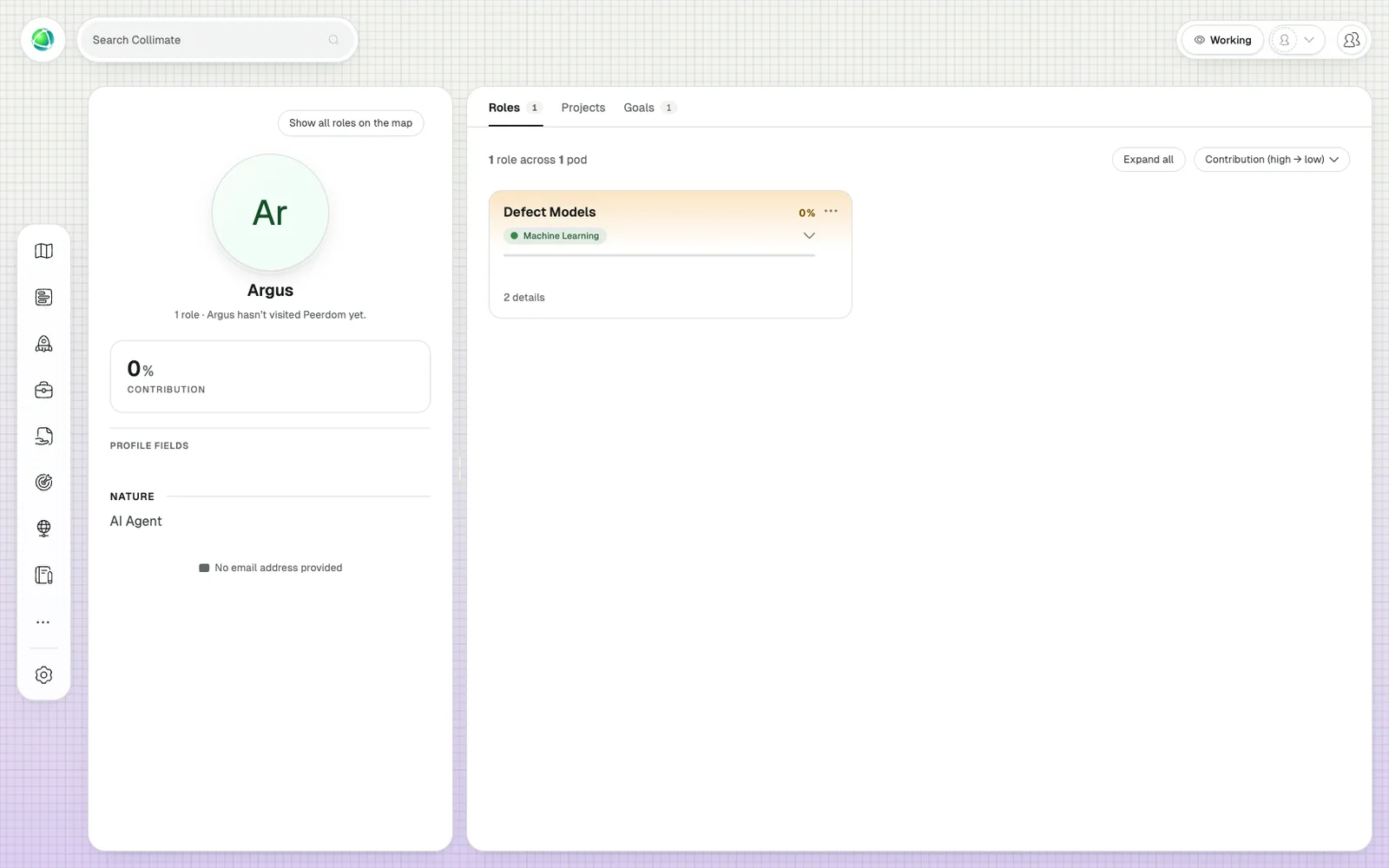
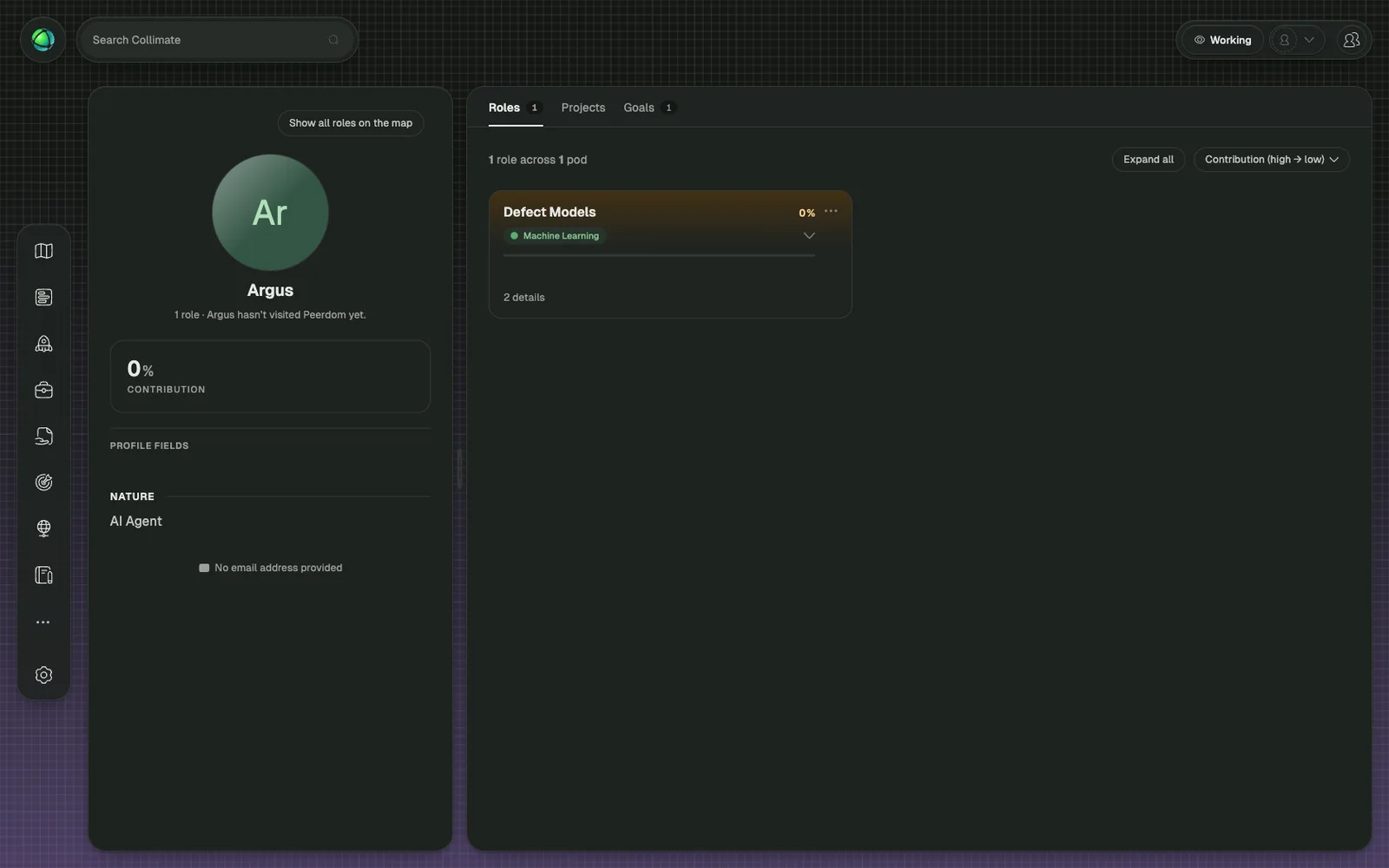
Something fundamental is shifting in how organizations work. AI agents are no longer tools you open in a browser tab, type a prompt into, and close. They are becoming entities that hold roles, carry accountabilities, and operate alongside human colleagues inside your organizational structure.
The question is no longer whether AI agents will join your workforce. That is already happening. The question is how you will govern them once they do.
As organizations introduce agentic workers, the bottleneck shifts from execution to coordination. AI agents can act quickly, but speed without structure is not an advantage. It is a liability. An agent that acts outside its scope, duplicates a colleague’s work, or makes decisions it was never authorized to make does not save time. It creates problems that humans must clean up.
AI agents cannot act safely or coherently without explicit organizational context: who is responsible for what, who can decide, what boundaries apply, what dependencies exist. Most organizations cannot provide this information to agents because it does not exist in a structured, queryable form. The knowledge lives in people’s heads, scattered documents, and institutional memory that no system can access.
This is an organizational problem, not a technical one. And solving it requires organizational thinking.
The Shift: From AI Tools to AI Teammates
To understand what is changing, it helps to distinguish two models of how organizations use AI.
AI as a tool
This is the familiar model. You open ChatGPT, Claude, or Copilot. You write a prompt. You get a result. The AI has no knowledge of your organization: your team structure, your role definitions, your decision boundaries, your current goals. You are the operator. The AI has no agency.
This model has made individuals more productive. But it does not change how organizations are structured, because the AI never enters the organization. It remains outside, a utility accessed on demand.
AI as a teammate
This is the emerging model. An AI agent holds a defined role within a team: Map Upkeeper, Data Import Specialist, Feedback Analyst. It has a purpose, a set of accountabilities, and explicit boundaries, just like a human colleague. It acts autonomously within the scope of its role and escalates decisions outside that scope. Other team members, both human and AI, can see what it is responsible for and how to interact with it.
This changes the coordination problem fundamentally. Traditional organizational structures were designed for humans only. Adding agents without adapting the governance layer creates predictable problems: duplicate work, boundary violations, accountability gaps, and “social debt” that humans must absorb.
The challenge is not building smarter agents. It is building organizational structures that can accommodate them.
What AI Agents Need to Work Effectively
AI agents need the same things humans need to function effectively inside an organization. The bottleneck is not technical. It is organizational.
| Requirement | What it means for humans | What it means for agents |
|---|---|---|
| Clear roles and accountability | I know what I am responsible for and what ongoing work I do | The agent’s scope is explicitly defined: purpose, accountabilities, deliverables |
| Understanding of organizational structure | I know who else works here, who does what, and how teams connect | The agent can query the organizational map to understand its context |
| Defined boundaries and permissions | I know what I can decide on my own and what I must escalate | The agent’s domain of authority is scoped. Actions outside it require human approval |
| Access to relevant context | I know the goals that matter, the projects I am part of, and who my collaborators are | The agent receives organizational context before acting: goals, collaborators, priorities |
| Visibility to others | My colleagues know what I am doing and how to reach me | The agent appears on the organizational map with its role, team, and status |
Without these, an agent is a capable tool running in a void, fast but directionless. It can produce outputs, but it cannot coordinate. And coordination is the entire point of an organization.
The Organizational Intelligence Layer
Between your systems of record (HR, ERP, CRM, project management) and your AI agents, there needs to be an organizational intelligence layer. This is the core concept that makes hybrid human-agent governance possible.
This layer stores organizational truth: roles, mandates, decision rights, team structure, goals, dependencies, and authority boundaries. It is not the agent’s brain. It is the situational awareness the brain requires before acting in a social system. Both humans and agents consult this layer before taking action, ensuring that everyone, regardless of whether they are carbon-based or silicon-based, operates from the same shared understanding of how the organization works.
A clean principle applies: prompts reference the org map. The org map does not reference prompts. The organizational structure is the stable foundation. Agent instructions draw from it. The structure does not bend to accommodate any single agent’s needs.
To make this concrete, here is what the organizational intelligence layer is and is not.
| What this layer IS | What this layer IS NOT |
|---|---|
| Organizational context provider | An agent runtime or workflow engine |
| Role and authority registry | Prompt storage or LLM memory |
| Governance enforcement layer | A replacement for your enterprise systems |
| Shared coordination substrate | The agent’s brain or reasoning engine |
| Human-agent visibility layer | An AI training platform |
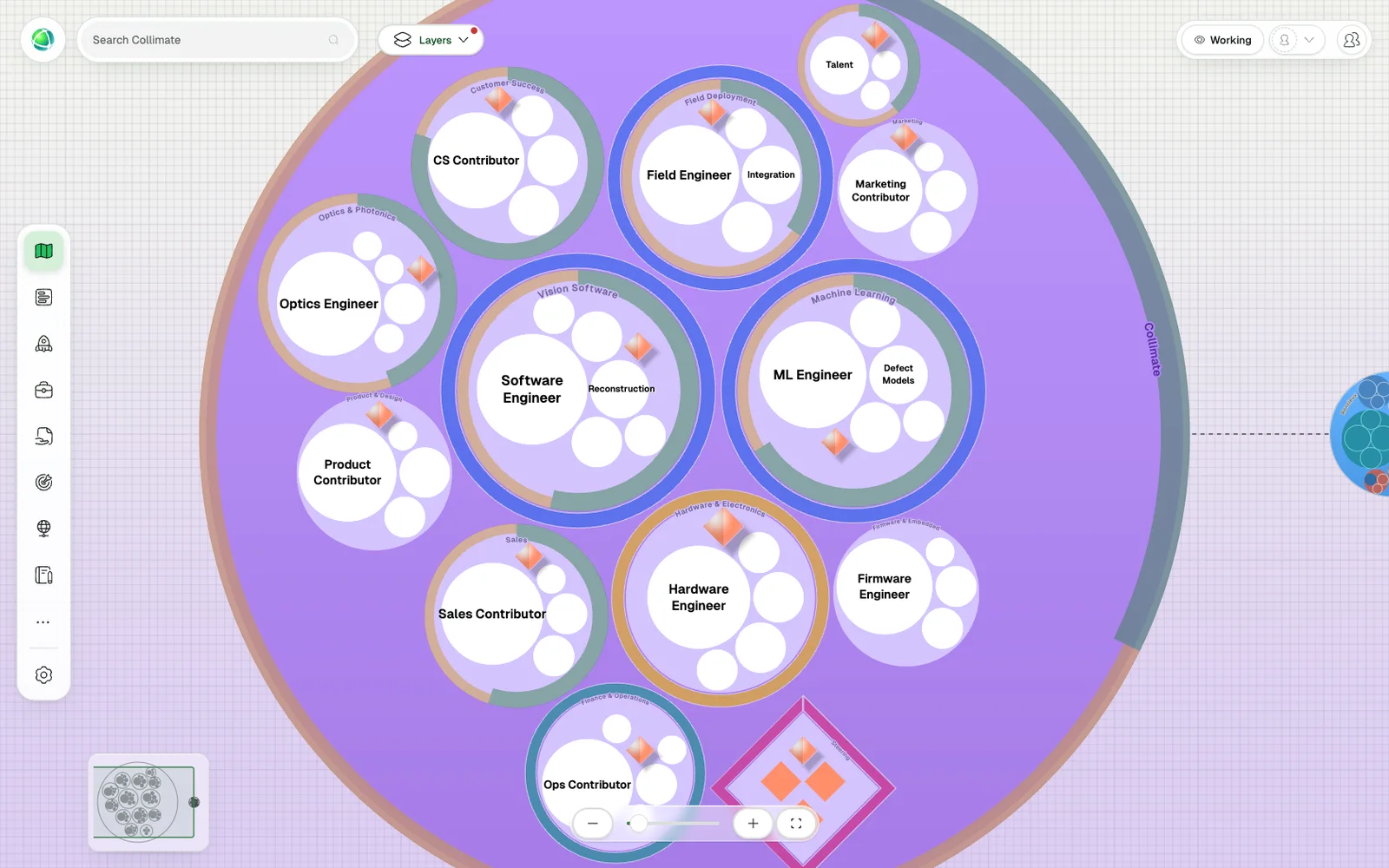
This is the layer that Peerdom provides. As an organizational intelligence platform, Peerdom sits above your systems of record and below your AI agents, giving both humans and agents a shared, authoritative map of how the organization works. Think of it as GPS for your organization: not the territory itself, but the map that everyone uses to navigate.
Agents as Role Holders
In a role-based governance system, work is decomposed into roles, each with a defined purpose, specific accountabilities, and a scope of authority. This model, used by organizations practicing holacracy, sociocracy, the Spotify model, Teal principles, and many other governance approaches, extends naturally to AI agents.
An AI agent holds a role the same way a human does. The role definition does not change based on who or what fills it. What changes is the holder.
Each agent role has:
- A name that describes its function (e.g., Map Upkeeper, Feedback Analyst)
- A purpose that explains why the role exists
- Defined accountabilities that specify the ongoing work the role is expected to perform
- A scope of authority that clarifies what the role can decide and where it must escalate
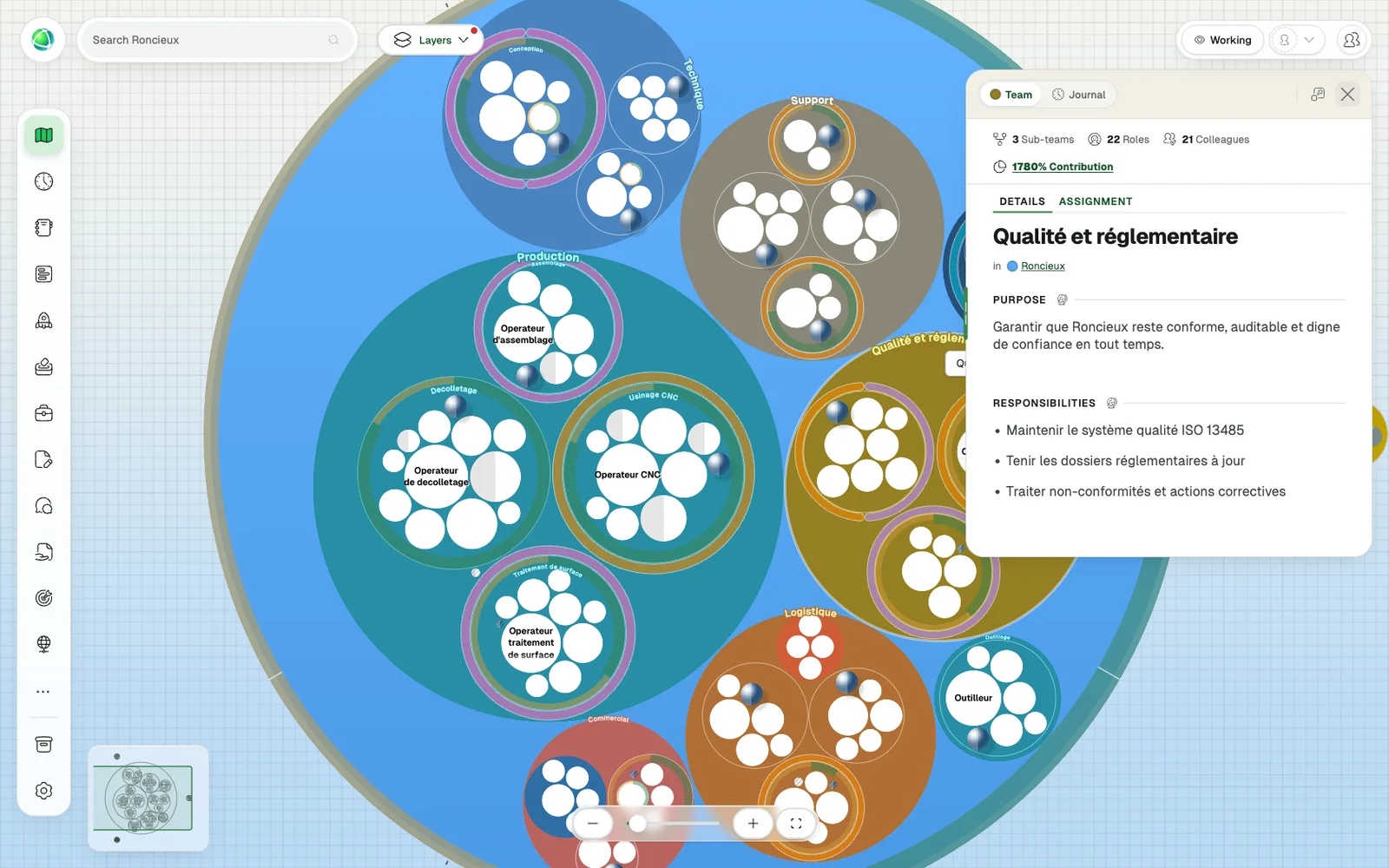
Agents appear on the organizational map alongside their human colleagues. Everyone can see the human-agent composition of any team. Visual distinction matters: in Peerdom, agents display with hexagonal shapes, while humans appear as circles. At a glance, you can see how many agents versus humans are in any team, which roles are held by agents, and where automation has been introduced.
The same role management principles apply. An agent can hold multiple roles. A role can have multiple holders, some human and some AI. Vacant agent roles are visible, just as vacant human roles are. If an agent role is unfilled, that gap is visible on the map, signaling a need that the team can address.
Example: A Map Upkeeper agent role in the Operations circle
- Purpose: Maintain organizational map hygiene
- Accountabilities: Identify stale roles, flag inconsistencies, suggest structural improvements
- Domain: Can flag issues; cannot delete roles or change structure without human approval
- Holder: AI Agent (hexagonal avatar)
- Visible to: Everyone on the map
The role itself is unremarkable. It could be held by a person. The governance is identical either way.
Governance Principles for Hybrid Teams
The same governance that works for human teams extends to hybrid human-agent teams. The principles do not change. They apply more broadly.
Roles define scope
An agent’s role defines what it can do, just like a human’s role does. No role means no authority to act. The principle is not new; it applies to a new category of role holder.
Circles provide structure
Agents belong to teams (sometimes called circles, squads, tribes, or units depending on your organizational model, whether you follow sociocracy, the Spotify model, or Beta Codex). They are not floating entities with organization-wide access. They have a home in the structure, bounded by the team’s domain and purpose.
Elections track assignments
Agent role assignments can be tracked with the same term-based election process used for human roles. When was this agent assigned? When should it be reviewed? When does its mandate expire? This ensures regular review and prevents role drift.
Contribution tracks capacity
Just as human contribution is tracked (how much of a person’s capacity goes to each role), agent contribution can be tracked similarly. This makes capacity planning possible across hybrid teams.
Conflict resolution is structural
When conflicts arise between role holders, the solution is the same regardless of who or what the role holders are: split the role. Divide it into distinct roles with clear, non-overlapping boundaries. This principle applies equally to human-human conflicts, agent-agent conflicts, and human-agent conflicts. The organizational governance process already knows how to do this.
Practical Scenarios
Abstract principles become concrete through examples. Here are four scenarios of AI agents functioning as governed role holders.
1. The Map Upkeeper Agent
An AI agent holds the Map Upkeeper role in the Operations circle. It scans the organizational structure on a regular cadence, identifies roles that have not been updated in months, flags inconsistencies (a role marked as filled by someone who has left), and suggests structural improvements. Humans review and approve every change. The agent surfaces issues; it does not resolve them unilaterally.
This is a role that exists in many organizations today, usually as an informal responsibility nobody owns. Making it explicit and assigning it to an agent means it actually gets done.
2. Import and Sync Agents
Instead of manual CSV imports that someone performs once a quarter (if at all), an agent handles continuous synchronization between HR systems and the organizational map. New hires appear. Departures are reflected. Structural changes flow through automatically. The agent holds a defined integration role with clear scope: pull data from specified sources, apply mapping rules, flag conflicts for human review.
3. Feedback Analyst Agent
An agent holds the Feedback Analyst role, reviewing anonymized feedback patterns across teams. It surfaces trends, such as increasing role confusion within a circle or declining clarity around decision rights in a specific area, without accessing individual feedback content. Humans decide what to act on. The agent’s role is analytical, not decisional. Its domain is pattern detection; intervention remains with people.
4. Onboarding Navigator
An agent helps new employees orient themselves within the organization. Based on the new hire’s roles and team assignments, it queries the organizational map and provides personalized context: “Here are the people you will work with most closely, the goals in your area, and the projects you will be contributing to.” The agent does not make decisions about the new hire’s responsibilities. It makes the existing structure legible and navigable, reducing the weeks of informal discovery that onboarding typically requires.
The API Approach
For organizations ready to integrate AI agents with their organizational structure programmatically, an API-based approach ensures governance is systematic, not ad hoc.
Authentication as role holders. Agents authenticate with the same permission model as humans. An agent holding the Data Import role has access to what that role grants, nothing more.
Context injection. When an agent activates, it receives organizational context through the API: “You are holding the Data Import Specialist role in the Operations circle. Your collaborators are [names]. Current goals in your area: [goals].”
Scoped actions. Agent actions are constrained by role capabilities. An agent in the Operations circle cannot modify the Marketing circle’s structure. This is enforced at the API level, not through trust or convention.
Audit trail. Every agent action is logged: who (which agent) did what, when, in which role. Full traceability.
Model-agnostic. The organizational layer works with any AI runtime: OpenAI, Anthropic, open-source models, or whatever comes next. Peerdom’s API and MCP integration provides organizational context as infrastructure, not a model dependency. Switching AI providers does not require rebuilding your governance layer.
What This Means for Your Organization
You do not need to restructure everything tomorrow. The transition to a hybrid human-agent workforce is incremental, and it builds on foundations that already serve your human teams well. Here are the principles to follow.
1. Start with your existing structure
AI governance works because role-based governance already works. Whether your organization follows holacracy, sociocracy, a Buurtzorg-inspired self-managed model, or a traditional hierarchy, if you already use roles and circles, adding agents is an extension of what you have, not a revolution. If you do not yet have role-based governance, that is the first step, and it benefits your human team regardless of whether you ever introduce AI agents.
2. Add agents incrementally
Start with one agent role in one team. Observe how it interacts with the existing structure. Adjust scope and boundaries based on what you learn. Then expand. The organizations that succeed with AI agents are the ones that treat adoption as an iterative process, not a big-bang deployment.
3. Keep governance unified
Do not create separate rules for agents. The whole point of role-based governance in a hybrid context is that one system works for everyone. Separate governance for agents and humans creates exactly the kind of fragmentation that role-based governance was designed to eliminate.
4. Make it visible
If an agent is doing work in your organization, everyone should be able to see it on the map. Invisible agents create invisible problems. Visibility is not optional. It is the mechanism that makes hybrid teams governable.
5. Review regularly
Agent roles need the same review cadence as human roles. Is the scope still appropriate? Is the agent effective? Should the role be expanded, narrowed, or retired? Organizations that treat agent roles as permanent fixtures will accumulate structural debt. The self-management software guide covers how to build this review into your governance rhythm.
Frequently Asked Questions
Can AI agents really hold organizational roles?
Yes. If a role is defined by its purpose, accountabilities, and scope of authority rather than by the biological nature of its holder, then any entity that can fulfill those accountabilities can hold it. The role definition remains the same. Only the holder changes. This is already how role-based organizations work: the role exists independently of who fills it.
How do you prevent AI agents from overstepping their boundaries?
The same way you prevent humans from overstepping: explicit role boundaries, defined domains of authority, and permission-based access. An agent can only act within the scope its role grants. Actions outside that scope require escalation to a human. The organizational structure encodes these boundaries, and the API enforces them.
What happens when an AI agent makes a mistake?
The same thing that happens when a human makes a mistake in their role: review, correct, and adjust. The audit trail shows what the agent did and when. If the mistake stems from a structural problem (the role’s scope was defined too broadly), fix the role definition. If the mistake is behavioral (the agent acted incorrectly within its defined scope), fix the agent’s configuration. The governance process is the same either way.
Do you need to change your org structure to add AI agents?
No. If you already have a role-based structure, adding agents means adding holders to existing or new roles. The structure itself does not need to change. If you do not yet have role-based governance, adopting it is the first step, and it delivers immediate value for your human team, with or without AI agents.
How is this different from just using ChatGPT?
ChatGPT is a tool with no organizational context. It does not know your roles, your team structure, or your decision boundaries. An agent holding a role in your organization has all of that context. It knows what it is responsible for, who it works with, and what it can decide. The difference is not the underlying AI model. It is the organizational layer that gives the model situational awareness.
What is an organizational intelligence layer?
A shared, authoritative representation of how your organization works: who does what, in which team, with what authority, toward which goals, and with what dependencies. Both humans and AI agents consult this layer to understand the organization before acting. Think of it as a navigation system for your organization: not the territory itself, but the map everyone uses to find their way. Peerdom provides this layer through its platform and API.
Can agents participate in governance meetings?
Not in the traditional sense of sitting in a meeting and contributing to discussion. But agents can be subject to governance: their roles can be created, modified, and retired through the same governance process as human roles. Certain agents, like the Map Upkeeper described above, can be authorized to suggest structural changes, subject to human approval. The governance process governs agents. Agents do not govern the process.
How do you track AI agent costs?
Agent operational costs (API calls, compute resources) can be attributed to the roles they hold. Just as human compensation is linked to roles and contribution levels, agent costs can be tracked per role. This allows organizations to understand the cost of automation at the role level, compare it with the cost of human fulfillment, and make informed decisions about where automation creates genuine value.
Explore the future of organizational governance
- Start mapping your organization for free: the foundation for human-agent governance is a clear, role-based structure.
- Try the AI-native template: see what an AI-native organization looks like in practice.
- Have questions about hybrid workforce governance? Book a demo and let’s discuss your use case.
Keep reading
insights
From circles and roles to elections and double-linking. A practitioner's guide to implementing holacracy and sociocracy with the right tools.
integrations & tools
Still managing your org chart in Excel or Google Sheets? Compare spreadsheet-based org management with a purpose-built organizational mapping platform and see what you are missing.
insights
A step-by-step guide to moving from job-title hierarchies to explicit, role-based accountability, with practical advice for every stage of the transition.