A team gets together for a kickoff, walks through the steps and agrees on a date. The date slips. The post-mortem finds a specific, unusual reason, and the next plan is made exactly the same way. If you work in HR or advise organizations, you’ve seen it in budgets, hiring plans and reorganizations too.
Psychologists call this the planning fallacy: we underestimate how long our own work will take, even when we know that similar work ran late before. It has been studied for almost fifty years, and the research points to a fix that most organizations already have the data for.
What an eponymous law is
Some ideas about work are so recognizable that they carry the name of the person who first put them into words: Parkinson’s law, the Peter principle, Hofstadter’s law. They are called eponymous laws. The planning fallacy is a close cousin: it doesn’t carry a person’s name, but it was named by two very famous ones. Like the others, it isn’t a law of nature. It’s a sharp observation that keeps turning out to be true.
This article is part of a series on these laws of work, written for HR leads and the consultants who help organizations change. Each one stands on its own. For each, I look at what the original source says, what research found since, and what you can concretely do about it. As a co-founder of Peerdom, I also show how we handle it in the product, because most of these laws are the reason Peerdom exists.
Kahneman, Tversky and the inside view
In the late 1970s, the psychologists Daniel Kahneman and Amos Tversky described why expert forecasts go wrong so systematically (Kahneman & Tversky, 1979). When we predict our own project, we focus on the case in front of us: its steps, its people, how it will probably unfold. We neglect what they called distributional information: how long similar projects actually took. They named the result the planning fallacy.
Kahneman and Dan Lovallo later gave it the vocabulary that stuck: the inside view, where you imagine how this project will go, and the outside view, where you look at how projects like it went (Kahneman & Lovallo, 1993). The inside view feels more relevant. But a well-chosen outside view can correct an optimistic forecast, especially for long, complex undertakings, even if picking the right class of comparable projects takes judgment.
What the experiments show
The classic study asked students in their final semester how many more days they needed to hand in their honors thesis (Buehler, Griffin & Ross, 1994):
- Their best guess, on average: 33.9 days. The reality: 55.5 days. Only 29.7% finished by their own predicted date.
- Their worst case: “if everything went as poorly as it possibly could”: 48.6 days. Fewer than half finished even by that date.
- The twist: in another of their studies, people who predicted how long someone else would take were more conservative and used past experience more. But they weren’t more accurate: where the planners underestimated, the observers overestimated.
Later studies added what matters most for organizations:
- Discussing the plan as a group can make it worse. In these experiments, group discussion made forecasts more optimistic than individual ones (Buehler, Messervey & Griffin, 2005). The authors are careful: their groups had no shared project history, and real teams may behave differently. Still, it’s a fair warning for kickoff workshops.
- Rewards for finishing early can increase optimism. In a field study of tax returns, people expecting a refund showed a stronger optimistic bias in predicting when they would file than people not expecting one. In a lab experiment, a monetary reward for finishing early made forecasts more optimistic, not more accurate (Buehler, Griffin & MacDonald, 1997).
- Breaking the work down can help. For tasks with many parts, listing the sub-steps lengthened estimates and, in some of the experiments, reduced the optimistic bias (Kruger & Evans, 2004).
- Large projects show a related pattern. In transportation infrastructure, Flyvbjerg and colleagues found that costs were systematically underestimated, and argued that the best explanation was a second cause besides optimism: forecasts made optimistic on purpose, to win approval (Flyvbjerg, Holm & Buhl, 2002). That interpretation is disputed (see below). The remedy Bent Flyvbjerg developed, reference-class forecasting, is now used in public planning: start from the outcomes of a class of comparable projects, then adjust (Flyvbjerg, 2008).
Is it real? Where the evidence is contested
The planning fallacy is well documented, but its size, direction and causes depend on the setting, and that’s worth knowing before you quote numbers in a board meeting:
- It’s not universal. A large review of time predictions found underestimation reported more often in engineering and management studies, but not in psychology studies. It also warns that the apparent pattern of small tasks being overestimated and large ones underestimated can be an artifact of random error (Halkjelsvik & Jørgensen, 2012).
- The “error or lie” framing is disputed. Critics argue that the evidence for deliberate misrepresentation in infrastructure projects is methodologically weak (Love & Ahiaga-Dagbui, 2018).
- Less biased isn’t the same as accurate. Remedies like breaking down the task can reduce the optimistic tilt in some conditions, but they don’t make individual forecasts precise.
Hours of work are not a date
One distinction runs through all of this research and is often missed: effort is not elapsed time. “Ten days of work” doesn’t mean “done in two weeks” if the people doing it spend a third of their time on it. Even an accurate effort estimate gives an unrealistic date if nobody asks how much time the people involved actually have, what else they’re working on, and who they’re waiting for. To me, this is the most practical idea in the whole literature, because it’s the one you can check on Monday morning. Keep it in mind; it comes back in the fix below.
Where it bites: six-week releases that take nine
Picture Geneva AI Commons, a non-profit that does open AI research, shares datasets and advises on policy for the public good, with program hubs in Lagos, Nairobi, Jakarta and Dhaka. Its Open Research group publishes ten to twelve open datasets and benchmarks a year, many of them built with the hubs: speech corpora, translation sets, evaluation benchmarks.
- The plan: each release team holds a kickoff workshop and commits to “six weeks from kickoff to release”.
- The reality: releases slip by two to three weeks. The partnerships team ends up apologizing to funders, and the universities waiting for the data start planning without it.
- The excuse: every post-mortem blames something specific and unusual: this time the ethics review was slow, this time a hub’s data arrived late. That is exactly the pattern Buehler and his colleagues found: past delays get explained away as one-offs, so they never inform the next plan.
The organization isn’t missing information. It has published dozens of releases. Its honest answer, “about nine weeks”, is sitting in its own history. It just never makes it into the kickoff workshop.
Planning from your own track record in Peerdom
When we started Peerdom out of our own reorganization at Nothing in 2017, we wanted an organization to be able to see itself as it actually works, not as it hopes it works. Here is how Geneva AI Commons brings its own outside view into every plan.
1. Build your reference class from your own history
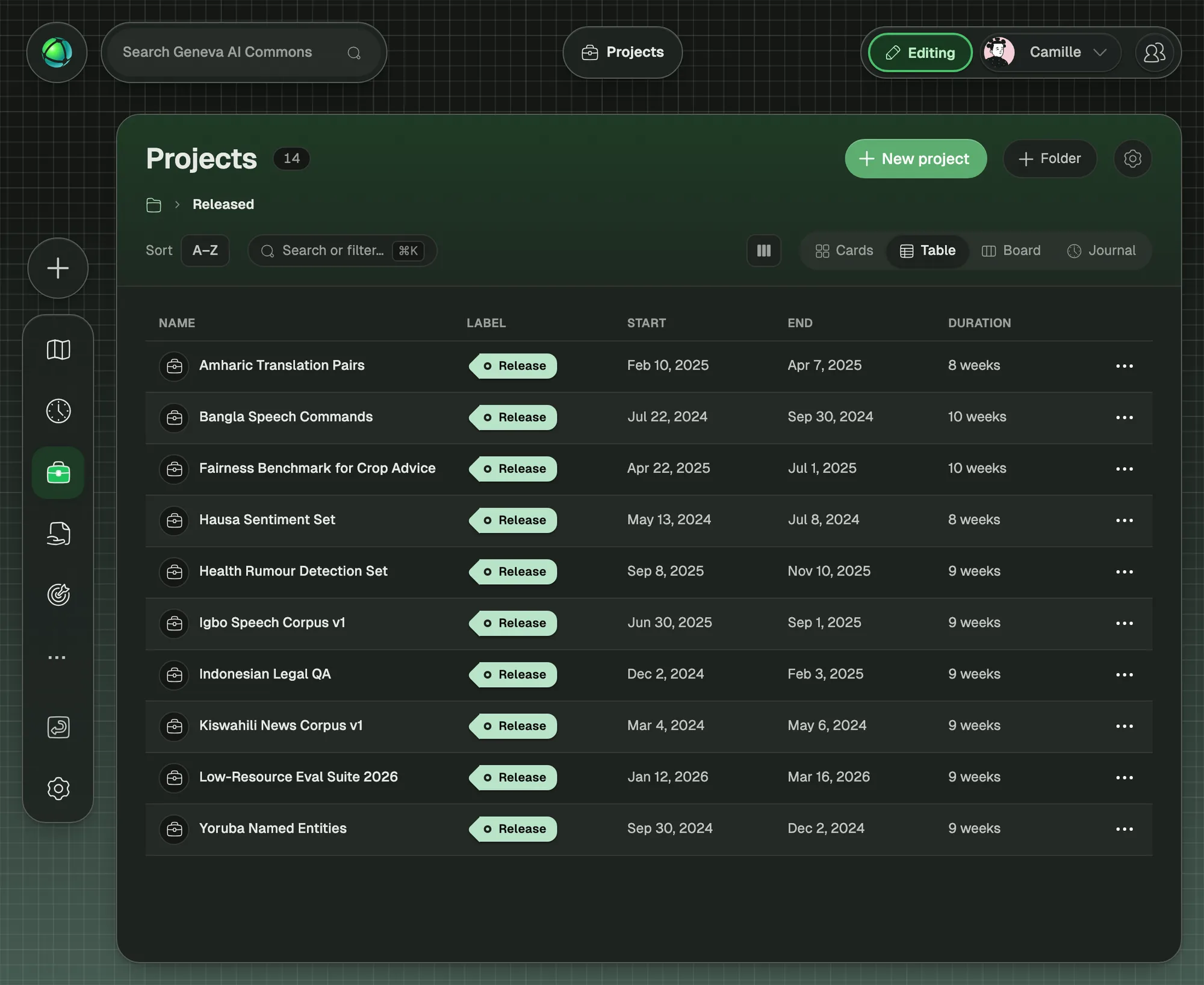
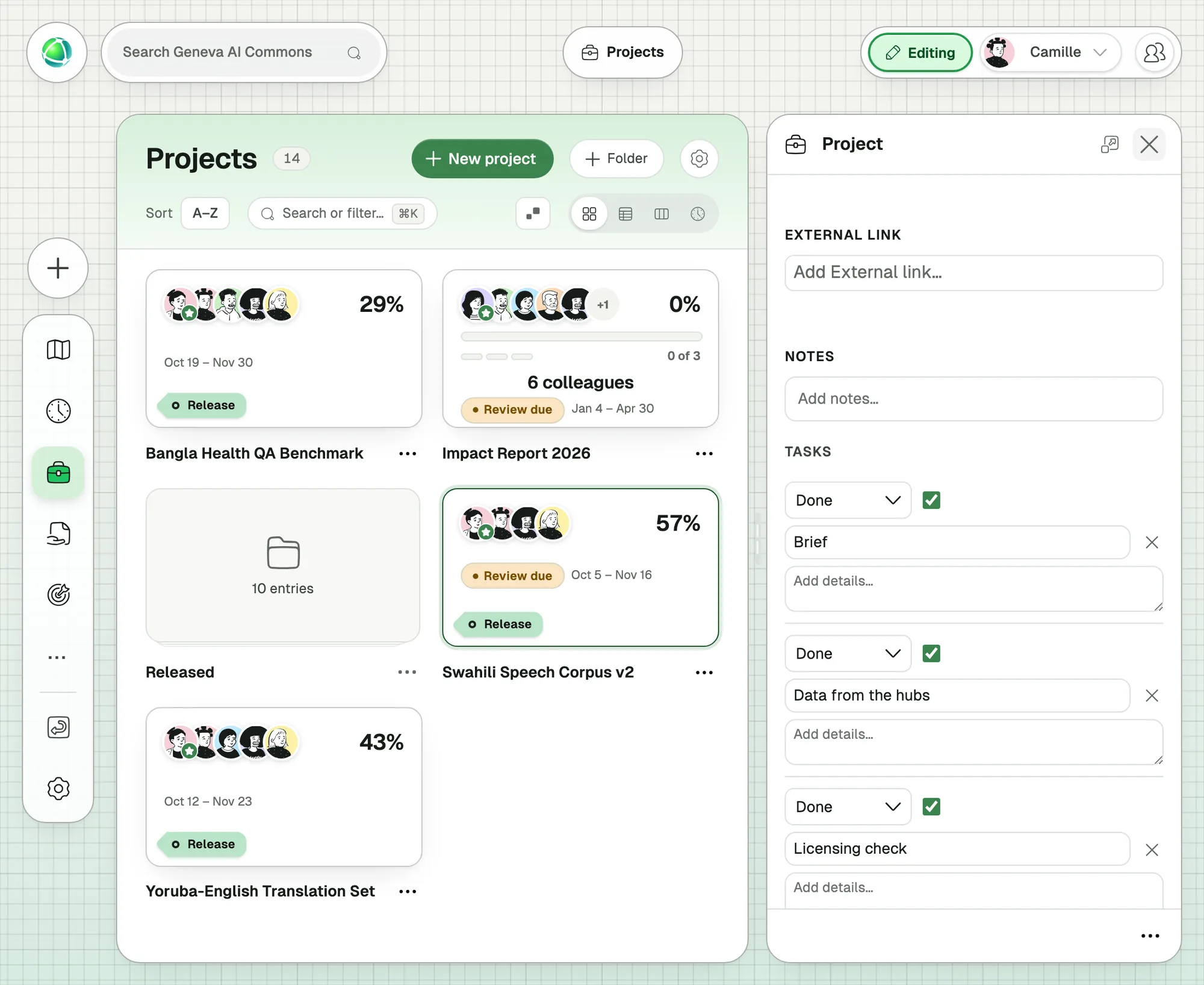
Make every release a project with the same label, “Release”, and its real start and end dates. When a release is out, don’t archive it: move it to a folder called “Released”, so the whole history sits in one place in the Projects app. In the Table view, each release shows its start, end and duration side by side, and the last ten tell you what the kickoff workshop doesn’t want to hear: the typical release takes nine weeks, not six.
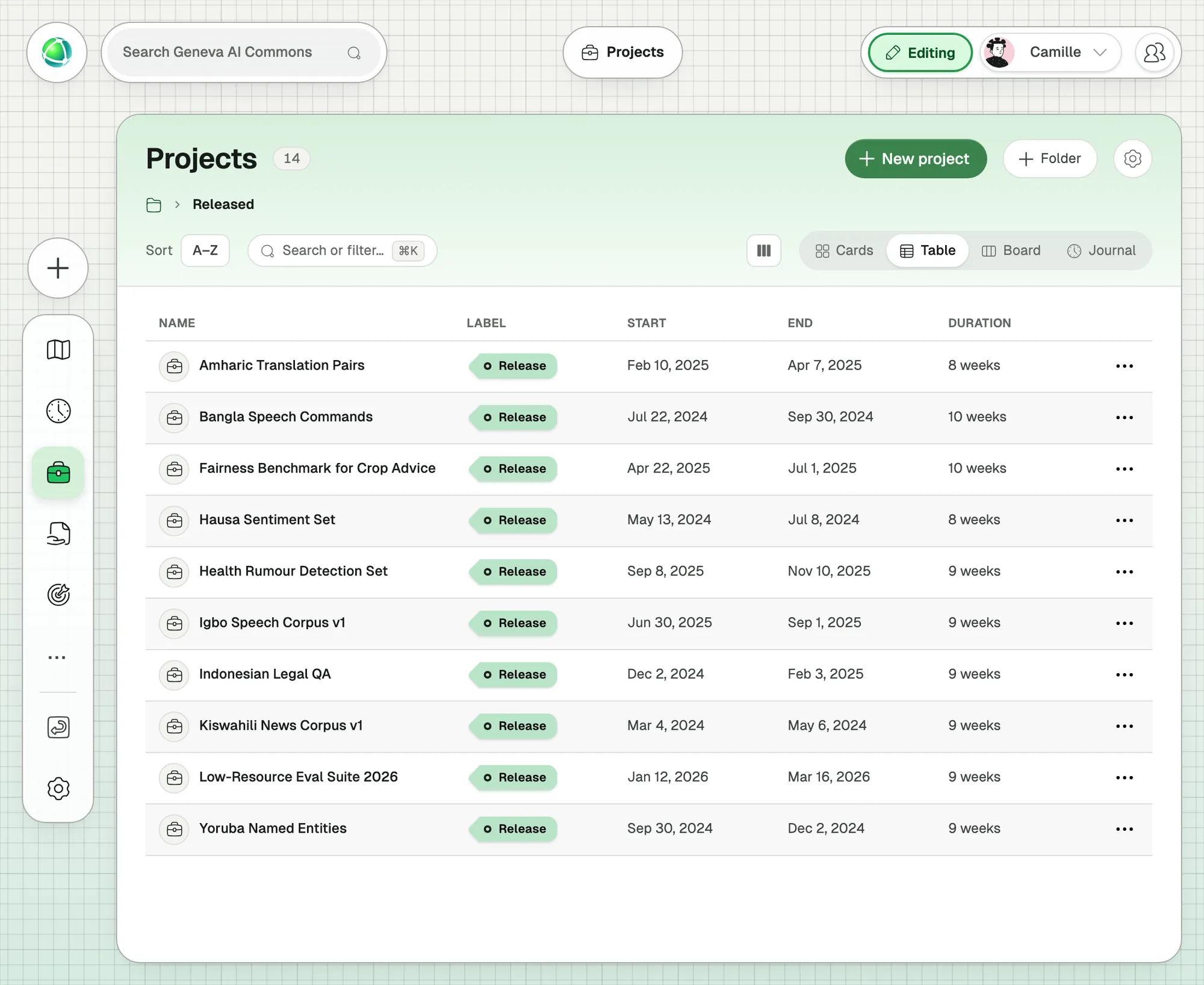
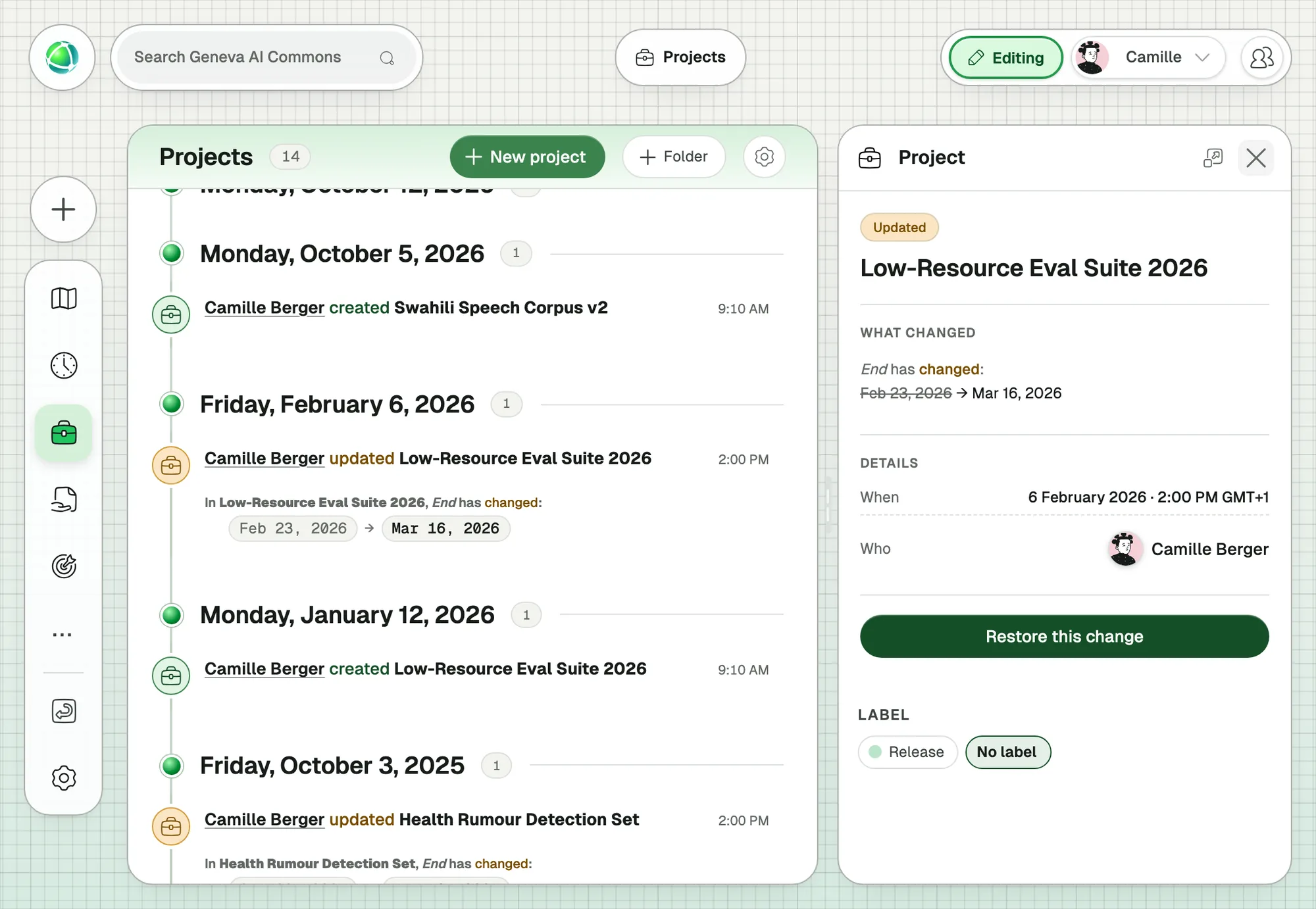
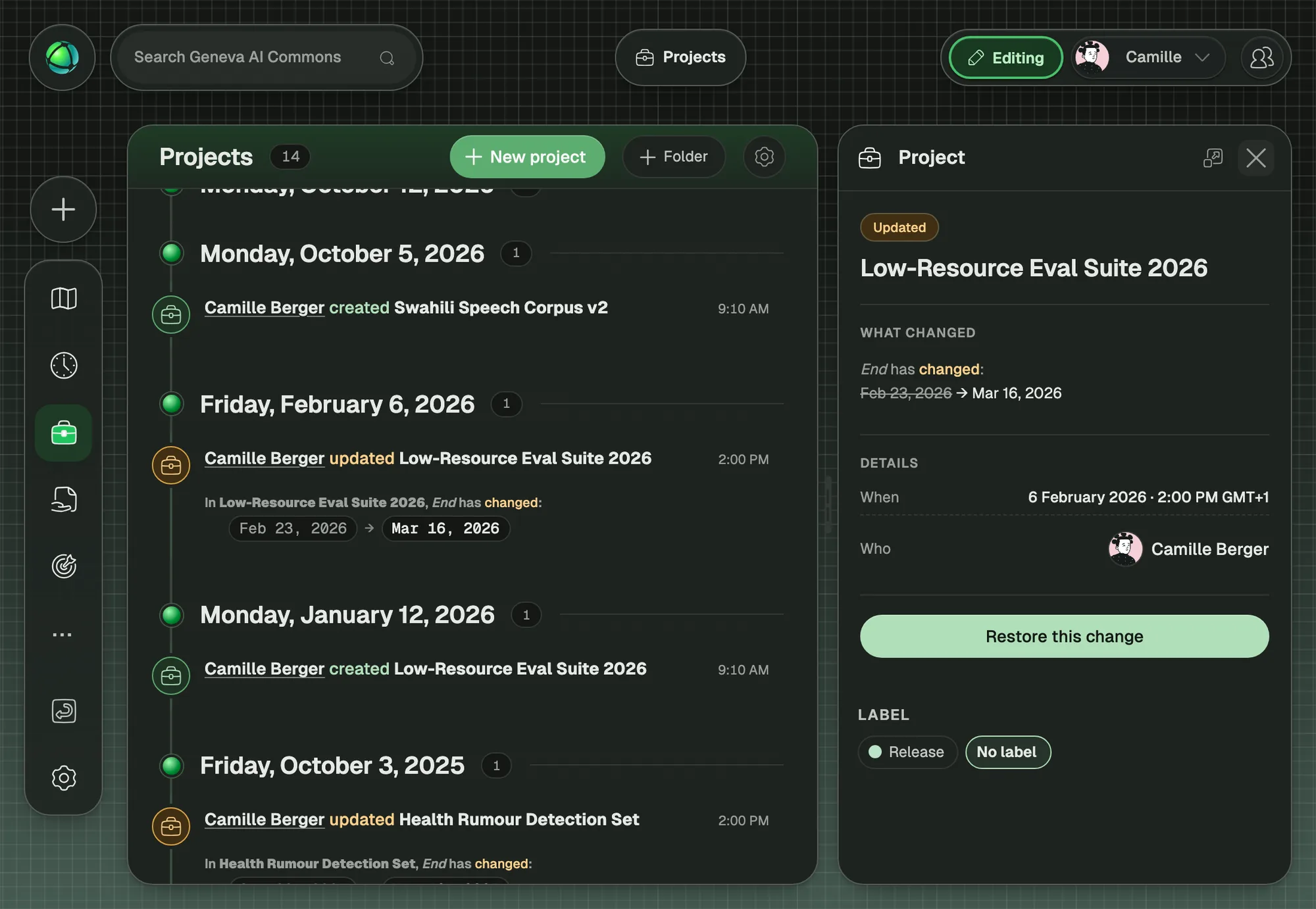
Each release also keeps the end date the team promised at kickoff. Its journal records every time a date moved, before and after, so the six-week promise stays on record next to the nine weeks it took.
2. Record the first forecast next to the outside view
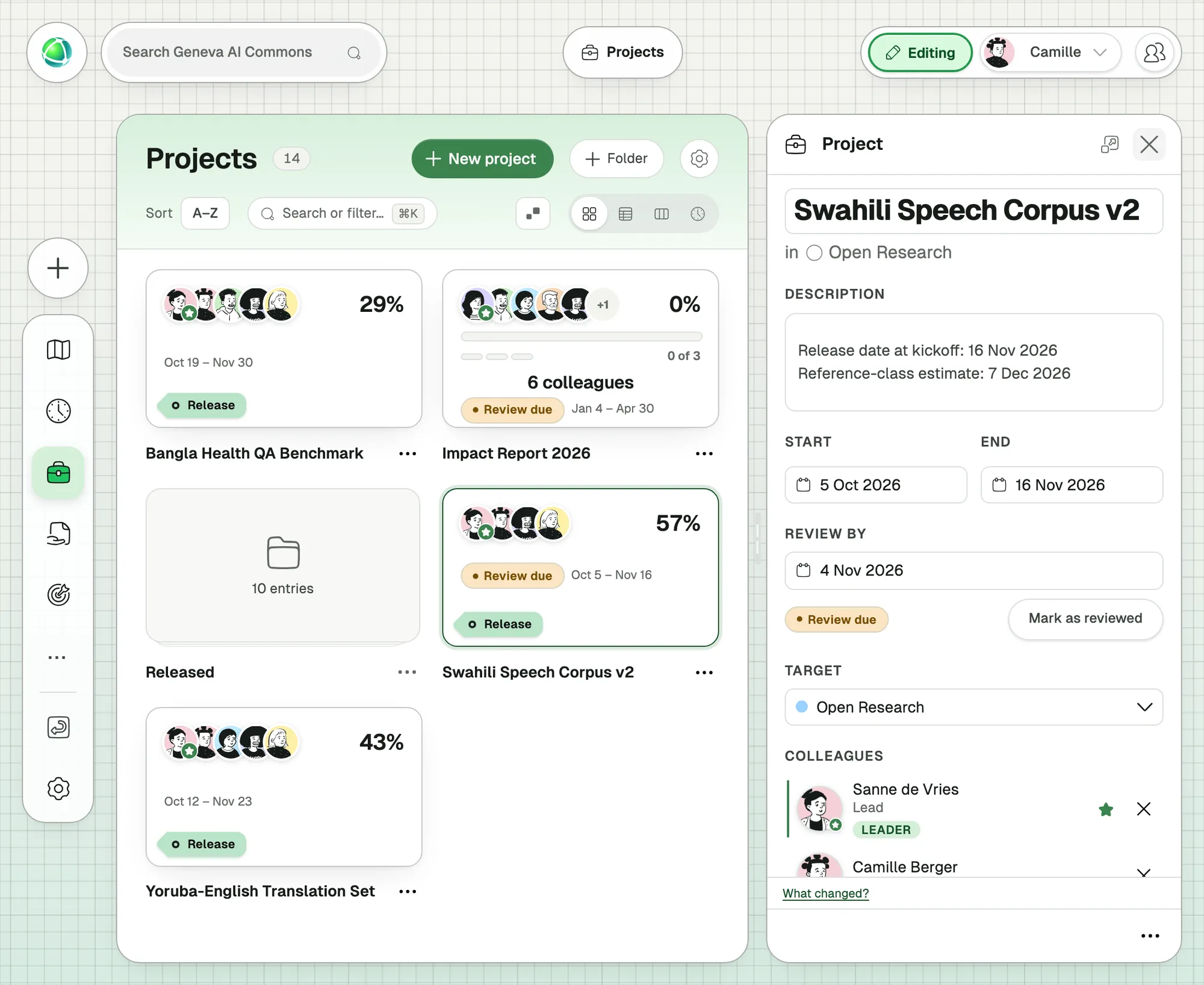
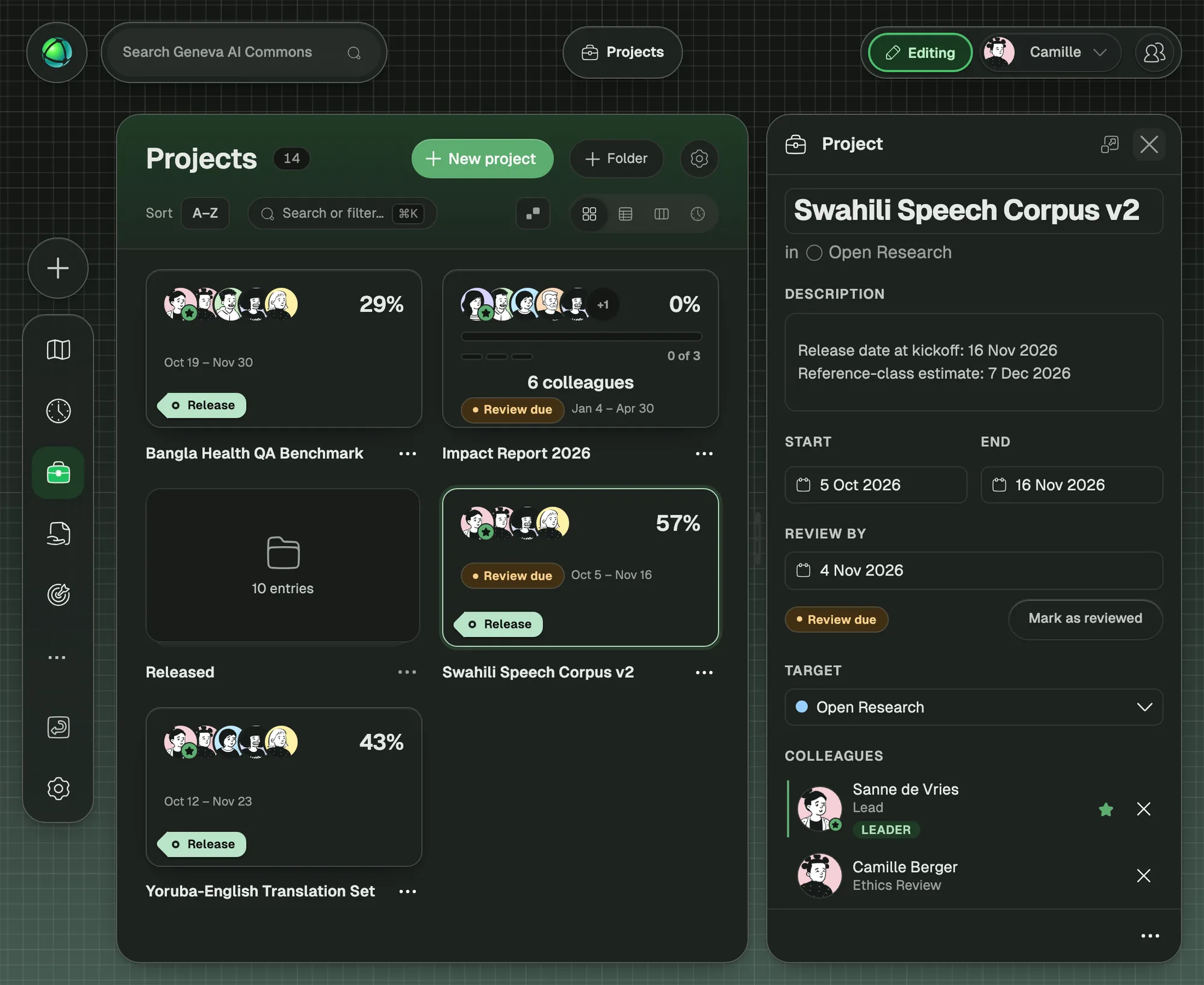
The journal keeps the history, but you don’t want to dig for it. Start every release’s description with two lines: “Release date at kickoff” and “Reference-class estimate”. Now the team’s plan and the track record sit side by side on every release, and if someone edits either line later, the journal shows the change, before and after. After a year, the organization has its own accuracy record, which is more convincing than any study.
3. Break the plan down
List every step as a task of the project: brief, data from the hubs, licensing check, ethics review, datasheet, reproducibility check, release. Mark each one done as it finishes, and the project shows how far it is: 57% for “Swahili Speech Corpus v2”, with four of seven tasks done. In the experiments, unpacking a task with many parts made estimates longer and less optimistic; I think it’s worth doing here for that reason, and because it shows where the time really goes.
4. Turn effort into calendar time
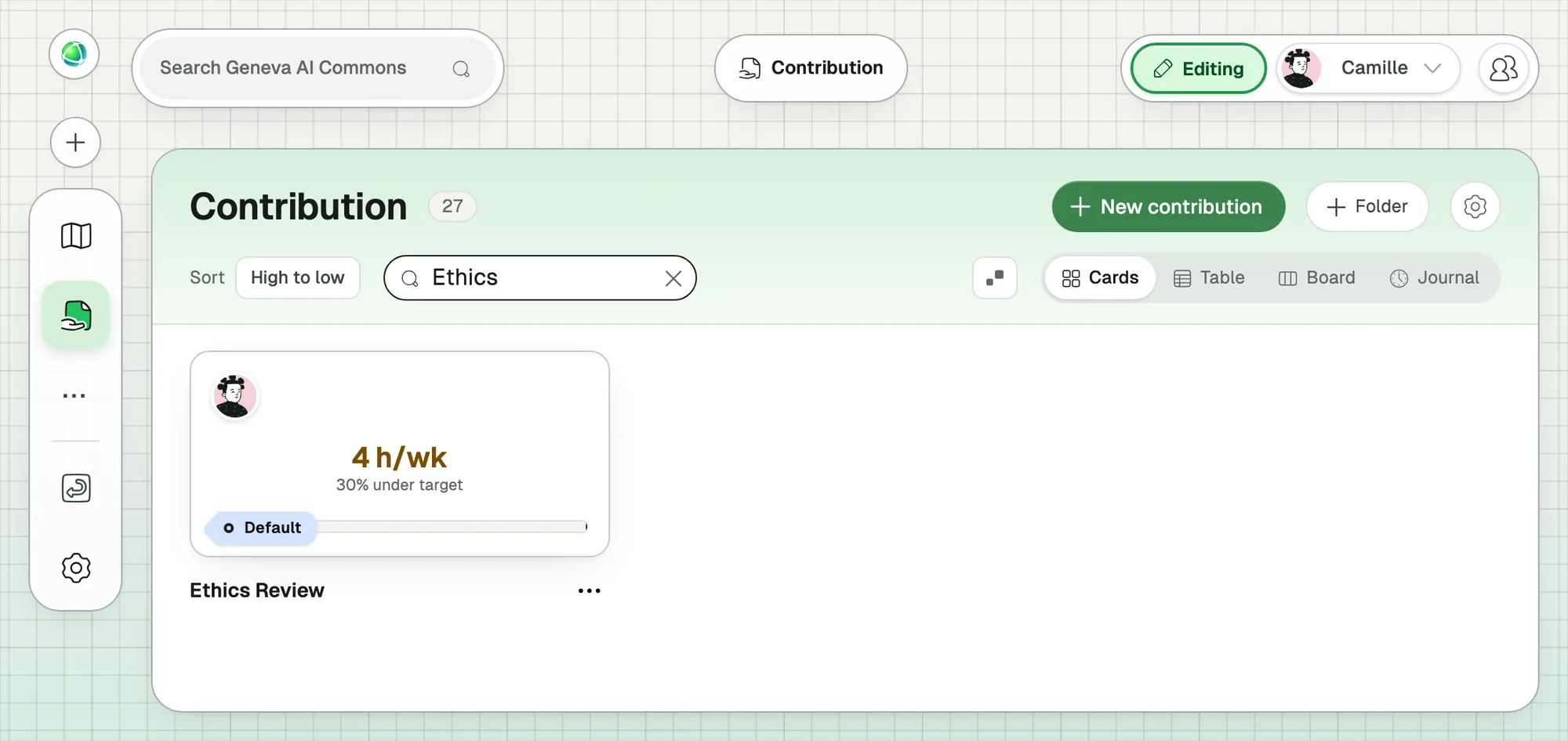
Check the contribution of the roles involved, in hours per week. The Ethics Review role in Policy & Governance was meant to have 0.4 of a full-time position. But Camille Berger, who holds it, also leads the group and is the UN liaison, and only four hours a week are actually given to Ethics Review, while three releases run at once. Its card in the Contribution app shows amber: 30% under target. That’s not a two-day step, it’s a queue, and in this example the queue explains most of the delay.
5. Give the outside view an owner
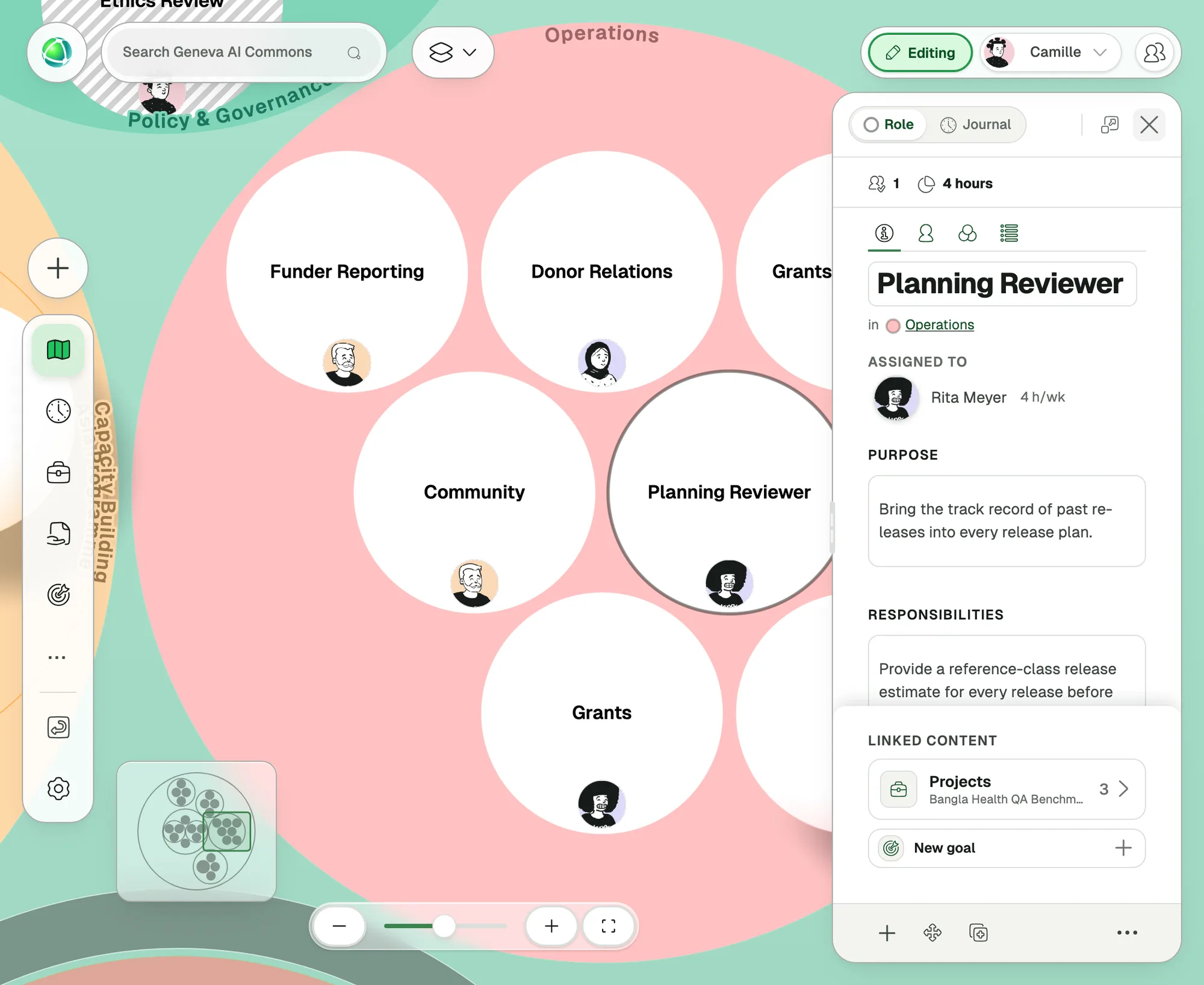
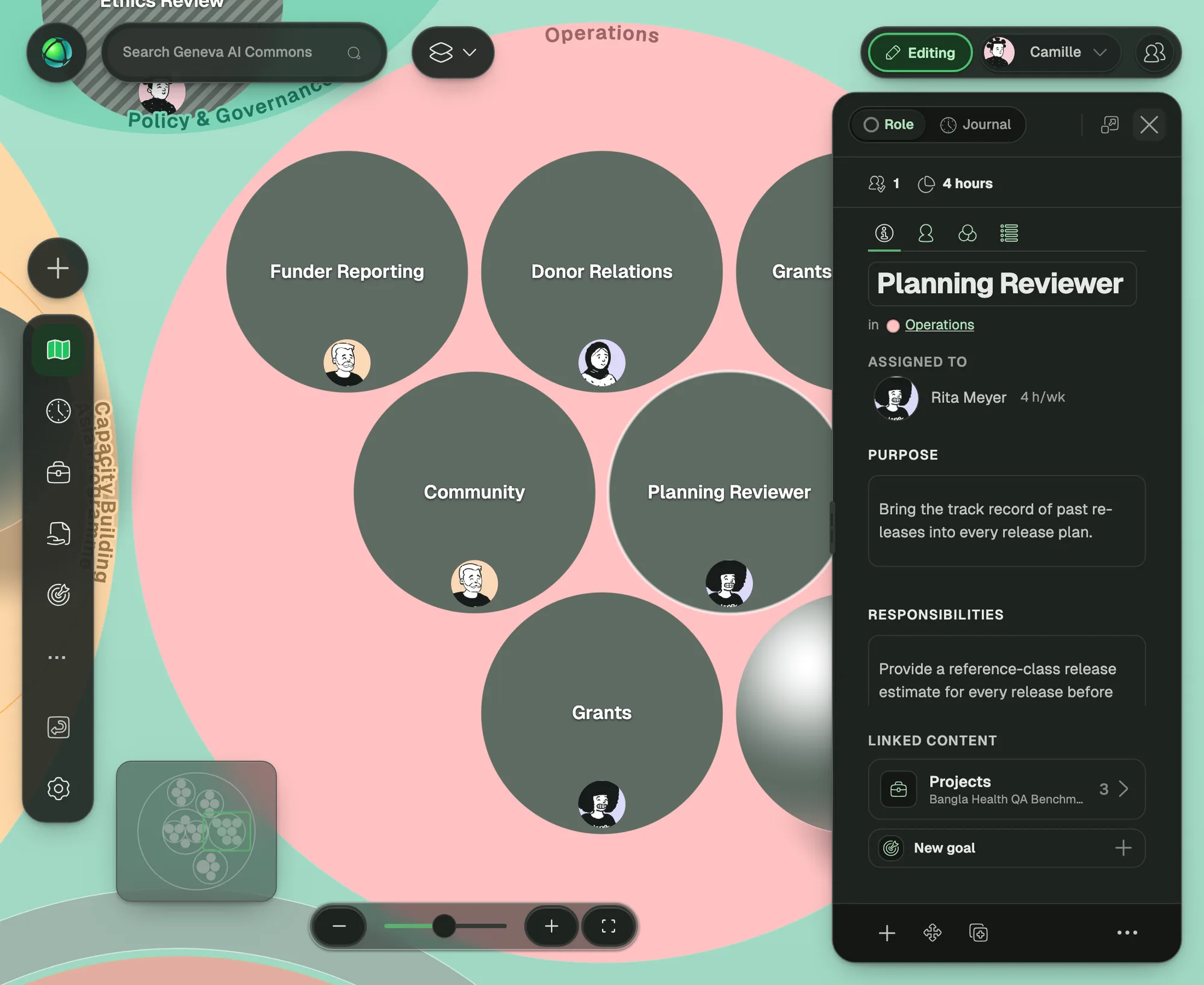
Outsiders lean on past experience more than the people doing the work, and an estimate made alone isn’t pulled along by the room. Neither makes a forecast accurate on its own, but together they make a useful counterweight to the kickoff workshop. So create a role, Planning Reviewer, outside the research team, for example in Operations, held by Rita Meyer. Give it the responsibility “Provide a reference-class release estimate for every release before kickoff, independently of the release team”. Add the role to every release project. And give each release a Review by date halfway through: in the week before, an amber “Review due” chip appears, and the project’s leader gets a weekly reminder email to hold the plan against the outside view once more. The outside view now has a person who brings it into the room, every time.
What this means for HR leads and consultants
If you lead HR, the planning fallacy shapes your own work as much as anyone’s:
- Hiring, onboarding and reorganizations are projects too. How long did your last three hires really take, from approval to first day? Plan the next one from that, not from the ideal process.
- Ask for individual estimates before the workshop. Collect them independently first, then discuss. In experiments, group discussion made plans more optimistic, not more realistic, and independent estimates keep that from setting the starting point.
- Make capacity part of the plan. A plan that doesn’t say how much time the key people have isn’t a plan, it’s a wish.
If you advise organizations, the planning fallacy gives you an easy, evidence-based intervention:
- Build a reference class together with the client. Take ten recent projects of the same kind and put their planned and actual durations side by side. Seeing the gap on one page gives the next plan something concrete to be challenged with.
- Install an independent reviewer. Someone outside the project team who brings the outside view into every kickoff.
- Separate effort from elapsed time. Ask how much time the key people actually have before you turn days of work into a date.
What Peerdom doesn’t do for you
Peerdom keeps your organization’s track record visible. It doesn’t do the forecasting for you:
- Peerdom shows each project’s duration, not the statistics. It doesn’t compute a median or a range across past projects; that reference-class arithmetic happens by eye or in a spreadsheet.
- There’s no blind estimation poll. Goal confidence votes are the closest built-in signal: they show the spread of High, Medium and Low, never who voted what. But they’re qualitative, not a date.
- A reference class needs discipline. It only helps if past projects were labeled and dated consistently. That habit comes first.
- It doesn’t fix deliberate optimism. If a date is chosen to win approval, no tool will correct it. That’s a governance question.
In short
The planning fallacy can persist even when relevant historical information is available. An organization with a record of comparable projects already has an honest answer to how long things take. The trouble is that the history easily stays out of the plan, because the plan is made from the inside, often in a group, by the people with the most to gain from an early date. Bring the outside view in, give it an owner, and plan in calendar time instead of effort.
The planning fallacy has close relatives in this series: Hofstadter’s law, about why correcting the estimate from the inside still falls short; student syndrome, about why even a right estimate gets missed when the work starts late; and Parkinson’s law, a warning in the other direction, about work that expands into generous estimates. Each stands on its own, and each starts from the same question: what does the work actually need?
Sources
- Kahneman, D., & Tversky, A. (1979). Intuitive prediction: Biases and corrective procedures. TIMS Studies in Management Science, 12, 313–327. Reprinted in Kahneman, D., Slovic, P., & Tversky, A. (Eds.) (1982), Judgment under Uncertainty: Heuristics and Biases, Cambridge University Press.
- Kahneman, D., & Lovallo, D. (1993). Timid choices and bold forecasts: A cognitive perspective on risk taking. Management Science, 39(1), 17–31. doi:10.1287/mnsc.39.1.17
- Buehler, R., Griffin, D., & Ross, M. (1994). Exploring the “planning fallacy”: Why people underestimate their task completion times. Journal of Personality and Social Psychology, 67(3), 366–381. doi:10.1037/0022-3514.67.3.366
- Buehler, R., Griffin, D., & MacDonald, H. (1997). The role of motivated reasoning in optimistic time predictions. Personality and Social Psychology Bulletin, 23(3), 238–247. doi:10.1177/0146167297233003
- Flyvbjerg, B., Holm, M. S., & Buhl, S. (2002). Underestimating costs in public works projects: Error or lie? Journal of the American Planning Association, 68(3), 279–295. doi:10.1080/01944360208976273
- Kruger, J., & Evans, M. (2004). If you don’t want to be late, enumerate: Unpacking reduces the planning fallacy. Journal of Experimental Social Psychology, 40(5), 586–598. doi:10.1016/j.jesp.2003.11.001
- Buehler, R., Messervey, D., & Griffin, D. (2005). Collaborative planning and prediction: Does group discussion affect optimistic biases in time estimation? Organizational Behavior and Human Decision Processes, 97(1), 47–63. doi:10.1016/j.obhdp.2005.02.004
- Flyvbjerg, B. (2008). Curbing optimism bias and strategic misrepresentation in planning: Reference class forecasting in practice. European Planning Studies, 16(1), 3–21. doi:10.1080/09654310701747936
- Halkjelsvik, T., & Jørgensen, M. (2012). From origami to software development: A review of studies on judgment-based predictions of performance time. Psychological Bulletin, 138(2), 238–271. doi:10.1037/a0025996
- Love, P. E. D., & Ahiaga-Dagbui, D. D. (2018). Debunking fake news in a post-truth era: The plausible untruths of cost underestimation in transport infrastructure projects. Transportation Research Part A: Policy and Practice, 113, 357–368. doi:10.1016/j.tra.2018.04.019