Mission Based Teams: How Roche Organizes for Impact
Nathan Evans
Mission Based Teams let people self-organize around the problems that matter most. Roche runs over 1,100 of them across 89 countries, alongside their formal structure, not instead of it.
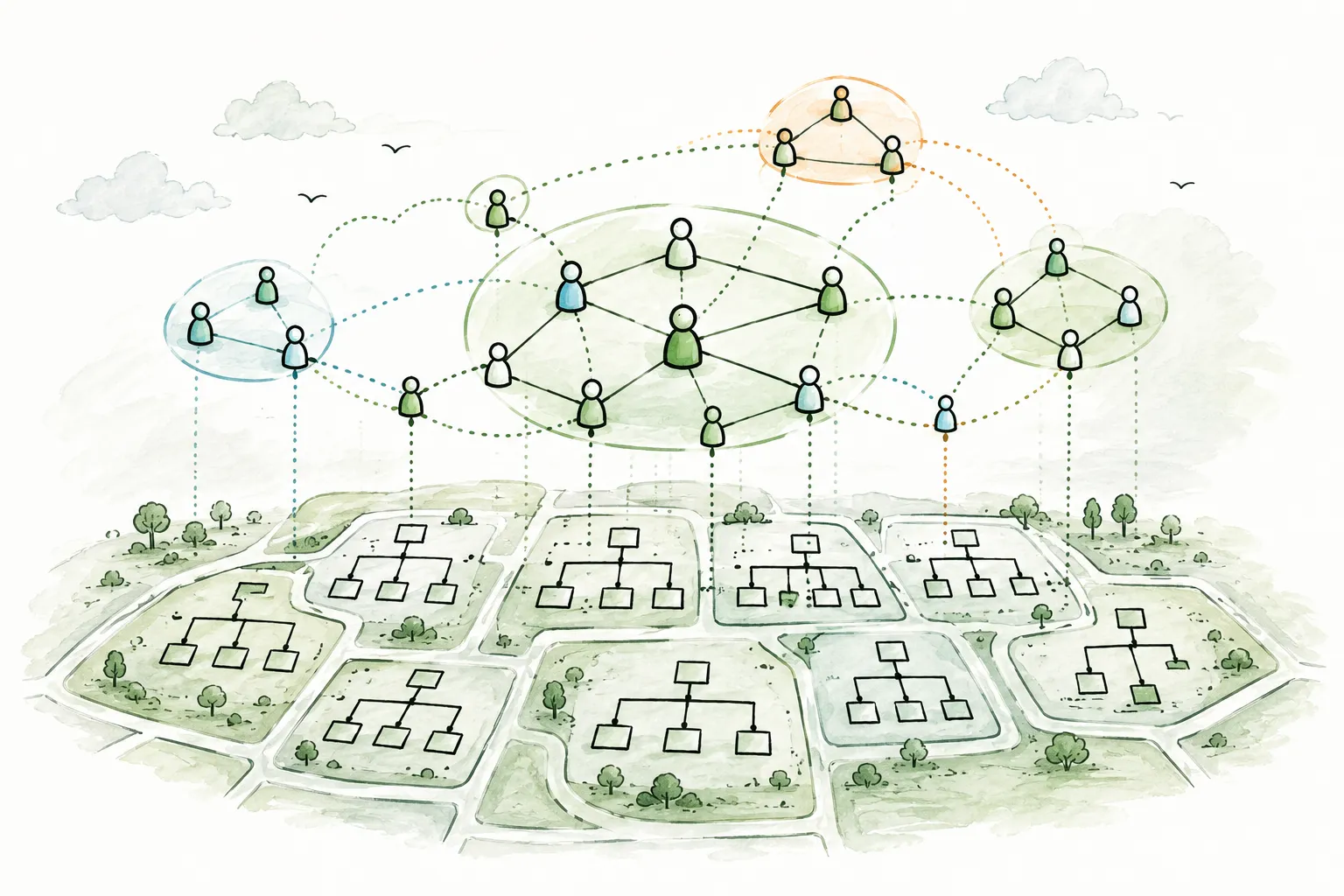
Most organizational structures optimize for control. Reporting lines, approval chains, departmental boundaries: these exist to ensure that decisions are predictable, resources are accounted for, and risk is managed. For a hundred years, this has been the default architecture of large organizations, and it works well enough for running the business as it is.
The problem is that running the business as it is and changing the business to meet new challenges are fundamentally different activities. The structure that keeps a 100,000-person pharmaceutical company compliant with regulations across 89 countries is not the same structure that enables a cross-functional team to solve a patient access problem that no single department owns. Hierarchies are built for stability. But the problems that matter most (innovation, cross-functional collaboration, rapid response to market shifts) cut across the very boundaries that hierarchies create.
Mission Based Teams are an emerging answer to this tension. They are self-organized groups that form around specific missions, drawing people from different departments, geographies, and skill sets. They operate alongside the formal organizational structure, not instead of it. And they are gaining traction in some of the world’s largest and most complex enterprises.
The most prominent example is Roche. The Swiss pharmaceutical and diagnostics company, founded in 1896, employing over 100,000 people, operating in more than 100 countries, runs over 1,100 Mission Based Teams across 89 countries. These teams work alongside Roche’s formal hierarchy, tackling problems that do not fit neatly into any single department’s mandate. Roche did not dismantle its org chart. It added a second operating system on top of it.
This guide explains what Mission Based Teams are, how they work, how Roche implements them at scale, and what any organization can learn from the model, whether you run a 50-person company or a 100,000-person multinational.
What Are Mission Based Teams?
A Mission Based Team (MBT) is a self-organized group of people who come together around a specific mission: a problem to solve, an opportunity to pursue, or an outcome to achieve. The concept is straightforward, but the implications are significant.
Self-organized. MBTs are not assembled by management. People opt in based on their passion for the mission and the expertise they can contribute. The team forms around the work, not the other way around.
Mission-driven. Each team has a clear mission statement, not a vague aspiration, but a specific problem or opportunity. “Reduce patient onboarding time for therapy X by 40%” is a mission. “Improve innovation” is not.
Cross-functional. MBTs cut across departmental boundaries. A team working on a patient access challenge might include people from medical affairs, regulatory, commercial, IT, and supply chain, people who would never sit in the same meeting in the formal hierarchy.
Voluntary. Participation is not assigned. People join because they care about the mission and believe they can contribute. This voluntary nature is not a soft perk; it is a structural feature. Voluntary teams attract motivated people. Mandated teams attract compliance.
Alongside the formal structure. This is the critical distinction. MBTs do not replace the org chart. They operate as an overlay, a second operating system that coexists with the formal hierarchy. People retain their departmental roles, reporting lines, and career paths. Their MBT work happens in addition to their formal responsibilities.
Outcome-oriented. MBTs are focused on impact, not activity. Success is measured by whether the mission is achieved, not by how many meetings were held or documents produced.
Temporally flexible. Some MBTs are time-bound; they dissolve when the mission is complete. Others are ongoing, maintaining a persistent focus on a long-term challenge. The key is that the team’s existence is tied to the mission’s relevance, not to organizational inertia.
As Jurriaan Kamer, organizational author and consultant who has written extensively about MBTs at Roche, Haier, and Bayer, describes the model: the basic idea is to create a place where anyone can publish missions. A mission is a statement about a problem or opportunity that, if tackled, would be valuable to the business. MBTs let people take ownership of what they care about and believe is good for business, without overhauling the organization’s structure.
The Dual Operating System
The idea that organizations need two operating systems (one for running the business, one for changing it) did not originate with Mission Based Teams. It comes from John Kotter, the Harvard Business School professor who introduced the concept in his 2012 Harvard Business Review article and his 2014 book “Accelerate.”
Kotter’s argument is that traditional hierarchies are effective at executing known processes but structurally incapable of driving the kind of strategic, cross-functional change that modern organizations need. His solution is not to replace the hierarchy; it is to supplement it with a network-like structure that operates in parallel.
The dual operating system has two components:
The hierarchy handles what it does well: day-to-day operations, compliance, career paths, resource allocation, legal and regulatory requirements, performance management, and the stable, repeatable processes that keep the business running.
The network handles what the hierarchy cannot: identifying strategic threats and opportunities, mobilizing cross-functional responses, driving innovation, and executing change initiatives that cut across departmental boundaries.
Mission Based Teams are one concrete implementation of this network side. They provide the mechanism through which people self-organize around strategic problems without dismantling the formal structure that runs the core business.
Why not just restructure?
The pragmatic appeal of the dual operating system is that it does not require an organizational redesign. Restructuring a large enterprise is slow, disruptive, and risky. It takes years, consumes enormous management attention, and often fails to deliver the promised benefits because the new structure creates new silos to replace the old ones.
MBTs offer a different path. Instead of redrawing the org chart, you create a parallel mechanism for cross-functional work. The formal structure continues to handle compliance, career progression, resource allocation, and operational execution. The MBTs handle the problems that do not fit into any single box on that chart.
This is particularly relevant for organizations in regulated industries (healthcare, finance, government, energy) where the formal structure exists for legal and regulatory reasons that cannot be wished away. A pharmaceutical company cannot eliminate its regulatory affairs department in the name of agility. But it can create Mission Based Teams that draw from regulatory affairs, medical, commercial, and supply chain to solve cross-functional problems faster than the hierarchy alone would allow.
The interface challenge
The dual operating system sounds elegant in theory. In practice, the hardest part is managing the interface between the two systems. When someone spends 20% of their time on an MBT and 80% in their department, whose priorities win when they conflict? When an MBT’s mission overlaps with a department’s mandate, who owns the outcome? When resources are scarce, does the department or the MBT get them?
These are not hypothetical problems. They are the daily reality of running a dual operating system, and how an organization resolves them determines whether MBTs thrive or become ignored side projects. Roche’s experience at scale offers some of the best available evidence for how these tensions play out, and how they can be managed.
Roche: 1,100+ Mission Based Teams Across 89 Countries
Roche is a Swiss multinational healthcare company headquartered in Basel, founded in 1896. It operates in two divisions (pharmaceuticals and diagnostics) across more than 100 countries. With over 100,000 employees, it is one of the world’s largest healthcare companies by revenue. The regulatory, scientific, and commercial complexity of pharmaceutical development makes Roche a particularly demanding environment for organizational experimentation.
Starting in 2016, Roche began a broad transformation of its organization, processes, people, and ways of working. The goal was not to dismantle the formal hierarchy but to create the conditions for people to work across it: to connect, collaborate, and solve problems that no single function or geography could address alone.
Mission Based Teams emerged as a central mechanism of this transformation. Today, Roche operates over 1,100 self-managed MBTs across 89 countries. These teams work alongside the formal organizational structure, bringing faster, cross-functional solutions to challenges in patient care, diagnostics, operations, and corporate functions.
How Roche’s MBTs work
At Roche, anyone, whether a leader or an individual contributor, can publish a mission. A mission is a statement about a problem or opportunity that, if tackled, would be valuable to the business and ultimately to patients. Missions are visible across the organization, and people opt in based on their passion and expertise.
This is a departure from how most large companies handle cross-functional work. In a traditional hierarchy, someone identifies a problem, escalates it, and management assembles a task force. The people on the task force may or may not care about the problem; they were assigned to it. In Roche’s MBT model, the people who care about the problem are the people who form the team. The intrinsic motivation is structural, not accidental.
Each MBT has a clear mission statement and operates with significant autonomy over how it pursues its goals. Teams self-organize their work, set their own cadence, and coordinate directly with other teams and stakeholders as needed. They are not micro-managed by the hierarchy. But they are also not disconnected from it. The formal structure provides the context, resources, and organizational support within which MBTs operate.
The agile transformation context
Roche’s MBTs did not emerge in isolation. They are part of a broader agile transformation that reshaped how the company thinks about leadership, decision-making, and collaboration.
A central element of this transformation was the Kinesis program, a four-day internal leadership development experience through which nearly 6,000 Roche leaders have passed. Kinesis begins with a 360-degree assessment that challenges leaders to confront patterns of thought that may limit their effectiveness. It then introduces the principles and practices of agile organizations, moves into application exercises where leaders reimagine how their parts of the organization could work differently, and culminates in a real-time dialogue with a member of the executive committee.
The Kinesis program is not an offsite motivational experience. It is designed to shift the leadership mindset from command-and-control to enabling and empowering, the exact shift that makes Mission Based Teams viable. Without leaders who understand and support self-organization, MBTs cannot function. Roche invested in building that leadership capability at scale before expecting MBTs to flourish.
The McKinsey case study on Roche’s transformation describes the results as an “unlocking” of potential: improved profit margins, increased R&D investment, a more diverse leadership team, streamlined processes, stronger decision-making quality, and, critically, the breakdown of legacy silos that had constrained cross-functional collaboration for decades.
Cross-functional “translators”
One specific structural move illustrates how Roche creates the conditions for MBTs to work. The company merged three functions (Digital Strategy, IT Infrastructure, and Operational Excellence) into cross-functional teams. This merger created a new kind of role: people who can speak business, technology, and process fluently. These “translators” are not hired from outside. They are grown internally through a custom learning journey that develops the ability to work across domains.
This matters for MBTs because cross-functional teams need people who can bridge different professional languages. A regulatory expert and a software engineer working on the same mission need someone who understands both domains well enough to translate between them. Roche’s investment in developing these translators is a concrete example of the support infrastructure that makes MBTs productive rather than frustrating.
Academic analysis
Roche’s transformation has been studied by several leading business schools, offering independent assessment of the approach.
The IMD case study “Future-proofing Roche: Transforming for agility and empowerment” examines the transformation’s trajectory from 2016 to 2023, focusing on the difficult tradeoffs that executives navigated: autonomy versus alignment, top-down versus bottom-up initiatives, and quantifiable business outcomes versus employee engagement and professional growth.
The SDA Bocconi case study “Organizational Revolution: The Radical Transformation of Roche Italy” documents how Roche Italy implemented deep changes across its sales processes, organizational structure, performance management, budgeting, and managerial culture. Specific innovations included replacing fixed-interval budget planning with an event-based approach that allows faster response to external changes, and creating a Customer Engagement Management unit oriented around patient outcomes rather than functional disciplines.
These case studies confirm that Roche’s approach is not a superficial agile overlay. It involves structural changes to how work is organized, how decisions are made, and how people are developed, with MBTs as a visible, scalable mechanism for cross-functional collaboration.
Why MBTs work at Roche
Healthcare is an industry that demands both rigorous compliance and rapid innovation. Drug development takes years and requires meticulous regulatory adherence. But patient needs evolve, diagnostic technologies advance, and competitive landscapes shift on timelines that annual planning cycles cannot accommodate.
This tension makes the dual operating system particularly appropriate. Roche’s formal hierarchy handles the compliance, regulatory, and operational requirements that cannot be shortcut. Its MBTs handle the cross-functional, patient-centric challenges that the hierarchy alone would process too slowly.
The voluntary nature of MBTs also aligns with a distinctive aspect of Roche’s culture. As observers of the company have noted, there is a strong common bond among Roche employees around the problems they want to solve for patients and society. MBTs channel that motivation into structured, cross-functional action. People do not join MBTs because they were told to. They join because the mission matters to them, and in a healthcare company, “the mission matters” often means “patients benefit.”
MBTs vs Other Distributed Models
Mission Based Teams exist within a broader landscape of organizational models that distribute authority and enable cross-functional work. Understanding how MBTs compare to other approaches clarifies what is distinctive about the model, and where it sits on the spectrum from overlay to full replacement of hierarchy.
| Dimension | Traditional Hierarchy | Mission Based Teams | Holacracy | Sociocracy | RenDanHeYi (Haier) | DSO (Bayer) | Spotify Model | Buurtzorg |
|---|---|---|---|---|---|---|---|---|
| Relationship to formal hierarchy | Is the hierarchy | Operates alongside it | Replaces management hierarchy | Can coexist or replace | Replaces hierarchy entirely | Replaces management hierarchy | Replaces traditional structure | Replaces management hierarchy |
| Basic unit | Department / division | Mission team (varies in size) | Circle with defined roles | Circle with double-linking | Microenterprise (10-15 people) | Autonomous team (6-10 people) | Squad (cross-functional team) | Self-managing team (10-12 nurses) |
| Formation mechanism | Top-down organizational design | Voluntary: people opt in around published missions | Governance process creates circles | Governance process creates circles | Market-driven ME formation | Management-designed team creation | Product-oriented squad formation | Regional team self-organization |
| Decision-making | Manager approval | Team-level autonomy within mission scope | Integrative decision-making | Consent (no reasoned objections) | Full ME autonomy with P&L | 95% of decisions at team level | Squad-level autonomy | Team-level with coaching support |
| Duration | Permanent | Mission-bound (temporary or ongoing) | Permanent (until governance changes) | Permanent (until governance changes) | Permanent (market-driven) | Permanent (90-day cycles) | Permanent (product-oriented) | Permanent (regional) |
| Cross-functional? | Rarely | Always (by definition) | Within circles, yes | Within circles, yes | Within MEs, yes | Yes (customer-centric teams) | Yes (by design) | Yes (generalist nurses) |
| Leadership model | Hierarchical managers | Mission owner + self-organization | Lead Links and Rep Links | Facilitators and delegates | ”Everyone is their own CEO” | VACC (Visionaries, Architects, Catalysts, Coaches) | Chapter leads, tribe leads | Regional coaches |
| Scale tested | Proven at any scale | 100,000+ employees (Roche) | Hundreds to low thousands | Hundreds to low thousands | 80,000+ employees (Haier) | 100,000+ employees (Bayer, in progress) | Thousands (Spotify-specific) | 15,000+ employees |
| Best for | Stable operations, compliance | Cross-functional challenges alongside hierarchy | Organizations wanting formal governance framework | Democratic governance with consent | Full entrepreneurial autonomy | Enterprise-scale hierarchy replacement | Product development organizations | Professional service delivery |
The spectrum from overlay to replacement
The most important dimension in this comparison is the relationship to the formal hierarchy. Models fall along a spectrum:
Overlay models (Mission Based Teams) leave the formal hierarchy intact and add a second operating system for cross-functional work. The hierarchy continues to handle operations, compliance, and career management. MBTs handle what the hierarchy cannot.
Replacement models (Dynamic Shared Ownership at Bayer, RenDanHeYi at Haier) dismantle the traditional hierarchy and rebuild the organization from the ground up. These are more radical transformations that touch every aspect of how the organization operates.
Governance models (holacracy, sociocracy) replace the management hierarchy with a formal governance framework. They can coexist with some traditional structures but typically require a significant commitment to the governance process.
Hybrid models (the Spotify model) create new structures that blend elements of hierarchy, autonomy, and cross-functional collaboration.
For most large enterprises, particularly those in regulated industries, the overlay approach may be the most adoptable starting point. It does not require restructuring the entire organization. It does not conflict with regulatory requirements for clear accountability structures. And it can start small and scale incrementally, rather than requiring a big-bang transformation.
Where Mission Based Teams Excel
MBTs are not a universal solution. They are particularly effective in specific contexts.
Innovation that cuts across departments
The most common use case for MBTs is innovation work that does not fit within any single department’s mandate. A pharmaceutical company developing a new patient engagement model needs input from medical affairs, IT, commercial, and regulatory. None of these departments owns the initiative. An MBT can draw from all of them without triggering the political negotiations that typically accompany cross-departmental projects.
Rapid response to market or regulatory changes
When external conditions shift (a new regulation, a competitive move, a technology disruption) the formal hierarchy processes the response through its standard channels: escalation, committee review, budget approval, resource allocation. An MBT can form around the response in days, bringing together the people who understand the problem and empowering them to act.
Strategic projects that no department owns
Some of the most important organizational challenges exist in the gaps between departments. Customer experience, for example, touches marketing, product, support, and operations, but no single department owns it end to end. MBTs are designed for exactly these gap problems.
Cultural transformation
MBTs do more than solve specific problems. They model a different way of working. When people experience cross-functional, self-organized, mission-driven work, they carry those behaviors back into their formal roles. The teams themselves become vehicles for cultural change, demonstrating that collaboration across boundaries is possible and productive.
Organizations that cannot dismantle their formal structure
This may be the most important use case. Many organizations operate in environments where the formal hierarchy exists for legal, regulatory, or contractual reasons. Government agencies have statutory reporting requirements. Pharmaceutical companies have regulatory accountability chains. Financial institutions have compliance structures mandated by law. These organizations cannot replace their hierarchy with autonomous teams. But they can create MBTs that operate alongside the hierarchy to address the cross-functional challenges that the formal structure cannot handle efficiently.
The Challenges
Mission Based Teams are not without significant challenges. An honest assessment of the model requires acknowledging the tensions it creates.
Resource conflict: MBT work vs the “day job”
When people participate in MBTs alongside their formal departmental roles, a basic question arises: whose work gets done when time is limited? A department manager has KPIs to meet and expects their team members to be available. An MBT has a mission to accomplish and needs its members’ time and attention.
Without clear agreements about how people split their time, MBT participation becomes either a source of guilt (neglecting the “real job”) or a casualty of departmental priorities (the MBT work gets deprioritized whenever the department is busy). Neither outcome is acceptable. Organizations need explicit norms around time allocation, and the leadership commitment to enforce them.
Visibility: MBTs as invisible side projects
If MBTs are not part of the organizational map, if they are not visible in the same way that departments and teams are visible, they become second-class structures. People outside the MBT do not know it exists. Leaders do not track its progress. The work happens in shadow, disconnected from the organization’s formal attention.
This is a structural problem, not a communication problem. MBTs need to be part of how the organization represents itself: on the organizational map, in leadership reviews, in resource planning. When they are visible, they are taken seriously. When they are invisible, they fade.
Accountability: overlapping ownership
When an MBT’s mission overlaps with a department’s mandate, accountability becomes ambiguous. If a patient engagement MBT improves a process that the commercial department also manages, who gets credit? Who is accountable if something goes wrong? Overlapping ownership without clear governance creates either conflict (both groups claiming the outcome) or avoidance (neither group taking responsibility).
The solution is not to eliminate overlap. MBTs exist precisely to work across boundaries. The solution is to define clearly how MBT and departmental accountabilities relate to each other, and to create governance mechanisms for resolving conflicts when they arise.
Sustainability: momentum without formal authority
MBTs operate without the formal authority that departments enjoy. They do not control budgets, headcount, or performance reviews. Their influence is based on the quality of their work and the voluntary commitment of their members. This makes MBTs inherently fragile. When a key member leaves, when the initial enthusiasm fades, when the formal structure reasserts its priorities, MBTs can lose momentum and quietly dissolve, not because the mission is complete, but because the organizational energy shifted.
Sustaining MBTs requires active sponsorship from senior leaders, recognition mechanisms that value MBT contributions, and organizational norms that protect MBT time from being consumed by departmental demands.
Recognition: MBT contributions in performance reviews
In most organizations, performance is evaluated through the departmental lens. Your manager evaluates your work. Your department’s goals define your objectives. If your most impactful contribution was through an MBT (a team your manager may not even know about) how does that factor into your performance review, your promotion, your compensation?
Until MBT contributions are formally recognized in how performance is evaluated, participating in an MBT will carry a career risk. People who spend time on MBTs may be seen as less committed to their “real” roles. This dynamic selects against exactly the cross-functional, initiative-taking behavior that MBTs are designed to encourage.
The interface problem
The fundamental challenge of any dual operating system is the interface between the two systems. The formal structure and the MBTs need clear coordination mechanisms: how missions are prioritized, how resources are allocated, how conflicts are resolved, how outcomes are reported. Without these mechanisms, the two systems operate in parallel but disconnected, creating confusion, duplication, and frustration.
Implementing Mission Based Teams
For organizations considering MBTs, the following practical guidance draws from the patterns visible in Roche’s implementation and from the broader literature on dual operating systems.
Start with 3-5 teams around clear missions
Do not launch 100 MBTs simultaneously. Start with a small number of teams around missions that are clearly important, genuinely cross-functional, and specific enough to measure progress. These early teams will establish the norms, demonstrate the value, and surface the challenges that inform broader rollout.
Choose missions that matter enough that senior leaders will pay attention to the teams’ work, but are focused enough that a small team can make tangible progress within a few months.
Define what “alongside the formal structure” means concretely
The phrase “alongside the formal structure” is easy to say and hard to operationalize. Before launching MBTs, answer these questions:
- How much time can people allocate to MBT work? Is it 10%, 20%, more?
- Who approves this time allocation: the person’s manager, the MBT sponsor, or the person themselves?
- What happens when departmental priorities conflict with MBT commitments?
- How do MBTs access resources (budget, tools, data) that sit in departmental budgets?
- How are MBT outcomes reported to the organization’s leadership?
These are not bureaucratic details. They are the operating agreements that determine whether MBTs function or founder.
Invest in leadership development
Roche’s experience with the Kinesis program is instructive. Nearly 6,000 leaders went through a four-day experience designed to shift their mindset from command-and-control to enabling and empowering. This investment was not optional; it was a prerequisite for MBTs to function.
Leaders who understand self-organization will sponsor, protect, and advocate for MBTs. Leaders who do not will see them as threats to their authority or distractions from “real work.” Investing in leadership development before or alongside MBT implementation is not a nice-to-have; it determines whether the model succeeds.
Create visibility
MBTs should not be hidden side projects. They should be visible in the organizational map, alongside departments and teams. This means representing both the formal hierarchy and the cross-functional MBTs in the same system, making the dual operating system literally visible to everyone in the organization.
Tools like Peerdom support this kind of dual-structure visualization, where formal reporting lines and cross-functional teams coexist on the same map. When a new employee looks at the organizational map, they should see not just which department they belong to, but which Mission Based Teams are active, what their missions are, and who is involved. This visibility is what transforms MBTs from informal initiatives into recognized organizational structures.
Set clear mission statements and success criteria
Every MBT needs a mission statement that answers three questions: What problem are we solving? For whom? How will we know we have succeeded? Without clear success criteria, MBTs drift into ongoing discussion groups with no accountability for outcomes.
Mission statements should be specific enough to guide the team’s work and measurable enough to evaluate progress. “Improve patient onboarding experience” is too vague. “Reduce average patient onboarding time from 14 days to 7 days for therapy X in the European market” gives the team a clear target.
Plan for dissolution
One of the advantages of MBTs is that they can end. When the mission is complete (the problem is solved, the opportunity is captured, the initiative is delivered) the team should dissolve. This is not a failure. It is the model working as intended.
Planning for dissolution means defining from the outset what “mission complete” looks like, how the team’s work will be handed off to the formal structure, and how the team’s learnings will be captured. Without this planning, MBTs become permanent fixtures that accumulate institutional inertia, exactly the kind of organizational calcification they were designed to avoid.
Make the dual structure navigable
As the number of MBTs grows, the dual operating system becomes complex. People need to find active MBTs, understand their missions, see who is involved, and identify opportunities to contribute. A list in a spreadsheet or a wiki page that no one updates is not sufficient.
The dual structure needs the same kind of navigable, dynamic representation that the formal hierarchy has. This is where organizational mapping tools become essential, not as a nice-to-have, but as infrastructure for the dual operating system to function. Dynamic org charts that can represent both hierarchical and network structures make the full picture of how work is organized visible and navigable.
The Bigger Picture: Mission Based Teams in the Enterprise Landscape
Mission Based Teams are not the only way large enterprises are rethinking how they organize. They exist within a broader landscape of experiments in distributed authority and cross-functional collaboration.
Haier: permanent microenterprises
Haier’s RenDanHeYi model goes further than MBTs. The Chinese manufacturer broke its entire organization into approximately 4,000 microenterprises, each with 10-15 people, full profit-and-loss responsibility, and the autonomy to hire, set strategy, and determine compensation. RenDanHeYi is not an overlay; it replaced the hierarchy entirely. Each microenterprise operates as a small business within the larger Haier ecosystem.
The key difference: Haier’s microenterprises are permanent and P&L-owning. Roche’s MBTs are voluntary, mission-bound, and operate alongside the hierarchy. Both models put cross-functional teams at the center of how work gets done, but they make different trade-offs between stability and disruption.
Bayer: replacing hierarchy with autonomous teams
Bayer’s Dynamic Shared Ownership is another enterprise-scale experiment, announced in January 2024. Like Roche, Bayer is a multinational with over 100,000 employees. Unlike Roche, Bayer chose to replace its management hierarchy rather than supplement it, cutting management layers from 12-13 to 6-7, reducing management positions by roughly 50%, and creating approximately 2,000 autonomous teams.
DSO and MBTs address similar problems (bureaucratic drag, decision bottlenecks, cross-functional barriers) but take fundamentally different approaches. Bayer chose structural replacement. Roche chose structural supplementation. The right choice depends on the organization’s starting point, risk tolerance, regulatory environment, and leadership commitment.
Spotify: product-oriented squads
The Spotify model organizes around permanent, cross-functional squads aligned to specific product areas, connected through tribes, chapters, and guilds. Unlike MBTs, squads are permanent and product-oriented rather than mission-bound and temporary. But the Spotify model shares MBTs’ emphasis on cross-functional composition and team-level autonomy.
The adoption spectrum
These models fall along a spectrum from low disruption to high disruption:
- Mission Based Teams (Roche): Overlay on existing hierarchy. Lowest disruption, highest adoptability for large enterprises.
- Spotify Model: New structure that replaces traditional department-based organization with product-based squads. Moderate disruption.
- Holacracy / Sociocracy: Formal governance frameworks that replace management hierarchy with consent-based circles. Moderate to high disruption.
- Dynamic Shared Ownership (Bayer): Full replacement of management hierarchy with autonomous teams. High disruption.
- RenDanHeYi (Haier): Complete restructuring into entrepreneurial microenterprises with P&L autonomy. Maximum disruption.
Other models, like the Beta Codex, which organizes around decentralized cells at the periphery, fall at various points along this spectrum.
For organizations exploring self-management or role-based governance for the first time, MBTs may be the most pragmatic entry point. They do not require restructuring the entire organization. They can start small and scale incrementally. They work within regulated environments where the formal structure serves legal and compliance purposes. And they deliver value from cross-functional collaboration without the risk of a full organizational redesign.
The choice is not binary. Some organizations start with MBTs as an overlay and gradually evolve toward more distributed models as their leadership capability, cultural readiness, and organizational infrastructure mature. Others find that the overlay model, the dual operating system, is the right permanent architecture for their context. Either path is valid.
Frequently Asked Questions
What is the difference between a Mission Based Team and a project team?
A project team is typically assembled by management to deliver a predefined scope of work, with assigned members, a project manager, and a structured methodology. A Mission Based Team is self-organized around a mission that the team itself helps define. Members opt in voluntarily. The team determines its own approach. And the mission may evolve as the team learns more about the problem. Project teams execute plans. MBTs own outcomes. The distinction matters because it determines who drives the work: the hierarchy (project teams) or the people closest to the problem (MBTs).
Do Mission Based Teams replace the formal organizational structure?
No. This is the defining feature of the MBT model. MBTs operate alongside the formal hierarchy, not instead of it. People retain their departmental roles, reporting lines, and career paths. Their MBT participation is an additional layer of engagement. This distinguishes MBTs from models like RenDanHeYi or DSO, which replace the hierarchy with autonomous teams.
How many people should be on a Mission Based Team?
There is no fixed number, but effective MBTs tend to follow the same patterns as other self-organizing teams: small enough for everyone to contribute meaningfully, large enough to bring the necessary skills. In practice, this usually means 5-12 people. Smaller teams move faster and communicate more easily. Larger teams bring more perspectives but face coordination challenges. The right size depends on the scope of the mission.
How does Roche manage 1,100+ MBTs?
Roche does not “manage” MBTs in the traditional sense; the teams are self-managed. What Roche provides is the infrastructure for MBTs to function: a mechanism for publishing missions, a culture of voluntary participation cultivated through leadership programs like Kinesis, cross-functional “translator” roles that bridge domain expertise, and organizational visibility that makes MBTs a recognized part of how work gets done. The scale works because MBTs are decentralized: each team manages itself, and the central infrastructure provides the platform rather than the control.
Can Mission Based Teams work in small organizations?
Yes, though the terminology may feel excessive for a 30-person company. The principles (forming voluntary, cross-functional teams around specific missions that cut across existing team boundaries) apply at any scale. In smaller organizations, MBTs may emerge naturally without formal mechanisms. In larger ones, the formal infrastructure (mission publishing, time allocation agreements, visibility tools) becomes necessary to prevent MBTs from being crowded out by departmental priorities.
What happens when an MBT’s mission is complete?
The team dissolves. Its work is handed off to the formal structure or to other teams that will maintain the outcomes. The team’s learnings are captured and shared. And the members return to other work: their departmental roles, other MBTs, or new missions. This dissolution is a feature, not a bug. It prevents MBTs from becoming permanent bureaucracy and keeps the model focused on outcomes rather than institutional self-preservation.
How do you prevent MBTs from becoming permanent bureaucracy?
Three mechanisms help. First, every MBT should have a clear mission with defined success criteria. When those criteria are met, the team’s purpose is fulfilled. Second, periodic reviews (quarterly or semi-annually) should assess whether each active MBT’s mission is still relevant and whether the team is making progress. Third, the cultural norm should be that dissolution is a success, a sign that the mission was accomplished, not a failure. Organizations that celebrate completed missions and dissolving teams reinforce the behavior they want. Organizations that only celebrate formation and growth will end up with MBTs that never end.
How do MBTs affect career development and performance reviews?
This is one of the model’s unresolved tensions. In most organizations, performance is evaluated through the departmental lens. MBT contributions may go unrecognized if the performance management system does not account for cross-functional work. Organizations implementing MBTs should explicitly address this: incorporate MBT contributions into performance evaluations, recognize cross-functional impact in promotion decisions, and ensure that MBT participation is seen as career-enhancing rather than career-risky.
Start mapping your organization
Whether you are exploring Mission Based Teams, implementing role-based governance, navigating organizational change, or building a hybrid model that draws from multiple frameworks, the first step is the same: make the structure visible.
The dual operating system only works when both systems are navigable. If the formal hierarchy is mapped but the MBTs are invisible, the network side of the organization operates in shadow. Peerdom supports dual-structure visualization, representing formal reporting lines and cross-functional teams on the same organizational map, so both systems are visible, navigable, and real.
- Start mapping for free: Peerdom supports hierarchies, holacratic circles, sociocratic governance, RenDanHeYi microenterprises, DSO teams, mission-based teams, and everything in between.
- Browse maps: see how real organizations of every kind have mapped themselves.
- Not sure where to start? Book a demo and we will walk through how your organization’s structure maps to the model you are exploring.
Keep reading
insights
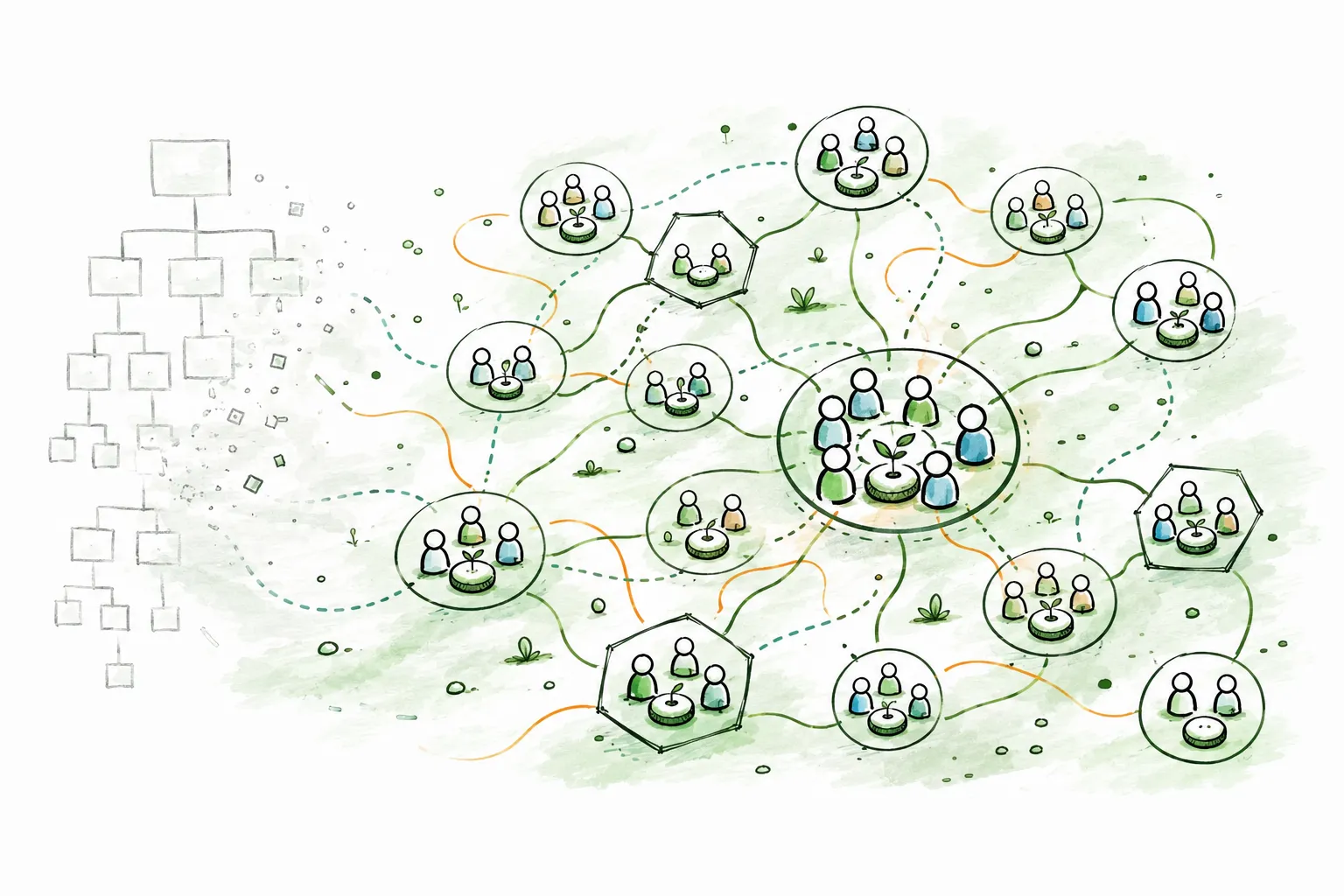
How one of the world's largest corporations is replacing hierarchy with 2,000 autonomous teams, 90-day cycles, and shared ownership, and what DSO means for the future of organizational design.
insights
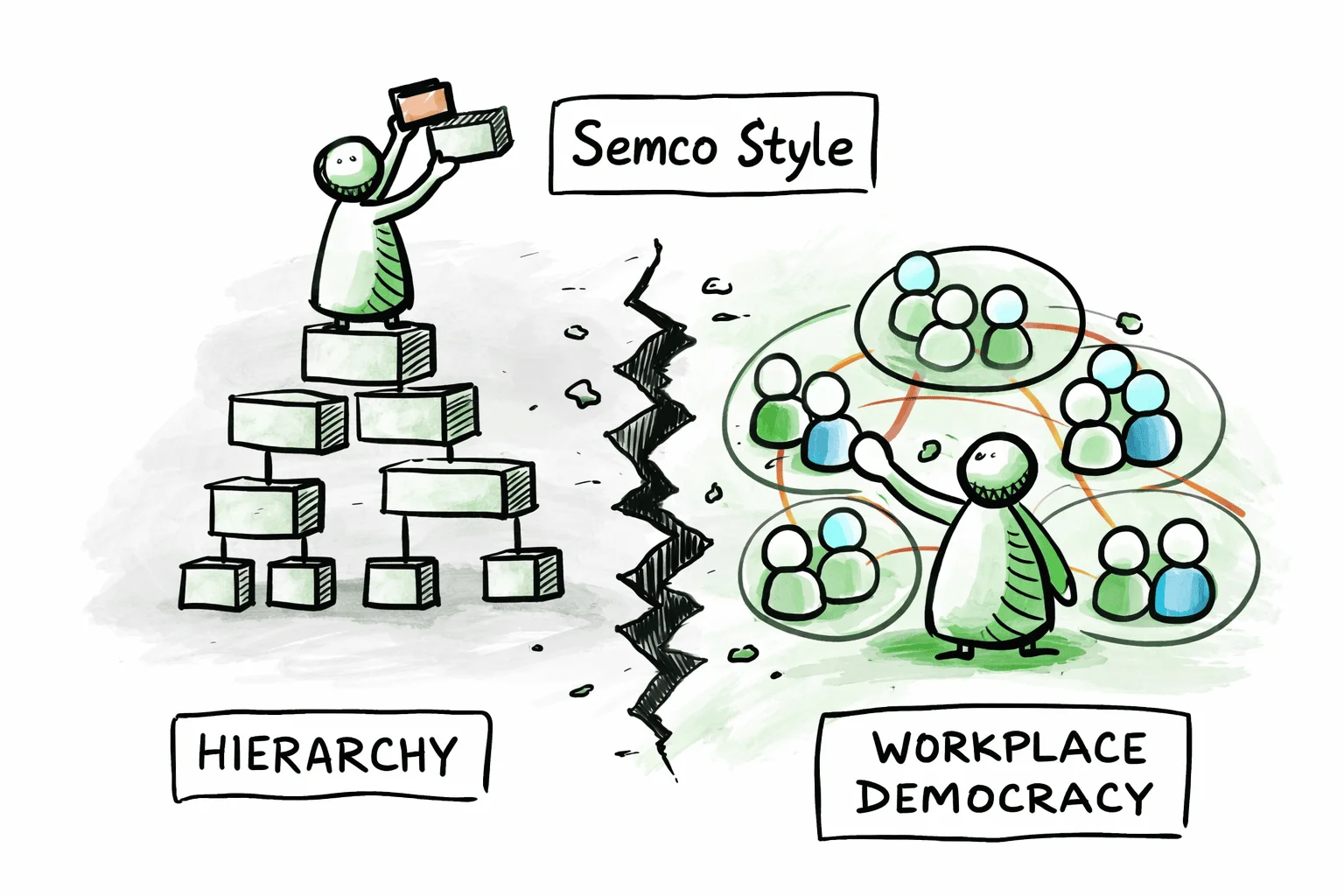
How a Brazilian manufacturer grew from $4 million to $212 million in revenue by letting employees set their own salaries, choose their own hours, and vote on company decisions.
insights
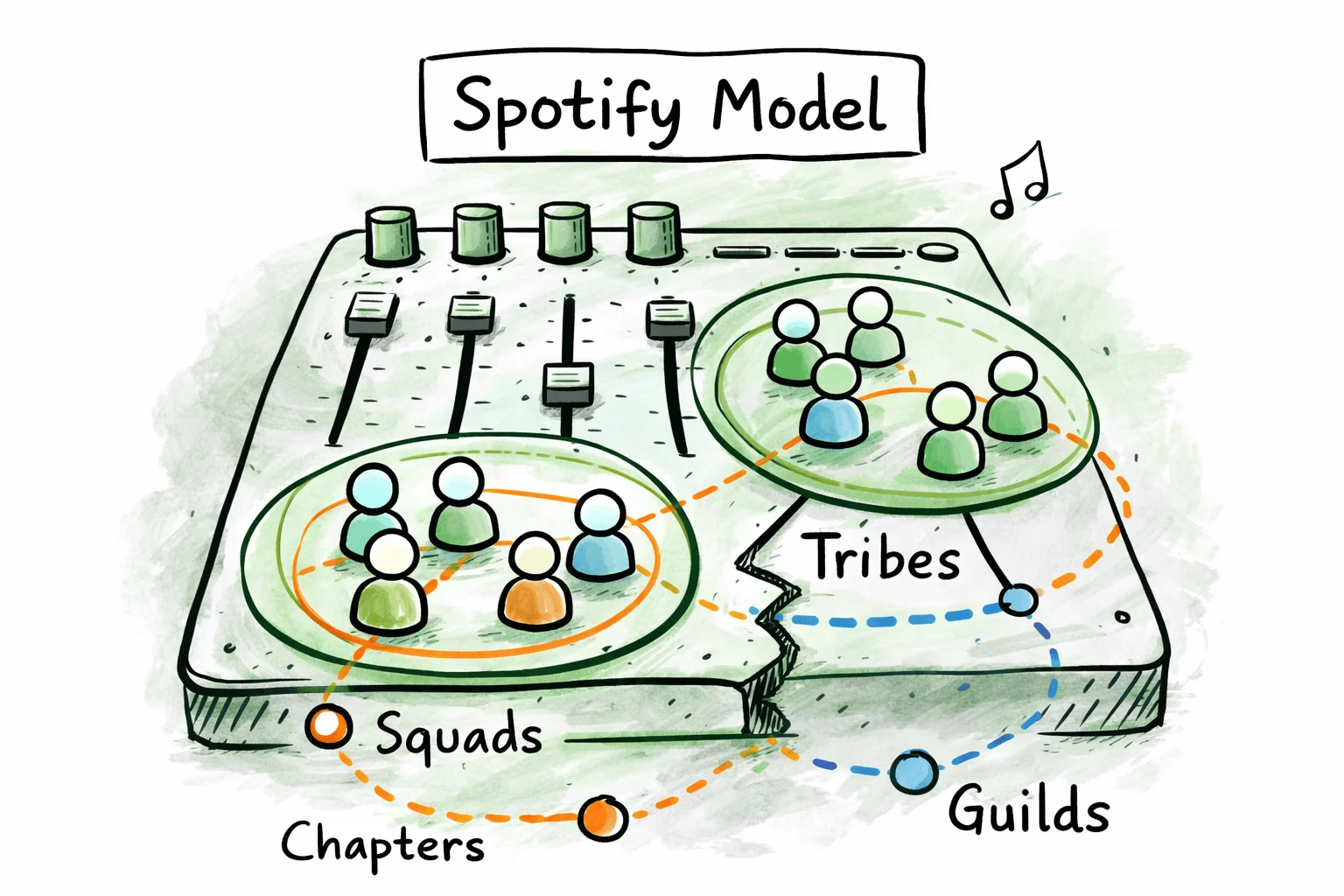
The most widely adopted agile scaling framework was never meant to be a framework. Here is what the Spotify model actually is, why it spread, where it breaks, and how to make it work.