Semco Style: Ricardo Semler's Workplace Democracy
Bastiaan Van Rooden
How a Brazilian manufacturer grew from $4 million to $212 million in revenue by letting employees set their own salaries, choose their own hours, and vote on company decisions.
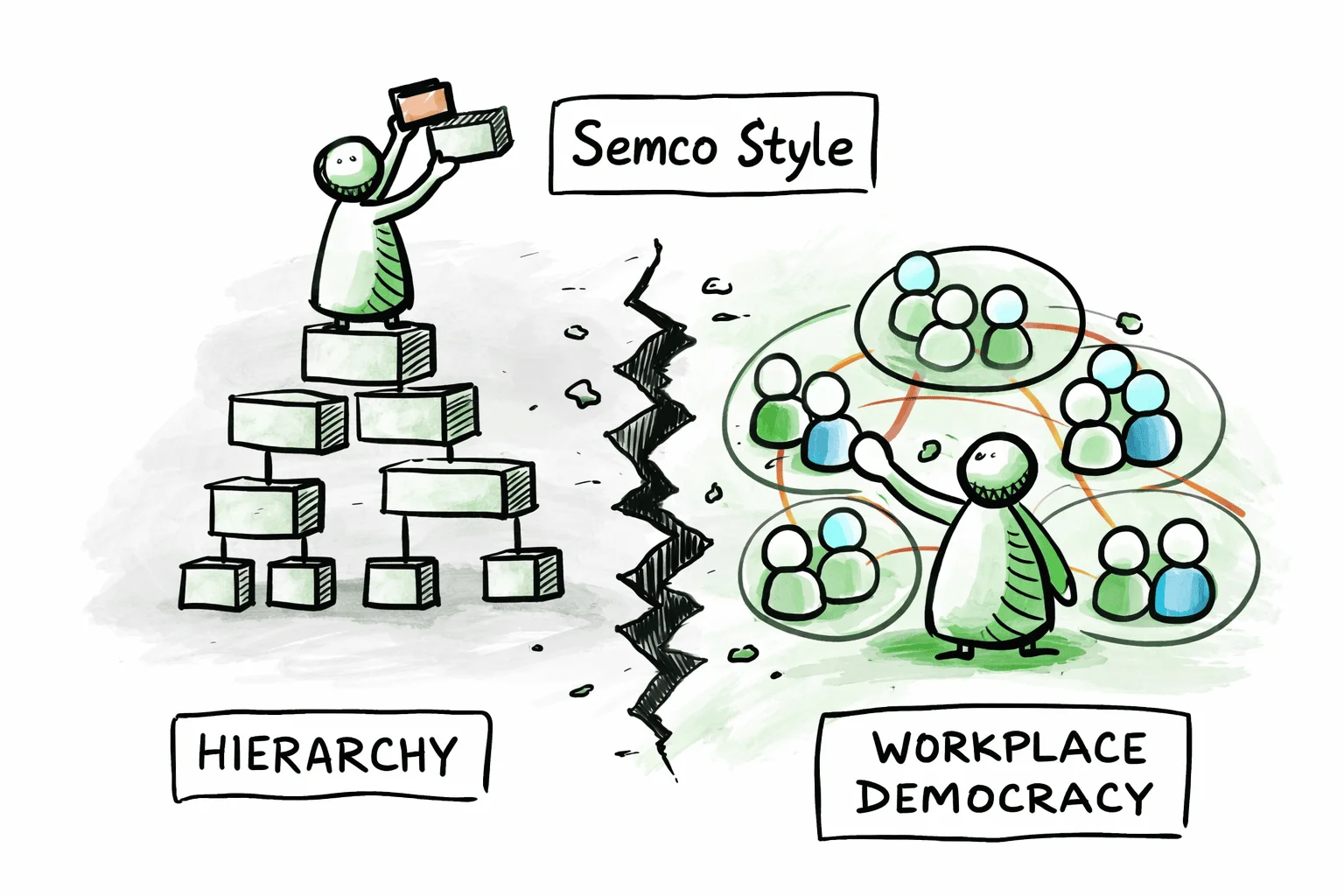
In 1980, a 21-year-old named Ricardo Semler took over his father’s company in São Paulo, Brazil. On his first day, he fired 60% of the top managers. Over the next two decades, he reduced management layers from twelve to three, cut corporate staff by 75%, and grew Semco from $4 million to $212 million in annual revenue, from 90 employees to over 3,000, with an average annual growth rate of 47%.
This is not a Silicon Valley startup myth. Semco was a manufacturing company: centrifuges, industrial mixers, dishwashers for commercial kitchens. The factory floor, not a venture-funded campus, was where Semler’s experiment in workplace democracy took shape. Employees set their own salaries. They chose their own working hours. They voted on how profits were distributed. Managers were evaluated by the people they managed, and the scores were posted publicly. There was no dress code, no assigned parking, no fixed CEO office.
What Semler built at Semco has since been codified into a transferable philosophy, the Semco Style, now taught by the Semco Style Institute to organizations worldwide. This guide covers the origins, the principles, the specific practices that made Semco distinctive, the results, and how the philosophy compares to other organizational frameworks. It is written to be useful whether you are considering adopting Semco-inspired practices or trying to understand what workplace democracy looks like when taken to its logical conclusion.
The Origin: A Health Crisis, a Sledgehammer to Bureaucracy
Ricardo Semler did not arrive at workplace democracy through academic theory. He arrived at it through burnout.
After taking over Semco at 21, Semler initially ran the company with an intensity that mirrored the conventional management thinking of the era: long hours, tight control, top-down decisions. By age 25, that approach had caught up with him. During a visit to a pump factory in upstate New York, he collapsed. Doctors at the Lahey Clinic in Boston diagnosed him with the most advanced case of stress they had ever seen in someone his age.
The diagnosis forced a question that most executives never ask: what if the management model itself is the problem? Not the people, not the market, not the product, but the fundamental assumption that organizations work best when a small number of people at the top tell everyone else what to do?
Semler began dismantling that assumption piece by piece. He eliminated layers of management. He opened the company’s financial books to every employee. He let teams make decisions that were previously reserved for executives. And rather than the chaos that skeptics predicted, the company grew: in revenue, in headcount, and in the range of industries it operated in.
Over the following decades, Semco diversified from industrial manufacturing into environmental consulting, facilities management, real estate brokerage, inventory support, and even hospitality. The company launched BrasilAgro, an $800 million farm development business. Semler attributes this diversification not to strategic genius at the top, but to the collective intelligence of empowered employees who saw opportunities that no centralized planning process would have identified.
By 2003, Semco had 3,000 employees and $212 million in revenue. Employee turnover sat at just 2%, in an industry where double-digit turnover was the norm. And Semler himself had largely stepped away from operations. The company ran itself.
“Participation gives people control of their work, profit sharing gives them a reason to do it better, information tells them what’s working and what isn’t.” — Ricardo Semler
What Is the Semco Style?
The term “Semco Style” refers to both the management philosophy that Ricardo Semler developed at Semco and the formalized framework later codified by the Semco Style Institute.
The distinction matters. What Semler did at Semco was intuitive, iterative, and deeply contextual. He did not work from a playbook. He experimented, sometimes radically, and kept what worked. The result was not a framework but a living culture, shaped over two decades by thousands of small decisions and a few dramatic ones.
The Semco Style Institute, founded in the Netherlands in 2016, took those decades of practice and formalized them into a structured methodology. Working with De Baak, a Dutch leadership institute, the Institute developed a framework built on five principles, fifteen organizational pillars, and over 100 specific practices, each tried and tested at Semco and other organizations that adopted similar approaches.
This formalization made Semco’s philosophy transferable. It moved the conversation from “look at what one company in Brazil did” to “here are the principles and practices that any organization can adopt, adapt, and implement.” The Institute now operates a global network, offering training, certification, assessments, and consulting to organizations exploring self-management.
The Semco Style is not a rigid constitution. Unlike frameworks that require organizations to adopt a specific governance structure or follow a detailed set of rules, the Semco Style offers principles and practices as a menu, not a mandate. Organizations are expected to adapt, not replicate.
The Five Principles of the Semco Style
The Semco Style framework rests on five interdependent principles. Remove one, and the others lose their coherence. Together, they form the philosophical foundation for everything that happens in a Semco-inspired organization.
1. Trust
Trust is the starting point. The entire Semco philosophy rests on a single premise: treat adults as adults. When people have access to the right information, they make good decisions, for themselves and for the organization. Trust replaces surveillance, control, and micromanagement.
At Semco: There were no time clocks. No one checked when employees arrived or left. Financial information was open to every employee, from revenue figures to profit margins to individual salary data. The assumption was that people would act responsibly when trusted to do so, and overwhelmingly, they did. Semler’s observation was direct: the vast majority of employees at any company are honest, competent adults. Building an entire control infrastructure around the small minority who might misbehave insults the majority and costs more than the misbehavior itself.
2. Alternative Controls
Traditional organizations rely on hierarchical controls: approvals, sign-offs, compliance checklists, management oversight. The Semco Style replaces these with alternative controls: peer pressure, transparent information, market accountability, and collective ownership. The controls are still real. They are just not hierarchical.
At Semco: When employees set their own salaries, the control was not a manager’s approval. It was full transparency: everyone could see what everyone else earned, and everyone could see the company’s financials. If someone set an unreasonably high salary, their peers would know, and the market data would make the discrepancy visible. The social and informational controls were more effective than any manager’s sign-off, because they operated continuously rather than once a year during performance reviews.
3. Self-Management
Self-management means that employees and teams manage their own work: scheduling, priorities, methods, and decisions. This is not delegation (where a manager assigns tasks and retains authority). It is genuine autonomy, where teams own both the decisions and their consequences.
At Semco: Teams chose their own working hours. Factory workers selected the color of their uniforms and the layout of the factory floor. Hiring and firing happened by consensus within teams. Business units set their own strategies. The role of coordinators (Semco’s term for what other companies call managers) was to facilitate, not to direct. And those coordinators were evaluated twice a year by the people they coordinated, with results posted publicly.
4. Extreme Stakeholder Alignment
This principle extends self-management beyond the organization’s boundaries. It involves working collaboratively with customers, partners, suppliers, and communities to co-design processes and deliver outcomes that serve all parties. The organization does not optimize for one stakeholder at the expense of others.
At Semco: The Satellite Programme encouraged employees to leave Semco and start their own companies, which then became Semco suppliers. Workers were offered favorable leasing conditions for production machines and could sell their output to Semco’s competitors as well. This created an ecosystem of aligned stakeholders rather than a rigid supply chain. The result was a network of businesses with genuine skin in the game, not a top-down vendor management program.
5. Creative Innovation
When people are trusted, self-managing, and connected to real stakeholders, innovation becomes a natural byproduct rather than a managed process. Creative innovation at Semco was not a department or a budget line. It was an emergent property of the culture.
At Semco: Three engineers proposed creating a Nucleus of Technological Innovation (NTI) to explore new business lines. Semler endorsed the idea, and the team operated with near-complete autonomy. The NTI model was so successful that it was replicated across the company, becoming the engine behind Semco’s diversification from manufacturing into services, real estate, environmental consulting, and agriculture. No innovation committee approved these ventures. They emerged from the bottom up, driven by employees who saw opportunities and had the freedom to pursue them.
Radical Practices That Define Semco
The five principles come to life through specific practices, many of which were considered radical when Semler introduced them in the 1980s and remain uncommon today.
Setting Your Own Salary
Employees at Semco set their own salaries. The process is more disciplined than it sounds. Employees receive two pieces of information before making their decision: market rate data for comparable positions at other companies, and full visibility into Semco’s financial performance: profit margins, revenue, and the total salary budget for their division.
With this information, employees propose what they believe is a fair salary. The decision is theirs, but it happens in full view of their colleagues, who can see the same financial data and the same market benchmarks. The social dynamic acts as a natural regulator. In practice, Semco found that employees more often undervalued themselves than overvalued, and the company actively encouraged people to raise their salaries when the data supported it.
Choosing Your Own Hours
There were no fixed working hours at Semco. Employees arrived when they wanted and left when they wanted. The constraint was not the clock but the work itself. Teams coordinated their schedules based on what the work required, not what a policy dictated. Factory workers on production lines coordinated shift patterns among themselves.
Open-Book Management
Every employee had access to Semco’s complete financial information: revenue, costs, profit margins, strategic plans, and productivity statistics. The company actively trained employees to read financial statements, because transparency without financial literacy is just noise. Semco wanted every employee to understand what the numbers meant, not just to see them.
Reverse Evaluations
Twice a year, coordinators (managers) were evaluated by the people they managed. Evaluations used a 100-point scale, and the results were posted publicly, not shared privately with the manager, not summarized by HR, but displayed for anyone in the company to see.
Coordinators who consistently scored below 75 were eventually removed from their coordination role. This happened. One coordinator scored 40. Investigation confirmed what the scores suggested: the person was an excellent salesman but an ineffective leader. The solution was not termination but reassignment: the coordinator moved into a role that matched their strengths. The reverse evaluation did not just identify problems. It provided data that led to better organizational design.
Profit Sharing by Employee Vote
Semco shared 23% of its profits with employees. But the distribution method was not set by management. Employees voted on how to allocate the profit-sharing pool. This meant that employees had a direct, democratic voice in one of the most consequential financial decisions a company makes. The practice reinforced ownership. People who help decide how profits are distributed pay closer attention to how profits are generated.
Voluntary Meetings With Open Chairs
All meetings at Semco were voluntary. If no one showed up, the meeting’s topic was considered untimely or unimportant. At every board meeting, two seats were reserved on a first-come, first-served basis for any employee who wanted to attend. No invitation required. No explanation needed. The practice ensured that strategic discussions were not insulated from the people who would be affected by the decisions.
Small Business Units
Semco capped business units at roughly 150 people. When a unit grew beyond that threshold, it was split. The reasoning was practical: people work differently when they know almost everyone around them. Beyond 150, anonymity creeps in, communication becomes formal rather than natural, and the sense of shared ownership erodes. Keeping units small preserved the culture of mutual accountability that made the rest of the system work.
No Dress Code, No Assigned Offices, No Corporate Hierarchy
Semco had no dress code. No assigned offices or parking spaces. No corporate hierarchy in the traditional sense. Job titles were minimal. The organizational structure was flat enough that the distance between any employee and any decision was measured in conversations, not in org chart layers.
The Results
The outcomes of Semler’s approach are documented across multiple sources and decades of observation.
Revenue growth: From $4 million in 1982 to $35 million in 1994 to $212 million by 2003. An average annual growth rate of 47%.
Employee growth: From 90 employees in 1982 to over 3,000 by 2003, with some sources citing growth to 5,000 over subsequent years.
Employee retention: Turnover of just 2%, in manufacturing industries where 10-20% is typical.
Industry diversification: From a single-product manufacturing company to a diversified group spanning industrial equipment, environmental consulting, facilities management, real estate development, agriculture, and hospitality.
Leadership succession: Semler gradually stepped away from daily operations. The company continued to operate and grow without him, the most compelling evidence that the system was not dependent on a charismatic founder but on the practices and principles embedded in the culture.
Longevity: The practices were introduced in the 1980s and sustained through multiple economic crises, including Brazil’s hyperinflation period, multiple recessions, and currency devaluations. A management model that works only in favorable conditions is not a model. Semco’s approach proved resilient across radically different economic environments.
These results did not come from a single intervention. They accumulated over decades of consistent application. The salary transparency did not work in isolation; it worked because it was supported by financial literacy training, open-book management, and a culture where trust was the operating assumption.
The Semco Style vs. Other Organizational Frameworks
The Semco Style exists within a broader landscape of organizational models that challenge traditional hierarchy. Each framework has different origins, different emphases, and different implementation approaches. Understanding where the Semco Style sits relative to these alternatives helps organizations choose the approach, or combination of approaches, that fits their context.
| Dimension | Traditional Hierarchy | Semco Style | Holacracy | Sociocracy | RenDanHeYi | Beta Codex | DSO (Bayer) | Spotify Model |
|---|---|---|---|---|---|---|---|---|
| Authority structure | Top-down chain of command | Flat, team-based democracy | Constitution-governed roles and circles | Consent-based linked circles | Distributed to autonomous microenterprises | Decentralized center-periphery | Empowered autonomous teams | Squads, tribes, chapters |
| Basic unit | Department / division | Self-managing team (max ~150) | Circle with defined roles | Circle with double-linking | Microenterprise (10-15 people) | Autonomous cell at periphery | Team of 6-10 people | Squad (cross-functional) |
| Decision-making | Manager approval | Consensus, democratic vote | Integrative decision-making | Consent (no reasoned objections) | ME autonomy with P&L accountability | Mastery-based | 90-day outcome cycles | Squad-level autonomy |
| Salary determination | Set by management / HR | Set by employees themselves | Typically traditional | Typically traditional | Based on user value created | Participation-based | Typically traditional | Typically traditional |
| Transparency | Need-to-know | Full open books (financials, salaries, evaluations) | Governance records visible | Governance transparent | Market and user data | Flow intelligence | Outcome visibility | Varies |
| Leadership model | Appointed managers | Elected / evaluated coordinators | Lead Links appointed by parent circle | Elected leaders | Entrepreneurial autonomy | Self-organization | Shared ownership, no fixed managers | Chapter leads, tribe leads |
| Formality | High (policies, procedures) | Low (culture-based, few rules) | Very high (written constitution) | Moderate (principles + process) | Moderate (market discipline) | Principles-based | Moderate (90-day cycles) | Moderate (model-specific) |
| Scale tested | Any scale | Thousands (Semco: 3,000-5,000) | Hundreds to low thousands | Hundreds to low thousands | 80,000+ (Haier) | Varies | 100,000+ (Bayer) | Thousands (Spotify) |
Key Distinctions
Semco Style vs. Holacracy: Holacracy provides a detailed governance constitution with specific rules for meetings, proposals, elections, and role definitions. The Semco Style is far less prescriptive. It provides principles and cultural practices, not governance procedures. At Semco, the way teams made decisions varied from unit to unit; there was no single mandated process. Holacracy optimizes for governance clarity. Semco optimizes for human autonomy.
Semco Style vs. Sociocracy: Sociocracy shares Semco’s emphasis on consent-based decision-making and distributed authority, but it operates through a more structured system of linked circles and formal decision processes. Semco’s approach is less structured; decisions happen through team consensus, democratic voting, or individual autonomy depending on the context. Organizations drawn to Semco’s philosophy but wanting more governance structure often find sociocracy a natural complement.
Semco Style vs. RenDanHeYi: RenDanHeYi, developed at Haier, shares Semco’s emphasis on autonomous units and direct market connection. The key difference is financial architecture. RenDanHeYi gives each microenterprise full profit-and-loss responsibility, creating internal businesses. Semco’s approach is more communal: profit sharing is collective, salaries are self-set but within a shared financial context. RenDanHeYi is entrepreneurial. Semco is democratic.
Semco Style vs. Beta Codex: Beta Codex operates at a more abstract level. It defines twelve organizational laws that describe how decentralized organizations should work. Semco’s approach is more practical and people-centered. Beta Codex provides the theory; Semco provides the lived example. An organization could practice Beta Codex principles using Semco-style practices within its teams.
Semco Style vs. DSO (Bayer): Dynamic Shared Ownership at Bayer is a top-down transformation of a traditional hierarchy, driven by a CEO’s mandate to restructure 100,000 employees into autonomous teams. Semco’s transformation was bottom-up, driven by a founder’s personal conviction and evolved organically over decades. Both aim for empowered teams and reduced hierarchy, but the change methodology is fundamentally different.
The Semco Style Institute
The Semco Style Institute was founded in May 2016 in the Netherlands, formalizing Ricardo Semler’s decades of practice into a structured, transferable methodology. The framework was developed in collaboration with De Baak, a Dutch leadership institute, which helped translate Semco’s lived culture into theoretical principles that could be taught, assessed, and adapted.
The Framework
The Institute’s methodology consists of three layers:
- 5 Principles: Trust, Alternative Controls, Self-Management, Extreme Stakeholder Alignment, and Creative Innovation. These are the philosophical foundation, the “why” behind Semco-inspired practices.
- 15 Pillars: Organizational building blocks that operationalize the five principles. These pillars span topics from decision-making structures to talent development to financial transparency.
- 100+ Practices: Specific, actionable methods that organizations can adopt and adapt. These are the “how”: concrete steps for implementing self-set salaries, reverse evaluations, open-book management, and other Semco-inspired approaches.
Global Network
The Institute operates a global network of certified partners, with affiliates in countries including South Africa, Australia, the United Kingdom, and the United States. It offers certification programs for consultants and organizational leaders, assessments that measure an organization’s readiness for self-management practices, and consulting engagements tailored to specific organizational contexts.
The Challenge of Transfer
The Institute’s central challenge is one that every organizational philosophy faces when it moves beyond its origin: culture is not a kit you assemble. What worked at Semco in São Paulo, within Brazilian work culture, under the specific leadership of Ricardo Semler, does not automatically work in a manufacturing firm in Munich or a technology company in Singapore.
The Institute’s response to this challenge is to frame Semco Style as adaptive rather than prescriptive. Organizations are not expected to replicate Semco. They are expected to understand the principles, assess their own context, and select the practices that fit. This makes the Semco Style less of a franchise and more of a philosophy with practical tools.
Where Semco Style Works (and Its Limits)
Any honest assessment of an organizational model must address both where it succeeds and where it struggles. The Semco Style has demonstrated its effectiveness across specific contexts, and it has real limitations that prospective adopters should understand.
Where It Works
Knowledge work and professional services: Organizations where output depends on judgment, creativity, and collaboration (consulting firms, technology companies, design agencies) are natural fits for Semco-style autonomy. The work itself resists standardization, making self-management a practical advantage rather than an ideological choice.
Manufacturing with a trust culture: Semco itself was a manufacturing company, proving that self-management is not limited to white-collar work. But the manufacturing context at Semco was supported by decades of trust-building, financial literacy training, and gradual cultural evolution. It did not happen overnight.
Organizations with committed leadership: Every successful implementation of Semco-style practices shares one feature: leadership that genuinely believes in the model and is willing to endure the discomfort of releasing control. This is not a practice you can delegate to HR.
Where It Struggles
Heavily regulated industries: In sectors where compliance requirements prescribe specific reporting structures, approval chains, and documentation processes (pharmaceuticals, aviation, financial services) the full Semco model faces friction with regulatory expectations. Elements of the philosophy (transparency, reverse evaluations, small units) can still be adopted, but the regulatory environment constrains how far autonomy can extend.
Organizations without leadership buy-in: The Semco Style requires that the people currently holding power voluntarily distribute it. If senior leadership is not genuinely committed, if the initiative is delegated to middle management or framed as a “culture program” rather than a structural transformation, the practices will be adopted superficially and abandoned at the first sign of difficulty.
The founder effect: Semler’s personal conviction and willingness to sustain the experiment through setbacks was a critical factor in Semco’s success. His health crisis gave him a personal reason to rethink work. His majority ownership gave him the authority to override skeptics. Not every organization has a founder with both the conviction and the authority to drive this kind of change.
Cultural context: Brazilian work culture, with its emphasis on personal relationships, informality, and communal identity, provided fertile soil for Semco’s practices. This does not mean the practices cannot work in other cultures. The Semco Style Institute’s global network demonstrates that they can. But the implementation path varies. A German manufacturing firm or a Japanese technology company will need to adapt the practices differently than a Brazilian services company.
The Honest Answer
The Semco Style is not a universal solution. It is a set of principles and practices that work when the organizational conditions support them. The answer for most organizations is not to replicate Semco but to understand the principles, select the practices that fit their context, and implement them gradually, starting with transparency and trust, and building from there.
Implementing Semco-Inspired Practices
Adopting the full Semco model requires years of cultural evolution. But individual Semco-inspired practices can be introduced incrementally, each one building the trust and capability needed for the next.
Start with Transparency
Open the books before you open the salaries. Share financial information (revenue, costs, profit margins) with all employees. This is the lowest-risk, highest-impact starting point. It builds financial literacy, creates shared context for decision-making, and demonstrates that leadership trusts employees with real information.
Introduce Reverse Evaluations
Let employees evaluate their managers. Start with anonymous surveys if the culture is not yet ready for public scores. The goal is to create a feedback loop where leadership quality is measured by the people who experience it, not by the people who appointed it. Over time, increase transparency until the evaluations become part of the organizational conversation rather than a private HR exercise.
Give Teams Ownership of Scheduling
Let teams determine their own working hours and shift patterns. The constraint is the work, not the clock. Most teams, given the authority and the information, coordinate more effectively than any top-down scheduling system. This practice builds self-management capability with relatively low organizational risk.
Experiment with Profit Sharing
Introduce a profit-sharing mechanism, even a modest one. Let employees participate in deciding how the pool is distributed. This creates a direct connection between organizational performance and individual benefit, and it shifts the conversation from “what am I paid” to “how are we performing.”
Keep Units Small
If a team or business unit grows beyond 150 people, consider splitting it. The 150-person threshold is not arbitrary; it aligns with research on group dynamics and the cognitive limits of maintaining meaningful working relationships. Smaller units preserve the mutual accountability that makes self-management possible.
Make the Structure Visible
As organizational structure evolves (new teams form, roles shift, authority is distributed differently) the structure needs to be visible and navigable. Everyone in the organization should be able to see who is responsible for what, how teams relate to each other, and how the structure has changed over time. This visibility is what turns a collection of practices into a coherent organizational model. Tools like Peerdom can map teams, roles, and relationships in a way that keeps the organizational structure alive and accessible rather than buried in a slide deck from the last offsite.
Frequently Asked Questions
Does Semco still operate this way?
Semco has evolved since the practices described in Semler’s books. The company has shifted its focus toward launching new businesses and investments, operating as Semco Partners. The core principles (employee autonomy, transparency, distributed decision-making) remain embedded in the culture. Semler himself has largely stepped away from daily operations, which he considers proof that the system works: the company does not need its founder to function.
Can employees really set their own salaries?
Yes. At Semco, employees set their own salaries after receiving market rate data for comparable positions and full visibility into the company’s financial performance. The transparency acts as a natural control: when everyone can see what everyone else earns and how the company is performing financially, people tend to make reasonable decisions. Semco found that employees more often undervalued themselves than overvalued, and the company actively encouraged people to raise their compensation when data supported it.
What happens when someone sets an unreasonable salary?
The system relies on transparency rather than authority. If someone sets a salary far above market rate or beyond what the company’s finances support, their colleagues can see it. Peer pressure, financial data, and the knowledge that an unsustainable salary hurts the profit-sharing pool for everyone create social and economic constraints that are more effective than a manager’s veto. In decades of practice at Semco, abuse of the system was rare.
How does Semco handle hiring and firing?
Hiring and firing at Semco happen by team consensus. The people who will work with a new hire are the people who interview and select them. When someone is not performing, the team addresses it collectively. This is more demanding than traditional manager-led decisions; it requires honest conversation and shared accountability. But it produces better outcomes because the people making the decision are the ones who experience the consequences daily.
Is the Semco Style only for Brazilian companies?
No. The Semco Style Institute operates a global network with certified partners in the Netherlands, the United Kingdom, South Africa, Australia, and the United States, among other countries. Organizations across industries and cultures have adopted Semco-inspired practices. The principles are universal (trust, transparency, autonomy) though the specific implementation varies by cultural and regulatory context.
What is the Semco Style Institute?
The Semco Style Institute, founded in the Netherlands in 2016, formalized Ricardo Semler’s management philosophy into a structured framework of 5 principles, 15 pillars, and over 100 practices. It was developed in collaboration with De Baak, a Dutch leadership institute. The Institute offers certification programs, organizational assessments, and consulting to help organizations adopt self-management practices. It operates through a global network of partners.
Has any large corporation adopted the Semco Style?
Large organizations have adopted elements of the Semco Style rather than implementing it wholesale. The principles (transparency, self-management, distributed authority) appear in various forms across companies experimenting with decentralization. Organizations like Bayer (through Dynamic Shared Ownership) and Haier (through RenDanHeYi) have implemented their own models that share philosophical DNA with the Semco approach, even if the specific practices differ. The Semco Style Institute works with organizations of various sizes to adapt the practices to their context.
What is the difference between the Semco Style and holacracy?
Holacracy is a formal governance framework with a written constitution, defined meeting formats, specific role structures, and prescribed decision-making processes. The Semco Style is a philosophy with a set of principles and practices, but it is far less prescriptive about governance procedures. Holacracy tells you exactly how to run a governance meeting. The Semco Style tells you to trust your people and gives you practices for building that trust. Organizations that want clear governance structure may prefer holacracy. Organizations that want cultural transformation with more flexibility may prefer the Semco Style. The two are not mutually exclusive; an organization could use holacratic governance within a Semco-style culture.
Start mapping your organization
Whether you are exploring the Semco Style, adopting holacracy, implementing sociocracy, building a Beta Codex network, or evolving your existing structure toward more self-management, the first step is the same: make your organizational structure visible, navigable, and accessible to everyone.
- Browse maps: see how real organizations of every kind have mapped themselves.
- Start mapping from scratch: Peerdom supports any organizational model: flat teams, holacratic circles, microenterprises, traditional hierarchies, and everything in between.
- Not sure where to start? Book a demo and we will walk through how your organization’s structure maps to the model you are exploring.
- For more on self-management software and role-based governance, those guides cover the practical tooling details.
Keep reading
insights
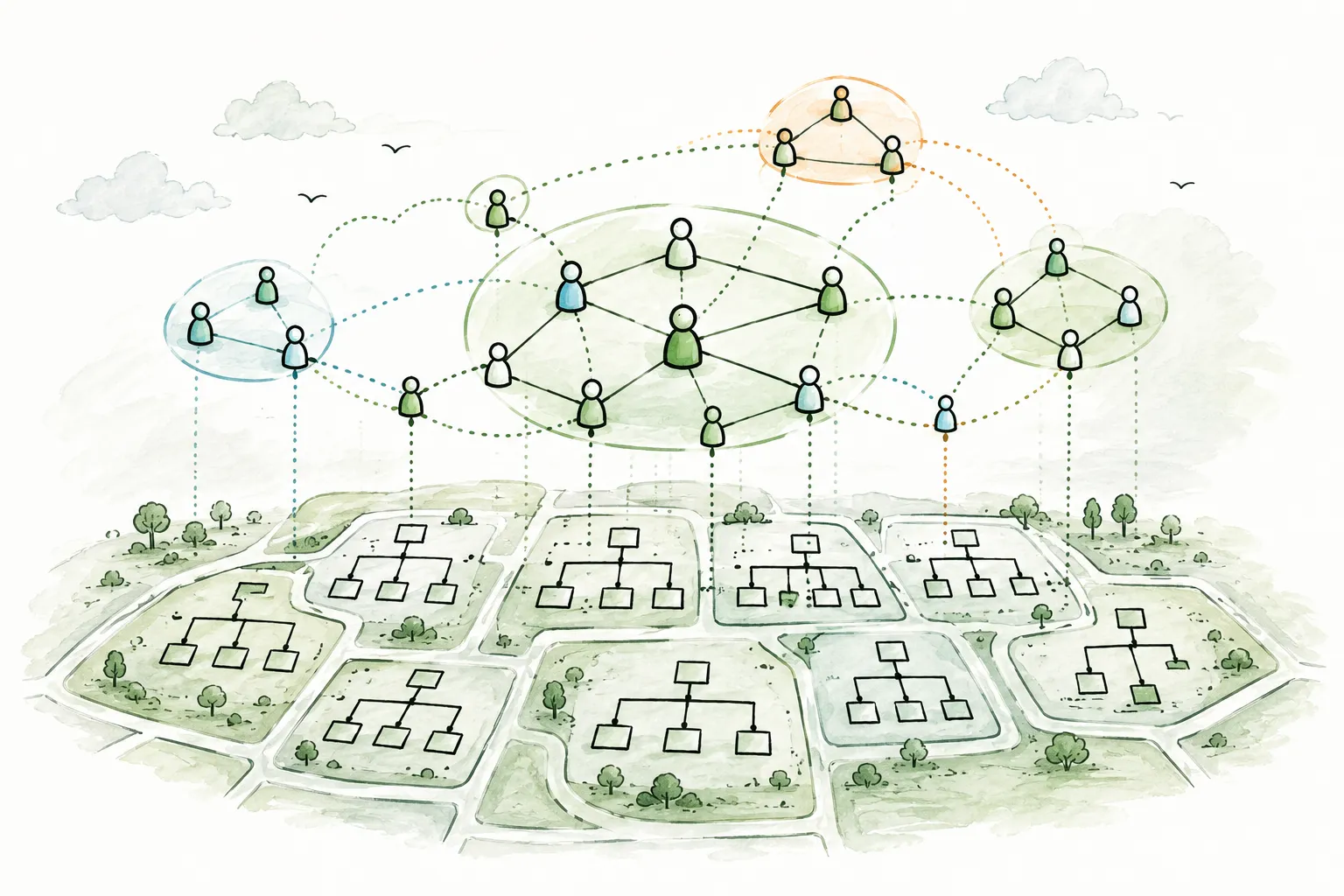
Mission Based Teams let people self-organize around the problems that matter most. Roche runs over 1,100 of them across 89 countries, alongside their formal structure, not instead of it.
customer stories
Learn how Bayer Pharma Schweiz paired its classical org chart with a living map of project and topic teams to make expertise visible, find experts faster, and support their Dynamic Shared Ownership operating model.
insights
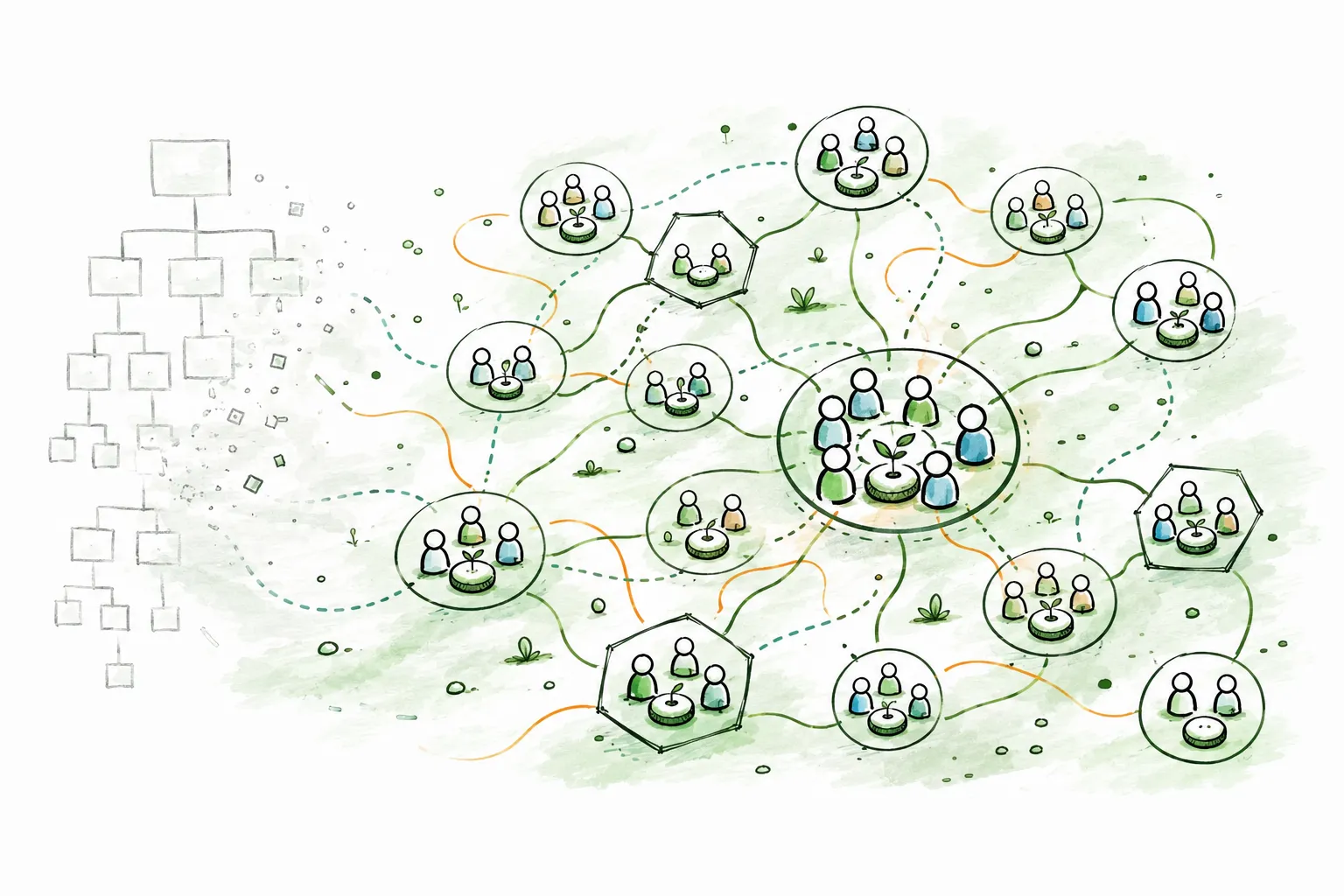
How one of the world's largest corporations is replacing hierarchy with 2,000 autonomous teams, 90-day cycles, and shared ownership, and what DSO means for the future of organizational design.