RenDanHeYi: Haier's Organizational Model Explained
Nathan Evans
How a Chinese appliance manufacturer became the world's most radical management experiment, and what the RenDanHeYi model means for the future of organizational design.
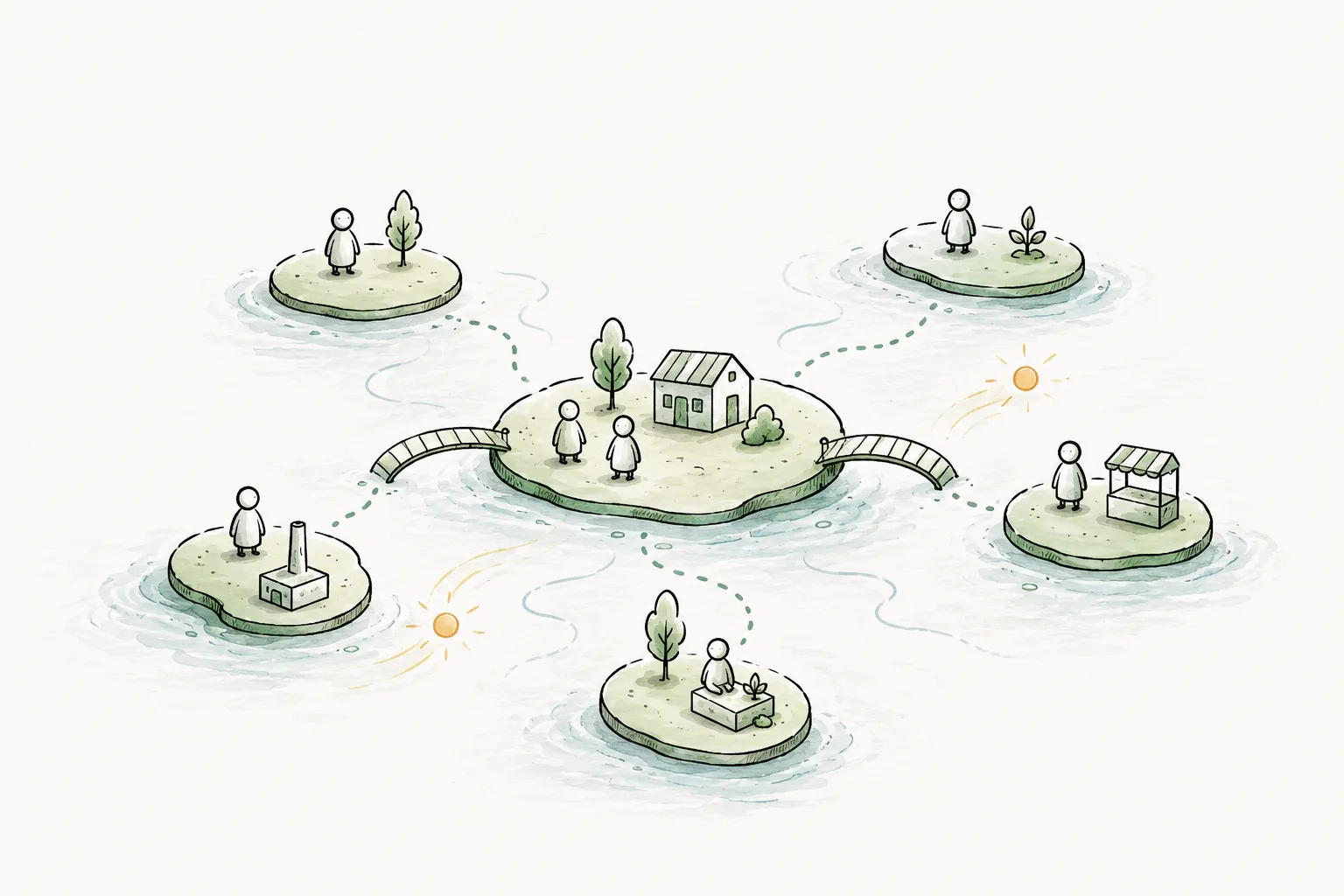
In 2005, the CEO of a Chinese appliance manufacturer made an announcement that would have sounded absurd at any Fortune 500 board meeting: he was going to eliminate all middle management, break the company into thousands of tiny entrepreneurial units, and let every employee act as their own CEO.
The company was Haier. With over 80,000 employees and more than $35 billion in annual revenue, it is today the world’s largest appliance manufacturer. The organizational model that CEO Zhang Ruimin introduced, RenDanHeYi, has since become one of the most studied, most debated, and most radical management experiments in business history.
What makes RenDanHeYi remarkable is not just its ambition. It is the fact that it actually works. At scale. Across cultures. For two decades. While most management innovations remain theoretical or collapse under the weight of real-world complexity, RenDanHeYi has been stress-tested at a scale few organizational models have ever faced.
This guide explains what RenDanHeYi is, how it works, where it came from, and what organizations of any size can learn from it, whether or not they plan to adopt the model wholesale.
Origins: From Smashing Fridges to Smashing Hierarchy
The story of RenDanHeYi begins not with organizational theory, but with a sledgehammer.
In 1985, Zhang Ruimin had just been appointed to lead the Qingdao Refrigerator Factory, a struggling, nearly bankrupt state-owned enterprise. When a customer complained about a defective refrigerator, Zhang had every refrigerator in the warehouse inspected. Seventy-six were found to be defective.
What happened next became legend in Chinese business. Zhang ordered his workers to line up the 76 defective units and smash them with sledgehammers, in front of the entire factory. At the time, a single refrigerator cost roughly two years of a Chinese worker’s salary. The message was unmistakable: quality is not negotiable.
That moment defined a leadership philosophy rooted in relentless customer focus. Over the following two decades, Zhang transformed the factory into Haier Group, a global manufacturing giant. But by the early 2000s, he recognized that even a well-run hierarchy could not keep pace with the speed of internet-era markets. The structure that had enabled Haier’s growth was becoming the very thing that slowed it down.
Customers were changing faster than the organization could respond. Information passed through too many management layers before reaching the people who could act on it. Innovation was bottlenecked by approval chains. The distance between Haier’s employees and Haier’s users had grown too wide.
On September 20, 2005, Zhang introduced RenDanHeYi, a model designed to close that distance permanently. Two decades later, the model’s influence earned Zhang the Thinkers50 Lifetime Achievement Award, the first business practitioner and the first Chinese recipient of what is widely considered the most prestigious recognition in management thinking. As Gary Hamel noted at the ceremony, Zhang was “the first to work on reinventing management” from the inside of a global enterprise.
The Three Characters: What RenDanHeYi Means
The name RenDanHeYi comes from three Chinese concepts, each carrying weight that resists easy translation.
Ren (人): People
Ren refers to the employees, the people within the organization. But in the context of RenDanHeYi, it carries a specific connotation: every person is a potential entrepreneur. Not a cog in a machine, not a resource to be managed, but an autonomous agent capable of creating value. The model assumes that people, when given the right structure and incentives, will self-organize around the problems that matter most.
Dan (单): User Needs
Dan refers to the orders, the needs, the value demands of users. This is not “customer” in the abstract marketing sense. It is the concrete, specific, measurable value that a user requires. In Zhang Ruimin’s framing, every employee must be able to identify whose needs they are serving and how their work creates value for those specific users. If you cannot draw a straight line from your work to a user’s need, something is wrong with the structure.
HeYi (合一): Integration
HeYi means merging, alignment, becoming one. It is the critical connective tissue of the model. HeYi is the principle that each employee’s value should be directly reflected in the value they create for users. There is no separation between “doing your job” and “creating user value.” They are the same thing.
Together, RenDanHeYi translates roughly as: “the integration of people with user value.” Every person’s contribution is measured by the value it creates for the user, not by the number of hours worked, the seniority held, or the approval of a manager.
How RenDanHeYi Works
The operational mechanics of RenDanHeYi are as radical as the philosophy. Haier replaced its entire traditional hierarchy with a structure built on three components: microenterprises, ecosystems of micro-communities, and platform functions.
Microenterprises (MEs)
The fundamental unit of a RenDanHeYi organization is the microenterprise. Haier operates approximately 4,000 of them. Each microenterprise consists of roughly 10 to 15 people, functions with full profit-and-loss responsibility, and exercises complete decision-making autonomy over three critical domains:
- Strategy: the ME decides what market to serve and how to serve it.
- People and organization: the ME hires, organizes, and manages its own team.
- Rewards: compensation within the ME is determined by the value generated for customers, not by hierarchical position or tenure. Haier calls this principle “Paid by Users,” in contrast to the traditional model of “Paid by Enterprise,” where salaries are set by posts and ranks, performance is evaluated by superiors, and employees execute commands from above. In a RenDanHeYi organization, value is evaluated by users, and income comes from value-added sharing.
These are known as the “three rights” of every microenterprise: the right to make independent decisions, the right to hire talent, and the right to distribute profit.
In Zhang Ruimin’s phrase: “Everyone becomes their own CEO.” This is not metaphorical. Each microenterprise operates as a small business within the larger Haier ecosystem, responsible for its own survival and growth. If a microenterprise does not create sufficient value for users, it does not receive resources. If it thrives, it grows.
The restructuring was not incremental. More than 80,000 employees were reorganized into over 4,000 microenterprises. Approximately 12,000 mid-level managers either started their own entrepreneurial ventures within the new structure or left the company. The entire management layer between the executive team and the frontline was eliminated, not through layoffs, but through a structural transformation that made the management function itself unnecessary.
Ecosystems of Micro-Communities (EMCs)
When a single microenterprise cannot solve a complex problem alone, multiple MEs form temporary alliances called Ecosystems of Micro-Communities. These EMCs combine internal microenterprises with external partners (suppliers, research institutions, technology providers, even customers) to tackle challenges that require broader capabilities.
The critical characteristic of EMCs is that they are transient. They form around a specific objective and dissolve once that objective is achieved. They are not permanent departments or cross-functional committees. They are purpose-built coalitions that exist only as long as they create value.
EMCs are governed by EMC Contracts, agreements that stipulate the rights and responsibilities of each participating microenterprise. The contract starts with the EMC owner proposing user needs, the Shared Service Platform (SSP) setting bottom-line goals, and each ME member presenting their own plan for meeting those needs. The contract is dynamic: if a member cannot keep their promise or is not recognized by other members, they are dismissed from the EMC. If they exceed expectations, the entire EMC shares in the added value according to ratios agreed at formation. Unlike traditional inter-departmental agreements, EMC contract signatories are collectively responsible for the goals of the entire ecosystem, and any member can evaluate any other.
This is fundamentally different from traditional matrix organizations, where cross-functional teams become permanent fixtures with their own politics, budgets, and territorial instincts. EMCs have no institutional interest in perpetuating themselves.
Platform Functions
What about the shared services that every organization needs (HR, finance, legal, IT)? In a RenDanHeYi organization, these exist as platform functions. They provide resources, infrastructure, and support to the microenterprises, but they do not control them.
The relationship is inverted from traditional hierarchy. In a conventional company, HR and finance often wield significant power over operating units through budget approval, hiring processes, and compliance requirements. In a RenDanHeYi structure, platform functions serve the microenterprises. They are support infrastructure, not command infrastructure.
The Zero Distance Principle
At the philosophical heart of RenDanHeYi is what Zhang Ruimin calls “zero distance”: the elimination of all gaps between the organization and its users.
In a traditional hierarchy, the distance between a customer’s need and the organization’s response is measured in management layers. A frontline employee observes a problem. They report it to their manager. The manager escalates it. It passes through a committee, a planning cycle, a budget approval. By the time the organization responds, the customer has moved on.
Zero distance means collapsing this chain entirely. The person who observes the need is the person empowered to act on it. There are no intermediaries, no approval chains, no information loss through managerial telephone games.
But zero distance goes beyond responsiveness. It redefines the relationship between the organization and its users:
Users at the top of the hierarchy. RenDanHeYi inverts the traditional pyramid. Instead of executives at the top making decisions that cascade downward, users sit at the organizational apex. Everything in the structure exists to serve their needs, and the people closest to users have the most authority to act.
Users as co-creators. In a zero-distance organization, users are not passive recipients of products or services. They actively shape what gets created. Microenterprises work directly with users to identify needs, test solutions, and iterate in real time. The boundary between “producer” and “consumer” becomes blurred.
Real-time responsiveness. Because decisions are made at the point of user contact, not mediated through management layers, the organization can respond at the speed of the market rather than the speed of its internal bureaucracy.
RenDanHeYi in Practice
Theory is one thing. Execution at the scale of a global manufacturer with 80,000 employees is another. Several concrete examples illustrate how RenDanHeYi operates in the real world.
The Internet of Food Ecosystem
One of the most frequently cited examples of RenDanHeYi in action is Haier’s “Internet of Food” ecosystem. Rather than manufacturing refrigerators, a Haier microenterprise recognized that users did not just want cold storage. They wanted food experiences.
The microenterprise partnered with professional chefs, agricultural suppliers, logistics companies, and more than 14 other organizations to create an ecosystem around Peking duck. Users could order premium duck through their Haier smart refrigerator, receive preparation instructions from professional chefs, and access the entire supply chain from farm to table.
This could not have happened in a traditional hierarchy. No refrigerator division would have been authorized to partner with chefs and duck farms. No middle manager would have approved a budget for “food experiences.” The microenterprise structure gave a small team the autonomy to see a user need, assemble an ecosystem, and deliver value that no single company could have created alone.
Global Implementation
RenDanHeYi is not a China-only phenomenon. Haier has applied the model across its global operations, including GE Appliances (acquired in 2016), Fisher & Paykel (New Zealand), Candy (Italy), and operations across Asia, Europe, and the Americas.
When Haier acquired GE Appliances, an iconic American brand with deeply entrenched traditional management practices, observers expected a culture clash. Instead, Haier introduced microenterprise principles gradually, allowing GE Appliances’ teams to experience the autonomy and user focus that RenDanHeYi provides. The result was a revitalization of the brand, with GE Appliances regaining market share and accelerating product innovation.
The 2025 European Journey
In 2025, Zhang Ruimin led the “Zero Distance Excellence Journey” across Europe, visiting organizations in Italy and San Marino to demonstrate and discuss the model. Companies like Siemens and ENGIE have studied RenDanHeYi’s principles. The European tour signaled a growing recognition that RenDanHeYi is not a culturally bounded experiment but a transferable organizational philosophy.
RenDanHeYi vs Other Organizational Models
RenDanHeYi exists within a broader landscape of organizational models that challenge traditional hierarchy. Understanding how it compares to other approaches helps clarify what is genuinely distinctive about it, and what it shares with other frameworks.
| Dimension | Traditional Hierarchy | RenDanHeYi | Holacracy | Sociocracy | Beta Codex / Peach | Teal | Spotify Model |
|---|---|---|---|---|---|---|---|
| Authority structure | Top-down chain of command | Distributed to autonomous MEs | Distributed to roles and circles | Distributed through consent governance | Decentralized center-periphery | Self-managed teams | Squads, tribes, chapters |
| Basic unit | Department/division | Microenterprise (10-15 people) | Circle with defined roles | Circle with double-linking | Autonomous cell at periphery | Self-managing team | Squad (cross-functional team) |
| Decision-making | Manager approval | ME autonomy with P&L accountability | Integrative decision-making process | Consent (no reasoned objections) | Local decision by those closest to work | Advice process | Squad-level autonomy |
| Financial accountability | Cost centers roll up to corporate | Full P&L per microenterprise | No direct financial autonomy | No direct financial autonomy | Decentralized budgeting | Varies by organization | Varies by organization |
| User relationship | Mediated through hierarchy | Zero distance, direct user connection | Internal focus (governance of structure) | Internal focus (governance process) | Market-pull from periphery | Evolutionary purpose sensing | Product-centric |
| Coordination mechanism | Management layers | EMCs (temporary ecosystems) | Lead Links and Rep Links | Double-linking between circles | Network dynamics | Peer relationships | Chapters and guilds |
| Entrepreneurial emphasis | Low (execution focus) | Very high (each ME is a startup) | Low (governance focus) | Low (process focus) | Moderate (market-oriented cells) | Moderate (wholeness focus) | Moderate (innovation focus) |
| Scalability tested | Proven at any scale | 80,000+ employees, $35B+ revenue | Hundreds to low thousands | Hundreds to low thousands | Varies | Varies | Thousands (Spotify-specific) |
| Formality | High (policies and procedures) | Moderate (market discipline) | Very high (written constitution) | Moderate (principles-based) | Low (network principles) | Low (philosophical principles) | Moderate (model-specific) |
What RenDanHeYi shares with other models
Every model in this comparison rejects the premise that decision-making authority should be concentrated at the top of a pyramid. All of them distribute authority in some form: to circles, teams, cells, or microenterprises. All of them recognize that the people closest to the work usually make better decisions than distant executives.
RenDanHeYi also shares a user-centric orientation with Beta Codex, which emphasizes market-pull from the periphery rather than plan-push from the center. Both models argue that value creation happens at the edges of the organization, not in the executive suite.
What makes RenDanHeYi unique
Three elements distinguish RenDanHeYi from the broader family of self-management models:
Full financial autonomy. Holacracy and sociocracy distribute governance authority but typically leave financial decisions with traditional management. RenDanHeYi gives each microenterprise complete P&L responsibility. MEs are not just self-governing; they are self-funding.
Explicit employee-to-user value linkage. The “HeYi” (integration) principle directly connects each employee’s compensation and purpose to the value they create for users. This is not an aspiration or a cultural value. It is a structural mechanism. Other models may encourage user-centricity, but RenDanHeYi builds it into the incentive architecture.
Entrepreneurial identity. While other models create self-managing teams, RenDanHeYi creates self-managing businesses. Each microenterprise operates as a startup within the larger ecosystem. This entrepreneurial orientation goes beyond autonomy into genuine business ownership.
What Western Organizations Can Learn
Adopting RenDanHeYi wholesale is not realistic for most organizations, and it is not necessary. The model emerged from a specific cultural context, a specific industry, and a specific leader’s two-decade commitment. But several principles from RenDanHeYi translate directly into practical lessons for any organization.
Shrink the distance between decisions and users
Every organization can ask: how many layers stand between a user’s need and the person empowered to act on it? Even without microenterprises, reducing that distance, through delegation, empowerment, or structural flattening, improves responsiveness and reduces information loss.
Give teams real ownership, not just responsibility
There is a meaningful difference between telling a team “you are responsible for this outcome” and giving that team the authority, budget, and decision-making power to actually achieve it. RenDanHeYi demonstrates that when people own the full scope of a problem, including its financial consequences, they solve it differently.
Let coordination be temporary
Most organizations create permanent cross-functional structures (committees, working groups, task forces) that outlive their usefulness. RenDanHeYi’s EMC model offers a different approach: form coalitions around specific problems, dissolve them when the problem is solved. This prevents organizational calcification.
Connect value to users, not to hierarchy
Compensation, recognition, and career progression tied to hierarchical position create incentives to move up rather than to create value. Even a modest shift toward measuring and rewarding user-facing impact, rather than managerial span of control, can change organizational behavior.
Think of support functions as infrastructure, not authority
HR, finance, and legal functions are essential. But when they become gatekeepers rather than enablers, they slow down the people who create value. Positioning support functions as platforms that serve operating teams, rather than authorities that control them, changes the power dynamic.
Tools for RenDanHeYi-Inspired Organizations
Implementing any distributed organizational model, whether inspired by RenDanHeYi, holacracy, sociocracy, Beta Codex, or a hybrid, requires making the structure visible, navigable, and governable. When an organization operates through dozens or hundreds of autonomous units, the question shifts from “who reports to whom?” to “how does anyone know what exists, who is responsible for what, and how the pieces connect?”
Traditional org chart tools were designed for pyramids. They render boxes and reporting lines. That visualization breaks down immediately when the structure is a network of microenterprises forming and dissolving ecosystems.
Organizational mapping platforms like Peerdom address this directly. Peerdom’s circle-based visualization maps naturally to microenterprise structures: each ME becomes a circle with defined roles, accountabilities, and autonomy. The network view makes relationships between microenterprises visible: dependencies, collaborations, and resource flows that would be invisible in a traditional org chart.
“We are impressed by Peerdom’s visual clarity and intuitiveness.” — Markus Eichel, Lufthansa
For RenDanHeYi-inspired organizations specifically, several capabilities matter:
- Circle views that map to microenterprises. Each autonomous unit is represented as a circle with its own structure, roles, and purpose. Circles nest, connect, and evolve as the organization changes.
- Role-based governance that maps to autonomous team authority. Instead of job titles and reporting lines, roles carry explicit accountabilities and decision-making domains. This makes the role-based governance that microenterprises need operational rather than theoretical.
- Network visualization for EMC-style coordination. When microenterprises form temporary ecosystems, the network view makes those connections visible without requiring permanent structural changes.
- Dynamic mapping that evolves in real time. In a model where teams form, dissolve, and reconfigure constantly, static diagrams are useless. The map must reflect reality at all times.
- Framework agnosticism. Most organizations run hybrid models. One division might operate as microenterprises, another might use holacratic circles, a third might maintain a traditional hierarchy. A self-management platform must accommodate all of these on the same map.
“A user-friendly tool that helped us make our organizational model tangible. Our 100+ Loycomates got used to it in only a few days.” — Christophe Barman, Loyco
Peerdom was presented at the RenDanHeYi Forum in 2023, demonstrating how organizational mapping can bring the model’s principles from theory into daily practice. The platform serves organizations from 3 to 30,000 employees across 18 countries, supporting traditional hierarchies, agile teams, holacratic circles, and RenDanHeYi-inspired microenterprises equally.
“We guide companies in organizational development. When it comes to mapping the organization, we always come across Excel sheets, a horror! Peerdom is our tool for this.” — DoDifferent
Frequently Asked Questions
What does RenDanHeYi mean?
RenDanHeYi is composed of three Chinese concepts: Ren (人) meaning people or employees, Dan (单) meaning user needs or value orders, and HeYi (合一) meaning integration or alignment. Together, the phrase describes a model where each employee’s value is directly reflected in the value they create for users. It was coined by Zhang Ruimin, CEO of Haier Group, and first introduced in 2005.
Can Western companies adopt the RenDanHeYi model?
Yes, though full adoption requires significant commitment. Haier itself has successfully applied RenDanHeYi across Western acquisitions including GE Appliances in the United States and Candy in Italy. For most organizations, the practical approach is to adopt specific principles (user-centricity, team autonomy, entrepreneurial accountability) rather than implementing the entire model at once. The principles translate across cultures even if the specific implementation details vary.
How does RenDanHeYi differ from holacracy?
Both models distribute authority away from traditional hierarchy, but they differ in scope and emphasis. Holacracy distributes governance authority through roles and circles, governed by a formal constitution. RenDanHeYi distributes both governance and financial authority, giving each microenterprise full P&L responsibility. Holacracy focuses on internal governance processes. RenDanHeYi focuses on the connection between employees and user value. For a detailed look at holacracy, see the holacracy tools and practices guide.
What is a microenterprise in the context of RenDanHeYi?
A microenterprise (ME) is the fundamental organizational unit in RenDanHeYi. It consists of roughly 10 to 15 people who operate as a small, autonomous business within the larger organization. Each ME has full profit-and-loss responsibility, hires its own team, sets its own strategy, and determines its own compensation based on the value it creates for users. Haier operates approximately 4,000 microenterprises.
What is zero distance?
Zero distance is the core philosophical principle of RenDanHeYi: eliminate all gaps between the organization and its users. This means removing management layers that mediate between user needs and organizational response, empowering the people closest to users to act directly, and treating users as co-creators rather than passive consumers. In practice, zero distance transforms the traditional organizational pyramid by placing users at the top and organizing everything else to serve them.
Has anyone besides Haier used the RenDanHeYi model?
Haier remains the primary large-scale implementation, but the model’s influence extends beyond a single company. Companies like Siemens and ENGIE have studied RenDanHeYi’s principles. Zhang Ruimin has led the “Zero Distance Excellence Journey” in Europe, bringing the model to organizations in Italy and San Marino. Academic institutions worldwide study the model, and elements of RenDanHeYi’s approach (microenterprise autonomy, user-centricity, platform-based support) appear in various forms across organizations experimenting with distributed structures.
How do microenterprises coordinate with each other?
Through Ecosystems of Micro-Communities (EMCs). When a problem or opportunity exceeds what a single microenterprise can address, multiple MEs form temporary alliances, often including external partners such as suppliers, research institutions, or technology providers. These coalitions exist for a specific purpose and dissolve once that purpose is fulfilled. Platform functions (HR, finance, legal, IT) provide shared infrastructure and support, but coordination between MEs is driven by market needs and user value rather than by management directives.
What tools support RenDanHeYi-style organizations?
Traditional org chart tools and HRIS platforms were designed for hierarchical structures and do not adequately represent networks of autonomous microenterprises. Organizations implementing RenDanHeYi principles benefit from organizational mapping platforms that support circle-based visualization, role-based governance, network views showing relationships between autonomous units, and real-time updates as the structure evolves. The key requirement is flexibility: the tool must support microenterprise autonomy while making the overall structure visible and navigable. For a broader overview of the software landscape, see the self-management software guide.
Start mapping your organization
Whether you are exploring RenDanHeYi, adopting holacracy, implementing Beta Codex, building a hybrid model, or making your current structure more transparent, the first step is the same: make the organization visible.
- Start mapping for free: Peerdom supports microenterprise structures, traditional hierarchies, agile teams, holacratic circles, and everything in between.
- Want to see how it works for your specific model? Book a demo and we will walk through your organizational structure together.
- Explore how AI agents are reshaping organizational design alongside models like RenDanHeYi.
Keep reading
insights
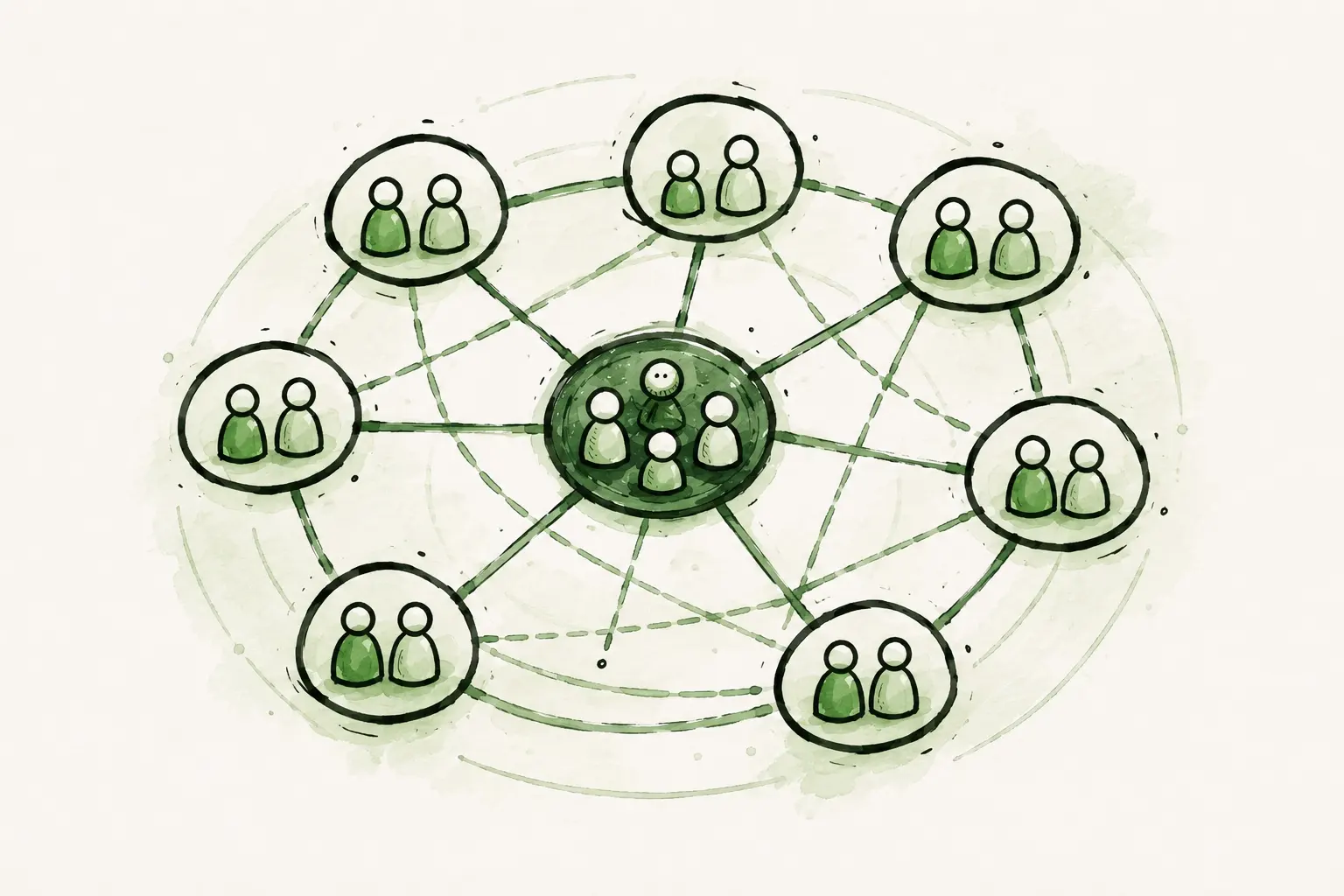
From command-and-control pyramids to center-periphery networks. Understanding the 12 laws of Beta Codex, the Peach Model, and how to build organizations where the periphery leads.
insights
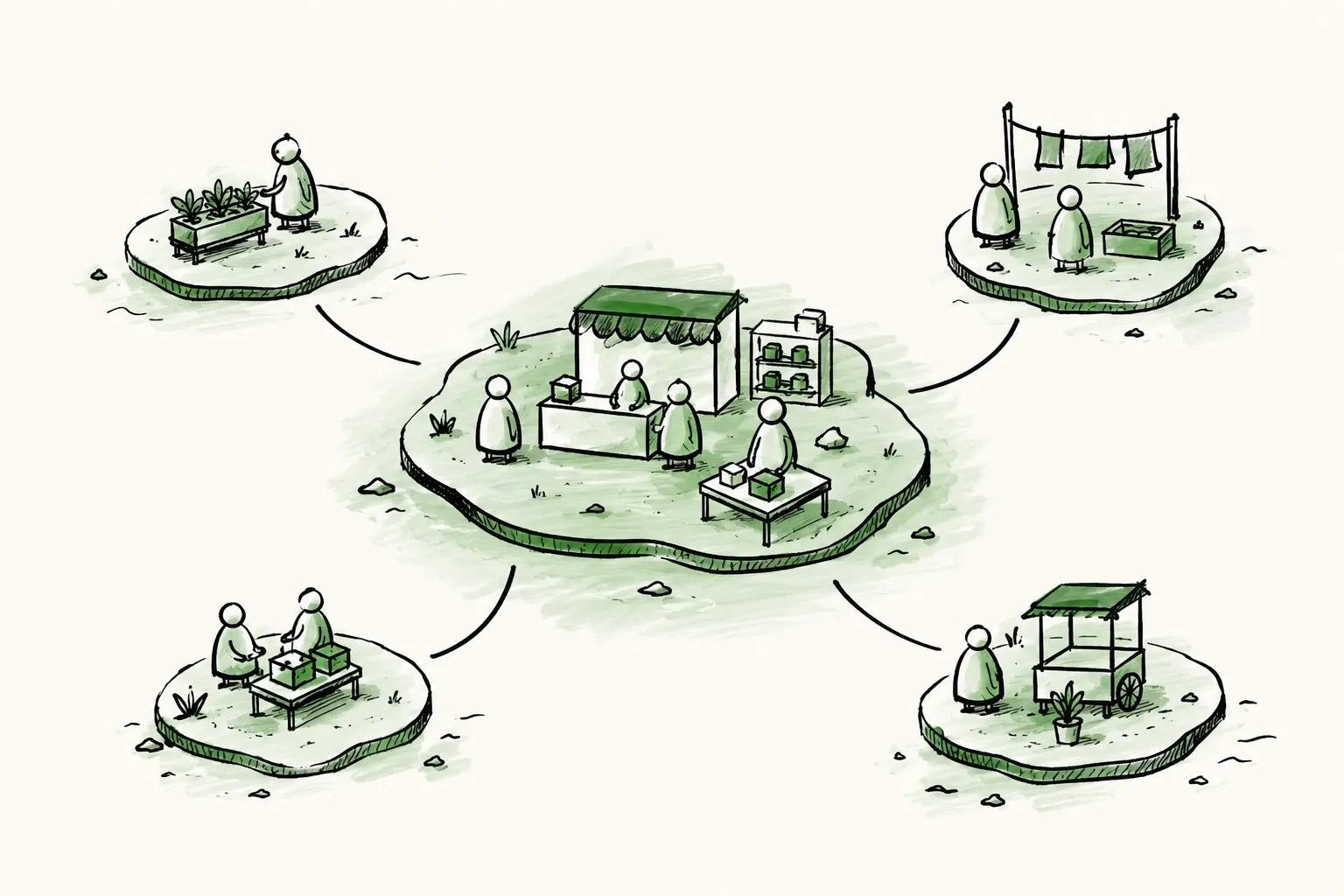
See how Peerdom helps organizations adopt the Rendanheyi model. Visualize microenterprises, networks, and accountabilities with living maps.


insights
Explore Peerdom’s picks of the top 5 product highlights from 2025.