Dynamic Shared Ownership: Bayer's Operating Model
How one of the world's largest corporations is replacing hierarchy with 2,000 autonomous teams, 90-day cycles, and shared ownership, and what DSO means for the future of organizational design.
In January 2024, one of the world’s largest corporations did something that most companies only talk about at offsites: it started dismantling its own hierarchy. Bayer, a 160-year-old multinational with over 100,000 employees and operations in nearly every country on earth, announced that it was replacing its management structure with something called Dynamic Shared Ownership.
The numbers alone are striking. Organizational layers cut from 12-13 to 6-7. Management positions reduced by roughly 50%. Approximately 12,000 positions eliminated. Some 2,000 autonomous teams created, each with 6-10 people and the authority to make decisions that were previously escalated through layers of approval. The target: two billion euros in sustainable organizational savings by the end of 2026.
This is not a pilot program in a single division. It is not a rebranding of an existing matrix structure. Under CEO Bill Anderson, Bayer is attempting a full-scale transformation of how one of the world’s most complex organizations operates, from the way decisions are made to the way teams form, plan, and measure their work. Harvard Business School has written a case study about it. The conceptual backbone draws from Gary Hamel and Michele Zanini’s “Humanocracy,” McKinsey’s organizational insights, and network models like Haier’s RenDanHeYi.
Whether DSO succeeds at Bayer’s full scale remains an open question; the rollout is still underway. But the model itself deserves serious examination, because the problems it addresses (bureaucratic drag, decision bottlenecks, misaligned incentives, slow adaptation) are not unique to Bayer. They are the defining challenges of large-scale organization in the 21st century.
This guide explains what Dynamic Shared Ownership is, how it works, how it compares to other organizational models, and what any organization can learn from it.
What Is Dynamic Shared Ownership?
Dynamic Shared Ownership is Bayer’s operating model for replacing hierarchical management with distributed authority, autonomous teams, and rapid planning cycles. The name reflects its three core principles:
- Dynamic: the structure adapts continuously rather than locking into annual plans and fixed hierarchies.
- Shared: ownership of outcomes is distributed across teams rather than concentrated in management positions.
- Ownership: every team and individual takes direct accountability for results, rather than delegating upward and waiting for approval.
DSO was introduced by CEO Bill Anderson in January 2024, though the groundwork began in mid-2023 with frontrunner teams piloting the new approach. Anderson’s diagnosis was blunt: Bayer had become too slow, too bureaucratic, and too far removed from its customers and patients. The distance between the people who understood problems and the people authorized to solve them had grown unsustainable.
The model’s goal is not cost reduction alone, though the two billion euro savings target is real. The deeper goal is to create an organization where decisions are made by the people closest to the work, where teams operate with genuine autonomy, and where the organizational structure itself becomes a competitive advantage rather than an obstacle.
The Five Fundamental Shifts
DSO is built on five fundamental shifts that describe the transformation Bayer is making. These are not aspirational values; they are structural and behavioral changes being implemented across the organization.
1. Focus: From Misaligned KPIs to Critical Outcomes
Traditional large organizations proliferate KPIs until teams are chasing metrics that have little connection to the organization’s actual mission. DSO replaces scattered, internally focused KPIs with critical outcomes, a smaller number of high-impact goals directly tied to delivering value for customers and patients. The question is no longer “are we hitting our internal targets?” but “are we creating the outcomes that matter?“
2. Organization: From Hierarchical Individuals to Empowered Teams in a Network
The fundamental unit of the organization shifts from the individual reporting to a manager to the team operating within a network. Instead of hierarchical chains where each person’s authority is defined by their position on an org chart, DSO creates networks of empowered teams that coordinate laterally. Authority resides in the team, not in the management layer above it.
3. Value Creation: From Large Functions to Customer-Centric Micro-Businesses
Large functional departments (marketing, regulatory affairs, supply chain) are restructured into smaller, customer-centric units that operate like micro-businesses. Each unit is oriented toward a specific customer or product outcome rather than toward a functional discipline. This mirrors the microenterprise model pioneered by Haier’s RenDanHeYi, adapted for a Western pharmaceutical context.
4. Work Execution: From Annual Planning to Rapid 90-Day Cycles
Annual planning cycles are replaced with 90-day rhythms. Every quarter, teams define high-impact outcomes, identify available capacity, make rapid decisions, test approaches, learn from results, and conduct retrospectives. This cadence allows the organization to adapt to new information (regulatory changes, market shifts, competitive moves) within weeks rather than waiting for the next annual planning cycle.
5. Mindset: From Reactive Preservation to Creative Possibility-Thinking
The final shift is cultural. DSO asks people to move from a mindset of preservation (protecting what exists, avoiding risk, conforming to established norms) to one of creative possibility. Specifically:
- Preservation to Possibility: instead of defending the status quo, look for what could be.
- Authority to Partnership: instead of waiting for permission, collaborate as partners.
- Scarcity to Abundance: instead of hoarding resources and information, share them.
- Certainty to Discovery: instead of requiring certainty before acting, embrace experimentation.
- Conformity to Self-Authorship: instead of fitting into predefined roles, take ownership of shaping your contribution.
These mindset shifts are not slogans posted on office walls. They are tied to concrete behavioral expectations, coaching frameworks, and the 90-day cycle structure that reinforces them.
How DSO Works in Practice
Team Architecture: 2,000 Autonomous Units
At the operational level, DSO organizes Bayer into approximately 2,000 autonomous customer and product teams, each consisting of 6-10 people. These teams are “front and center”: they have direct accountability for customer and product outcomes and the authority to make the decisions needed to deliver them.
Supporting these frontline teams are two additional types of units:
- Technical expertise teams provide specialized knowledge (scientific, regulatory, engineering) that customer teams draw on as needed.
- Enabling functions distribute capabilities dynamically based on priority. Rather than sitting in permanent functional departments, enabling resources flow toward the highest-priority initiatives.
Bayer describes this as a “brand marketplace” model: team members and resources self-allocate toward the work that creates the most value, rather than being permanently assigned to fixed organizational boxes. This dynamic allocation is one of the model’s most distinctive features, and one of its most challenging to operationalize.
The 90-Day Rhythm
The 90-day cycle is the heartbeat of DSO. Each quarter:
- Teams define high-impact outcomes: not activity-based goals, but outcomes that advance the mission.
- Teams identify available capacity: what resources, people, and capabilities are available.
- Teams make rapid decisions: without escalating through management layers.
- Teams test and learn: executing their plans, gathering data, and adapting.
- Teams conduct retrospectives: what worked, what did not, what to change for the next cycle.
This replaces the traditional annual planning cycle where budgets are set in Q4, plans are locked in Q1, and the organization spends the rest of the year executing against assumptions that may already be obsolete.
Decision Distribution
One of DSO’s most significant structural changes is the redistribution of decision-making authority. Bayer estimates that 95% of decisions previously made by management have been handed to employees at all levels. The span of coaching, previously 3-5 direct reports per manager, has expanded to 15-30 or more people per coach. This is not a wider span of control. The role of the manager has been fundamentally redefined: from decision-maker and approver to coach and enabler.
The VACC Leadership Model
DSO does not eliminate leadership. It redefines it through the VACC model, four leadership orientations that replace the traditional manager role:
Visionaries guide teams toward the organization’s mission and long-term outcomes. They provide strategic direction without prescribing how teams achieve it. The visionary role is about alignment, ensuring that autonomous teams are rowing in the same direction, not about control.
Architects shape value creation by focusing on customers and products. They design the structures and systems that enable teams to deliver value effectively. Architects think about organizational design, workflow, and how the pieces fit together.
Catalysts enable autonomy, accountability, and cross-team collaboration. They remove obstacles, connect teams that need to work together, and ensure that the conditions for self-organization are in place. Catalysts are the glue in a distributed system.
Coaches facilitate the 90-day cycles and drive continuous improvement. They work directly with teams to refine how they plan, execute, learn, and adapt. Coaching is not about telling teams what to do; it is about helping them get better at managing themselves.
These four roles can be held by the same person or distributed across multiple people. The point is that traditional management, where one person approves, directs, evaluates, and controls, is replaced by a set of leadership functions that enable rather than constrain.
DSO vs Other Organizational Models
DSO exists within a broader landscape of organizational models that challenge traditional hierarchy. Understanding how it relates to other approaches clarifies what is genuinely distinctive about Bayer’s experiment, and what it shares with the broader movement toward distributed authority.
| Dimension | Traditional Hierarchy | DSO (Bayer) | RenDanHeYi (Haier) | Holacracy | Sociocracy | Beta Codex / Peach | Spotify Model |
|---|---|---|---|---|---|---|---|
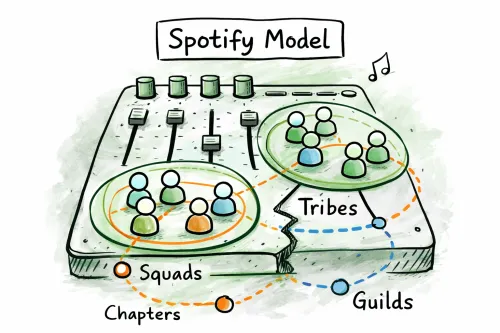
| Authority structure | Top-down chain of command | Distributed to 2,000 autonomous teams | Distributed to microenterprises | Distributed to roles and circles | Distributed through consent governance | Decentralized center-periphery | Squads, tribes, chapters |
| Basic unit | Department / division | Customer or product team (6-10 people) | Microenterprise (10-15 people) | Circle with defined roles | Circle with double-linking | Autonomous cell at periphery | Squad (cross-functional team) |
| Decision-making | Manager approval | 95% of decisions at team level | ME autonomy with P&L accountability | Integrative decision-making process | Consent (no reasoned objections) | Mastery-based, at the periphery | Squad-level autonomy |
| Planning cadence | Annual budgets | 90-day cycles | Continuous, market-driven | As-needed governance meetings | As-needed governance meetings | Rhythm-based, adaptive | Sprint-based |
| Leadership model | Hierarchical managers | VACC (Visionaries, Architects, Catalysts, Coaches) | “Everyone is their own CEO” | Lead Links and Rep Links | Facilitators and delegates | Distributed, mastery-based | Chapter leads, tribe leads |
| Financial accountability | Cost centers roll up to corporate | Team-level outcome accountability | Full P&L per microenterprise | No direct financial autonomy | No direct financial autonomy | Decentralized budgeting | Varies |
| User / customer focus | Mediated through hierarchy | Customer-centric micro-businesses | Zero distance: direct user connection | Internal focus (governance of structure) | Internal focus (governance process) | Market-pull from periphery | Product-centric |
| Scale tested | Proven at any scale | 100,000+ employees (in progress) | 80,000+ employees | Hundreds to low thousands | Hundreds to low thousands | Varies | Thousands (Spotify-specific) |
| Formality | High (policies, procedures) | Moderate (VACC + 90-day structure) | Moderate (market discipline) | Very high (written constitution) | Moderate (principles-based) | Low (network principles) | Moderate |
What DSO shares with other models
Every model in this comparison distributes authority away from a hierarchical apex. All of them recognize that the people closest to the work usually make better decisions than distant executives. DSO shares its team-based structure with the Spotify model, its rapid-cycle approach with agile frameworks, its micro-business orientation with RenDanHeYi, and its emphasis on coaching over managing with sociocracy and the Beta Codex.
The 90-day cycle has clear parallels to the quarterly rhythms used in OKR frameworks and agile planning. The VACC leadership model echoes servant leadership principles found across multiple frameworks.
What makes DSO distinctive
Three elements set DSO apart from the broader landscape:
Enterprise scale from day one. Most organizational models are adopted by small and mid-sized organizations first, then scaled up. DSO was designed for and deployed at one of the world’s largest corporations, across multiple divisions, countries, and regulatory environments simultaneously. The model had to accommodate the complexity of a global pharmaceutical, agricultural, and consumer health company.
Explicit management reduction. While other models redistribute authority, DSO quantifies the reduction: management positions cut by roughly 50%, organizational layers halved, 12,000 positions eliminated. This is not a gradual evolution; it is a deliberate structural compression.
Hybrid of existing ideas. DSO is not a novel theoretical framework. It is a pragmatic synthesis of ideas from Humanocracy, RenDanHeYi, agile, and network organizational theory, adapted for Bayer’s specific context. This makes it more a model of implementation than of theory, which may be its greatest strength and its greatest vulnerability.
Implementation: A Three-Phase Journey
Bayer’s DSO rollout follows a three-phase plan spanning from 2023 to 2026 and beyond.
Phase 1: Frontrunners (Mid-2023 to Mid-2024)
Frontrunner teams, early adopters within the organization, pioneered the new ways of working. This phase established the operating architecture: team structures, 90-day cycles, VACC leadership roles, and the support infrastructure needed to help teams transition. Frontrunners served as proof points, demonstrating that autonomous teams could deliver results without traditional management oversight.
Phase 2: Expansion (Mid-2024 to End-2025)
Selected teams across the organization adopted DSO, with the model expanding toward enterprise-wide rollout. This phase involved the most significant structural changes: management layers being removed, roles being redefined, and the 90-day rhythm becoming standard operating procedure across divisions.
Phase 3: Proficiency (2026 and Beyond)
The current phase aims for full organizational proficiency, where DSO is not a change initiative but how Bayer operates. The focus shifts from adoption to mastery: continuous improvement of the model itself, deeper capability building, and sustained cultural transformation.
Support Infrastructure
Bayer did not announce DSO and expect the organization to figure it out. A substantial support infrastructure accompanies the rollout:
- 200+ DSO practitioners: a community of internal coaches who guide teams through the transition.
- Champion network: at least one champion per team, acting as local advocates and resources.
- “DSO-in-a-box”: self-learning programs designed for peer-to-peer learning, so teams can develop capabilities without depending entirely on central training.
- Talent Marketplace: a tool connecting people to opportunities across the organization, supporting the dynamic allocation that DSO requires.
- Structured onboarding: 2-3 day onboarding workshops for new teams, followed by 6 months of practitioner support and an 18-month journey toward full proficiency.
DSO in Action: Bayer Pharma Schweiz and Peerdom
The principles of DSO are visible in their most concrete form at Bayer Pharma Schweiz, where the transformation has been supported by Peerdom.
Pharmaceutical organizations face a specific structural challenge: work is organized around overlapping product lifecycles. As products move from research through production, commercialization, and support, people take on multiple roles that cut across reporting lines. The classical org chart hides this cross-functional reality. People are spread across projects and topic groups, but that work is invisible, making it difficult to deploy expertise where it creates the most value.
Bayer Pharma Schweiz addressed this by mapping both their formal structure and their actual working structure side by side in Peerdom:
- Home Teams (Chapters) represent the formal reporting structure. Each person is hired into a single Chapter with a clear Chapter Head. Chapters are visualized as hexagons.
- Work Teams (Nuclei) represent the cross-functional projects, working groups, and topic teams where much of the daily work actually happens. Nuclei are visualized as circles.
This dual mapping (hexagons for home teams, circles for work teams) makes the full picture of how work is actually distributed visible to everyone in the organization.
Beyond mapping, the team uses several Peerdom capabilities to operationalize DSO:
- Drafts app: previewing alternative structures before committing to changes, allowing teams to scenario-plan reorganizations.
- Contribution app: tracking capacity allocation across Chapters and Nuclei, making FTE distribution visible and discussable.
- Skills fields: adding capability keywords to roles so that expertise becomes searchable. When someone needs to find the right expert, they can search by skill rather than navigating reporting lines.
The results are concrete. Across Bayer Pharma Schweiz, 90% of roles have a defined purpose, 80% have documented responsibilities, and 60% include skill keywords. More than 90 Bayer teams now have maps in Peerdom, covering hundreds of people.
“As we deploy skills and resources to where they create the most value for customers, Peerdom helps us maintain oversight and make expertise visible.” — Thorsten Hein, Bayer Pharma Schweiz
“The search function is really amazing. If I can look for ‘patient support program’ and see who’s done it, I can directly reach out to that person.” — Andrea Marty, Bayer Pharma Schweiz
“Peerdom’s usability is outstanding. There is not much need for training.” — Dr. Rainer Braun, Bayer Pharma Schweiz
The impact goes beyond documentation. Before Peerdom, finding the right contact could take a week if an intermediary was busy or on holiday. Now, look-ups are instant. People search by role or skill and reach out directly, exactly the kind of frictionless expertise-finding that DSO requires to function.
For the full story of how Bayer Pharma Schweiz built their living organizational map, see the customer story: How Bayer Pharma Schweiz Made Its Org Chart Match How They Actually Work.
What Other Organizations Can Learn
DSO is Bayer’s model, designed for Bayer’s scale, complexity, and industry context. Not every element transfers directly to other organizations. But several principles from the DSO experiment apply broadly.
Concrete examples that cut through theory
The most persuasive arguments for DSO are not structural diagrams; they are stories of teams acting differently.
An oncology team at Bayer eliminated 800 internally focused documents by asking a single question: “Does this help deliver life-saving data faster?” Everything that could not pass that test was removed. No committee, no approval chain, just a team with the authority to make the call.
An Italian hemophilia team needed a better way to present a medication vial to patients. In the old structure, this would have required a formal product redesign, a process that could take two or more years. Instead, the team designed and 3D-printed a custom vial holder for six euros. Problem solved in weeks.
Supply chain teams facing FDA warning letters coordinated their response directly, without routing through management hierarchies. The people who understood the problem were the people who fixed it.
Lessons for any organization
Start with outcomes, not structure. DSO begins by asking “what critical outcomes do we need?” before asking “how should we organize?” Most reorganizations do it backwards: they draw a new org chart and hope the outcomes follow.
Shorten the planning cycle. Even if 90-day cycles are not feasible for every function, the principle applies: shorter feedback loops allow faster adaptation. Annual planning creates rigidity. Quarterly rhythms create learning.
Redistribute decisions, not just responsibility. Giving a team responsibility for an outcome without giving them the authority to make decisions is not empowerment; it is a setup for frustration. Real distribution means moving both the responsibility and the decision-making power.
Make expertise findable. In any organization larger than a few dozen people, the question “who knows about X?” becomes a bottleneck. Making skills, roles, and expertise searchable, rather than locked in people’s heads or buried in HR systems, reduces friction and accelerates collaboration.
Coach, do not manage. The shift from manager-as-approver to coach-as-enabler is not just a DSO principle. It is an insight that applies to any organization trying to move faster: the role of leadership is to build capability in teams, not to make decisions on their behalf.
Make the structure visible. The most elegantly designed organizational model is useless if people cannot see it, navigate it, or understand where they fit. Whether you are running DSO, holacracy, sociocracy, or a hybrid, the first step is always the same: make the organization visible.
Frequently Asked Questions
What does DSO stand for?
DSO stands for Dynamic Shared Ownership. It is the operating model introduced by Bayer in January 2024 under CEO Bill Anderson. “Dynamic” refers to the organization’s ability to adapt continuously through 90-day cycles. “Shared” describes the distribution of ownership across teams rather than concentration in management. “Ownership” means direct accountability for outcomes at the team level.
Is DSO the same as holacracy?
No. While both models distribute authority away from traditional hierarchy, they differ significantly. Holacracy is a formal governance framework with a written constitution, specific meeting formats, and defined processes for role creation and decision-making. DSO is an operating model that restructures the entire organization (including team formation, planning cadence, leadership roles, and decision distribution) without adopting a formal governance constitution. Holacracy focuses primarily on internal governance processes. DSO focuses on connecting teams directly to customer outcomes. For more on holacracy, see the holacracy tools and practices guide.
Can smaller companies adopt DSO principles?
Yes, though the specific structures (VACC leadership model, 2,000 autonomous teams, brand marketplace allocation) are designed for enterprise scale. The principles behind them translate directly: shorten planning cycles, distribute decision-making to teams, make expertise findable, coach rather than manage, and orient teams around customer outcomes rather than internal functions. A 50-person company can adopt these principles without replicating Bayer’s specific architecture.
What are 90-day cycles in DSO?
90-day cycles are DSO’s replacement for annual planning. Every quarter, teams define high-impact outcomes, identify available capacity, make decisions, execute, and conduct retrospectives. This rapid cadence allows teams to adapt to new information (market shifts, regulatory changes, competitive moves) within weeks rather than waiting for the next annual planning cycle. The approach has parallels to OKR frameworks and agile sprint planning, adapted for organizational-level operation.
What is the VACC model?
VACC stands for Visionaries, Architects, Catalysts, and Coaches, four leadership orientations that replace the traditional manager role in DSO. Visionaries align teams to mission. Architects design value-creation structures. Catalysts enable autonomy and cross-team collaboration. Coaches facilitate 90-day cycles and continuous improvement. These roles can be held by one person or distributed across several, and they focus on enabling teams rather than directing them.
How does DSO handle decision-making?
DSO moves approximately 95% of decisions that were previously made by management to employees at all levels. Decisions are made by the teams closest to the work and the customers. The span of coaching expands from 3-5 direct reports to 15-30 or more, reflecting the shift from manager-as-decision-maker to coach-as-enabler. The 90-day cycle provides the cadence within which teams plan, decide, and learn from their decisions.
What tools support DSO?
DSO requires tools that can represent autonomous teams, cross-functional relationships, dynamic resource allocation, and evolving structures. Traditional org chart software, designed for fixed hierarchies, does not accommodate the fluidity DSO requires. Bayer Pharma Schweiz uses Peerdom to map both home teams and work teams side by side, track capacity allocation across teams, and make expertise searchable through skill-tagged roles. Bayer also uses internal tools like a Talent Marketplace for connecting people to opportunities. For a broader look at the software landscape for distributed organizations, see the self-management software guide.
Has DSO been successful at Bayer?
DSO is still in its rollout phase. Bayer’s three-phase plan runs through 2026 and beyond. Early results include concrete examples of teams eliminating bureaucracy and accelerating decisions: an oncology team that cut 800 internally focused documents, an Italian team that 3D-printed a patient solution for six euros instead of waiting years for a formal product redesign, and supply chain teams that coordinated FDA responses without hierarchical mediation. The full organizational and financial impact will become clearer as Phase 3 progresses. What is clear already is that the model has generated significant interest as one of the most ambitious organizational redesign experiments since Haier’s RenDanHeYi.
Start mapping your organization
Whether you are exploring DSO, implementing role-based governance, navigating organizational change, or building a hybrid model that borrows from multiple frameworks, the first step is always the same: make the structure visible.
- Read the full story: How Bayer Pharma Schweiz Made Its Org Chart Match How They Actually Work, see how DSO principles come to life with Peerdom.
- Start mapping for free: Peerdom supports DSO, holacracy, sociocracy, RenDanHeYi, Beta Codex, agile, and everything in between.
- Browse templates: explore pre-built structures for various organizational models.
- Not sure where to start? Book a demo and we will walk through how your organization’s structure maps to the model you are exploring.