The Buurtzorg Model: Self-Managing Teams Explained
How a Dutch healthcare organization scaled to 10,000+ nurses in 850+ self-managing teams with no middle managers, and what any organization can learn from it.
In 2006, a Dutch community nurse named Jos de Blok had a problem. The healthcare system he worked in had become so layered with management, so fragmented by specialization, and so driven by billable minutes that the actual care, the human relationship between nurse and patient, had been buried under bureaucracy. Nurses spent more time on paperwork and protocols than on the people they were supposed to help.
De Blok’s solution was radical in its simplicity: start a nursing organization with no managers. Give small teams of nurses full responsibility for their patients and their operations. Trust them to figure it out.
He started with four nurses in the small city of Almelo. Within a decade, Buurtzorg had grown to over 10,000 nurses in more than 850 self-managing teams across the Netherlands. It achieved the highest employee satisfaction scores in the country. Ernst & Young found it delivered care at 40% lower cost than traditional organizations. Its overhead was 8%, compared to an industry average of 25%. The model has since been adopted in 25 countries.
Buurtzorg did not succeed despite lacking middle management. It succeeded because of it. The layers of coordination, approval, and oversight that conventional organizations treat as necessary infrastructure. Buurtzorg proved they were the problem, not the solution.
This guide explains what the Buurtzorg model is, how its self-managing teams work in practice, what replaces the management layer, and what organizations in any industry can learn from it.
What Is the Buurtzorg Model?
Buurtzorg (Dutch for “neighborhood care”) is a home care organization built on two intertwined strategies: holistic, person-centered nursing and self-managing teams as the basic organizational unit.
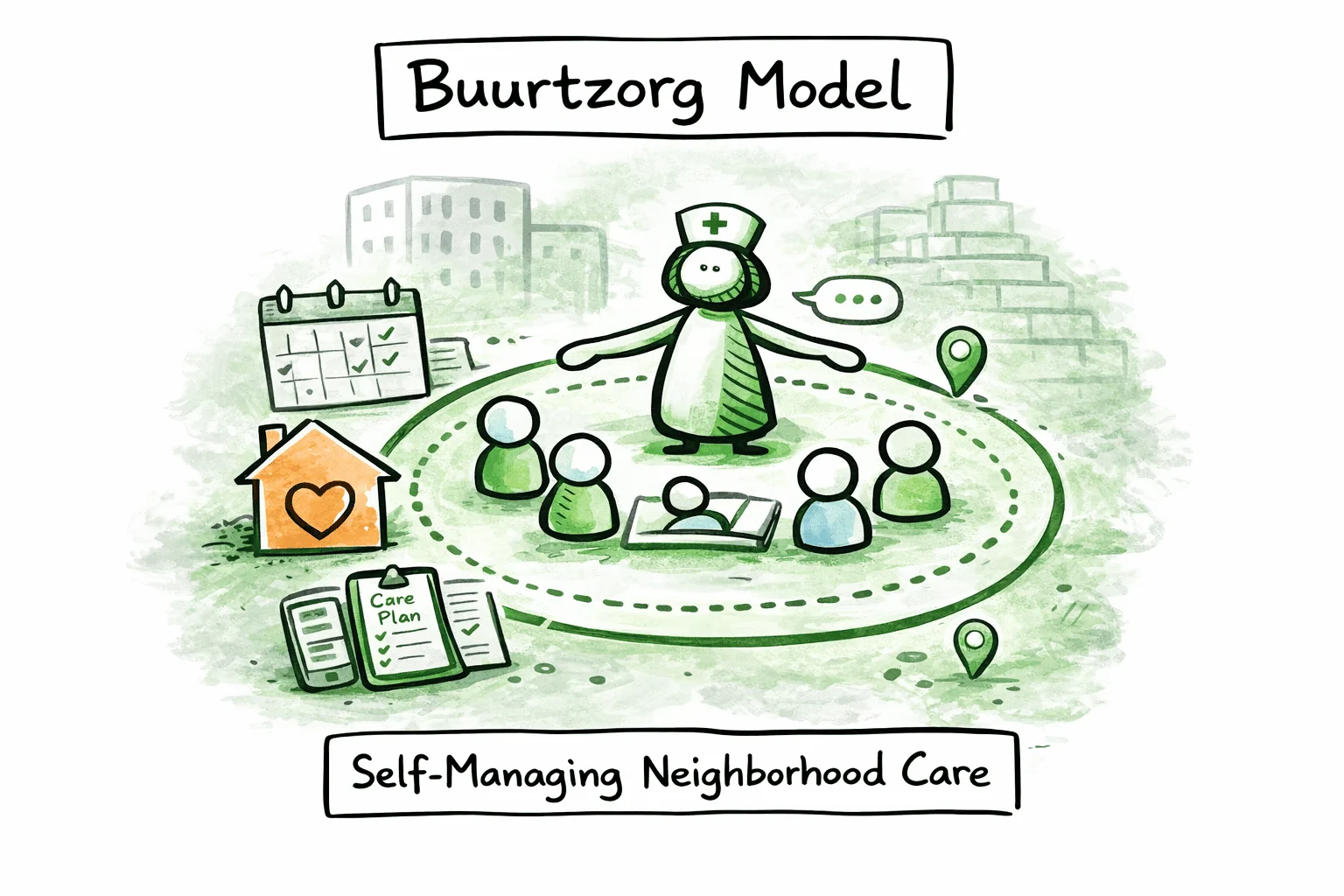
The model’s core structure is straightforward. Teams of up to 12 nurses serve a defined neighborhood. Each team handles its own scheduling, client intake, hiring, quality monitoring, budgeting, and administration. There are no managers overseeing these teams. No supervisors reviewing their decisions. No middle management layer translating directives from the top into tasks at the bottom.
Instead, Buurtzorg provides a lean support infrastructure: a purpose-built ICT platform called BuurtzorgWeb, a small group of regional coaches who advise (but do not direct) teams, and a back office of roughly 50 people supporting the entire organization of 10,000+ staff.
The result is an organization that is simultaneously decentralized in its operations and unified in its purpose. Every team operates independently, but all teams share the same philosophy, the same tools, and the same approach to care.
Frederic Laloux featured Buurtzorg prominently in his 2014 book Reinventing Organizations as one of the leading examples of a “Teal” organization, one characterized by self-management, wholeness, and evolutionary purpose. A 2024 paper in the Journal of Organization Design examined how Buurtzorg scaled to hundreds of self-managing teams without middle managers, concluding that its success depends on specific supportive structures rather than the absence of hierarchy alone.
Core Principles
The Buurtzorg model rests on a small number of principles that reinforce each other. None of them works in isolation.
Humanity over bureaucracy
This is the phrase most associated with Buurtzorg, and it means exactly what it says. When a choice arises between following a protocol and doing what is right for a patient, the patient wins. When a process exists primarily to satisfy administrative requirements rather than improve care, the process gets removed.
This is not a vague aspiration. It is a structural commitment. Buurtzorg keeps its overhead at 8% specifically so that resources flow to patient care rather than to management infrastructure. The organization’s administrative burden on nurses is deliberately minimized, not through efficiency programs layered on top of existing bureaucracy, but by eliminating the bureaucracy that created the burden in the first place.
Self-managing teams as the basic unit
The team is the fundamental building block of Buurtzorg. Not the individual nurse. Not the regional division. Not the department. The team.
Each team is a complete operational unit. It does not depend on a manager to set priorities, allocate work, or resolve internal issues. The team handles all of this itself, using structured processes for decision-making and problem-solving. This is what distinguishes Buurtzorg from organizations that call their teams “self-directed” but still route all significant decisions through a management chain.
Holistic, person-centered care
Buurtzorg rejects the fragmentation of care into discrete tasks assigned to different specialists. In the traditional Dutch home care model, the one Buurtzorg was created in reaction to, patient care was broken into standardized activities: wound care, medication administration, bathing assistance. Each activity was assigned to the lowest-cost worker qualified to perform it. Nurses became task executors rather than caregivers.
Buurtzorg takes the opposite approach. A small, stable team of nurses builds a relationship with each patient. They assess the whole person: medical needs, social context, family situation, community resources. The goal is not to maximize billable hours but to help patients become as independent as possible, as quickly as possible. This means involving family members, connecting patients with community networks, and coordinating with general practitioners, all things that are difficult to do when care is fragmented across rotating specialists.
Simplicity in organizational structure
Buurtzorg’s organizational chart is almost absurdly simple. There are self-managing teams. There is a small support structure. There is Jos de Blok. That is essentially it.
This simplicity is not accidental. Every layer of management adds cost, slows decisions, and creates distance between the people doing the work and the people receiving it. Buurtzorg’s position is that most of what management layers do (coordinate, translate, approve, monitor) becomes unnecessary when teams are small, autonomous, and directly accountable for their work.
Trust over control
Traditional management structures are built on the assumption that people need to be supervised, measured, and incentivized to do good work. Buurtzorg operates on the opposite assumption: given the right conditions (small teams, clear purpose, adequate support, professional autonomy) people will self-organize effectively.
This trust is not blind. Teams have access to transparent performance data. They can see how they compare to other teams on key metrics. Coaches are available when teams struggle. But the default is trust, not control. There are no time-tracking systems monitoring individual nurse productivity. No performance reviews conducted by managers. No targets imposed from above.
How Self-Managing Teams Work at Buurtzorg
The phrase “self-managing” is used loosely in many organizations. At Buurtzorg, it has specific, concrete meaning.
Team size: the 12-person rule
Buurtzorg teams are capped at approximately 12 members. This is not arbitrary. Research on group dynamics consistently shows that small groups can self-organize effectively, while larger groups require formal coordination structures. At 12 people, everyone knows everyone. Communication is direct. Consensus is achievable. Social accountability is natural: when your team is small enough that everyone knows your work, the incentive to contribute is built into the social fabric rather than imposed by a supervisor.
When a team grows beyond 12, it splits into two teams. This is treated as a natural, positive development, a sign that the team is successful and its neighborhood needs more capacity, not as a disruption.
What teams own
Buurtzorg teams do not just own their nursing tasks. They own their operations:
- Client intake: the team decides which new clients to accept and how to allocate care.
- Scheduling: nurses coordinate their own schedules, balancing patient needs with personal availability.
- Hiring: when the team needs a new member, the team recruits, interviews, and selects the person. There is no HR department making the decision.
- Firing: if a team member is not performing, the team addresses it directly. Dismissal, when necessary, is a team decision reached through a structured process.
- Quality: teams monitor their own care quality and client satisfaction.
- Budget: teams manage their own budgets within Buurtzorg’s overall financial framework.
- Administration: teams handle their own paperwork, billing, and reporting.
This scope of ownership is what makes Buurtzorg’s self-management substantive rather than cosmetic. The team is not “empowered” to make suggestions that a manager then approves. The team makes the actual decisions.
Decision-making by consensus
Buurtzorg teams make decisions by consensus. This means the team discusses issues until everyone can support the decision, not necessarily that everyone considers it the ideal option, but that no one has a fundamental objection.
In practice, this works because teams are small and share a common professional background. Twelve nurses discussing patient care or scheduling do not need an elaborate governance framework to reach agreement. The shared context of nursing practice, combined with the intimacy of a small team, makes consensus achievable in most situations.
When consensus cannot be reached, the team can escalate to a regional coach for facilitation. But the coach does not make the decision. The team does.
The seven team roles
Corporate Rebels documented seven distinct roles that Buurtzorg teams distribute among their members. These are not hierarchical positions; they are functional responsibilities that team members take on alongside their primary nursing work:
-
Main role: the core nursing function that every team member performs. This is the shared professional identity that binds the team together.
-
Housekeeper: responsible for the team’s physical workspace, equipment, and supplies. Keeps the practical infrastructure running.
-
Informer: manages internal communication within the team and external communication with the broader Buurtzorg network. Ensures information flows in both directions.
-
Developer: focuses on the team’s professional development: identifying training needs, organizing learning opportunities, and keeping the team’s clinical knowledge current.
-
Planner: coordinates scheduling, balancing patient needs with team members’ availability and workload.
-
Team player: monitors team dynamics, facilitates collaboration, and addresses interpersonal issues before they become conflicts. This role is essentially the team’s social health monitor.
-
Mentor: supports new team members during onboarding and provides ongoing guidance. Ensures that Buurtzorg’s culture and practices are transmitted to new nurses joining the team.
These roles rotate. The expectation is that team members take on roles that interest them, but all roles need to be filled, and rotation prevents any single person from accumulating informal authority. This role distribution is one of the practical mechanisms that makes self-management work. It distributes leadership rather than concentrating it.
When teams split
Growth at Buurtzorg happens through cell division, not expansion. When a team’s caseload exceeds what 12 people can handle, the team splits. The original team typically divides its client base geographically, with each new team taking responsibility for a portion of the neighborhood.
The splitting process is managed by the teams themselves, sometimes with support from a regional coach. Both new teams start with experienced members who carry the culture and practices forward. This organic growth model is how Buurtzorg scaled from 4 nurses to over 10,000 without adding management layers. Each new team is a fully autonomous unit from the moment it forms.
Conflict resolution without managers
When conflicts arise within a team, and they do, Buurtzorg has a structured escalation process. All nurses receive training in Nonviolent Communication and conflict resolution techniques as part of their onboarding.
The process follows a clear sequence:
- Direct resolution: team members involved in the conflict attempt to resolve it between themselves.
- Team mediation: if direct resolution fails, the full team discusses the issue and works toward a solution.
- Coach involvement: if the team cannot resolve the conflict, they can invite a regional coach or external facilitator to mediate.
- Founder mediation: in rare cases where no resolution is found, team members can ask Jos de Blok himself to mediate.
- Separation: if all mediation fails, the team and the individual may agree to part ways.
In most cases, resolution happens at the first or second step. The process works because the team, not a manager, owns the outcome. There is no authority figure to appeal to, no HR department to file a complaint with. The team must work through its own issues, which creates both the motivation and the capability to do so.
The Support Infrastructure
If there are no managers, what replaces them? This is the question most people ask about Buurtzorg, and the answer reveals why the model works. Buurtzorg did not remove management and leave a vacuum. It replaced management with three support structures that serve teams without directing them.
BuurtzorgWeb
BuurtzorgWeb is Buurtzorg’s purpose-built ICT platform. It is not an off-the-shelf EHR system adapted for self-managing teams. It was designed from the ground up to support the Buurtzorg way of working.
The platform handles:
- Care planning and documentation: nurses record patient assessments, care plans, and progress notes directly in the system.
- Scheduling and coordination: teams manage their schedules through the platform, making workload distribution visible to all team members.
- Financial management: teams can see their revenue, costs, and performance metrics in real time.
- Communication: BuurtzorgWeb connects all teams in a shared network, enabling knowledge sharing and peer support across the organization.
- Benchmarking: teams can compare their performance (client satisfaction, cost per client, hours of care delivered) against other teams.
BuurtzorgWeb is critical to understanding how Buurtzorg works at scale. Self-managing teams need information to make decisions. In a traditional organization, managers serve as information intermediaries, filtering, interpreting, and distributing data to the people below them. BuurtzorgWeb eliminates this intermediary by giving teams direct access to the information they need. The platform replaces the information function of management without replicating the control function.
Over 30 organizations in the Netherlands that have adopted the Buurtzorg model also use BuurtzorgWeb, and in all cases they have reported improved care quality, higher productivity, and reduced administration.
Regional coaches
Buurtzorg employs approximately 20 coaches, each supporting 40 to 50 teams. The coaches are not managers. They have no authority over the teams they support. They cannot make decisions for teams, override team decisions, or evaluate individual team members.
What coaches do:
- Facilitate: help teams work through difficult situations: conflicts, performance issues, team dynamics.
- Advise: offer perspectives based on their experience with other teams facing similar challenges.
- Connect: link teams that could learn from each other or collaborate on shared problems.
- Onboard: support newly formed teams in establishing their practices and team dynamics.
The critical distinction is that teams can ignore their coach’s advice. A coach may suggest a particular approach to a scheduling problem, and the team is free to do something entirely different. This is not a semantic distinction; it is the structural boundary that prevents coaching from drifting into management.
The back office
Buurtzorg’s back office consists of roughly 50 people supporting the entire organization. For context, a traditional home care organization of comparable size in the Netherlands would typically have hundreds of people in administrative and management functions, contributing to overhead rates of 25% or more.
The back office handles functions that genuinely require centralization: legal compliance, financial reporting, insurance contracts, IT infrastructure, and organizational-level administration. Everything that can be handled by teams, and at Buurtzorg, that is almost everything, stays with teams.
Jos de Blok’s role
De Blok occupies an unusual position. He is the founder and CEO, but he does not manage in any conventional sense. He does not make operational decisions for teams. He does not review team performance. He does not approve hiring decisions.
His role is closer to organizational steward: maintaining the Buurtzorg philosophy, representing the organization externally, and being accessible to teams that need him, including as a last-resort mediator for unresolved conflicts. De Blok is known for responding personally to messages from nurses, maintaining a direct connection with the organization’s frontline that most CEOs of 10,000-person organizations would find impractical.
This accessibility is intentional. It creates a direct feedback channel between the organization’s purpose (as articulated by its founder) and the teams that deliver on it, bypassing the information filtering that management layers typically introduce.
Results and Impact
Buurtzorg’s results are well-documented and independently verified.
Cost efficiency
Ernst & Young estimated that the Dutch healthcare system would save 40% on home care costs if all care were provided using the Buurtzorg model. A KPMG study commissioned by the Dutch Ministry of Health, Welfare, and Sport confirmed that Buurtzorg delivers care using fewer hours per client than the industry average while achieving better health outcomes.
The 8% overhead rate, compared to the 25% industry average, means that 92 cents of every euro goes to patient care rather than to management, administration, and coordination.
Employee satisfaction
Buurtzorg has been named Best Employer in the Netherlands in four out of five years surveyed. In a sector notorious for burnout and staff shortages, this is significant. According to KPMG’s 2015 study, Buurtzorg had the most satisfied workforce of any Dutch company with more than 1,000 employees.
The satisfaction is not incidental. It is structural. Nurses at Buurtzorg have professional autonomy, direct patient relationships, manageable caseloads, and team-level control over their working conditions. These are the factors that research consistently links to professional satisfaction, and they are precisely the factors that traditional healthcare management structures erode.
Patient outcomes
Buurtzorg clients regain autonomy more quickly, have fewer emergency hospital admissions, and experience shorter hospital stays when admitted. The holistic, relationship-based care model produces better outcomes not because the nurses are more skilled (they hold the same qualifications as nurses elsewhere in the Dutch system) but because the organizational structure allows them to practice nursing the way the profession was designed to work.
Growth
Buurtzorg grew from 4 nurses in 2006 to over 10,000 nurses and nurse assistants by 2020, organized in more than 850 self-managing teams. This growth happened organically, through teams splitting as neighborhoods demanded more care, without adding management layers.
International adoption
Buurtzorg International now operates or has inspired adaptations in 25 countries. The model has been applied in Japan, Sweden, the United Kingdom, India, China, the United States, and across Europe and Asia. The international implementations vary in their fidelity to the original model, but all share the core principles: small self-managing teams, holistic care, and minimal hierarchy.
The Buurtzorg Model vs Other Organizational Frameworks
Buurtzorg exists within a broader landscape of frameworks that challenge traditional hierarchy. Understanding where it sits in relation to other models clarifies what makes it distinctive and what it shares with different approaches.
| Dimension | Traditional Hierarchy | Buurtzorg | Holacracy | Sociocracy | RenDanHeYi | Beta Codex / Peach | DSO (Bayer) | Spotify Model |
|---|---|---|---|---|---|---|---|---|
| Authority structure | Top-down chain of command | No management layer; team autonomy | Distributed to roles and circles | Distributed through consent governance | Distributed to autonomous microenterprises | Decentralized center-periphery network | Distributed to empowered teams | Squads, tribes, chapters |
| Basic unit | Department/division | Self-managing team (max 12) | Circle with defined roles | Circle with double-linking | Microenterprise (10-15 people) | Autonomous cell at periphery | Autonomous team (6-10 people) | Squad (cross-functional team) |
| Decision-making | Manager approval | Consensus within team | Integrative decision-making | Consent (no reasoned objections) | ME autonomy with P&L accountability | Local decision by those closest to work | Team-level with coaching support | Squad-level autonomy |
| Management layers | Multiple (5-12 typical) | Zero | Minimal (circle nesting) | Minimal (circle nesting) | Zero (between MEs) | Minimal (center serves periphery) | Reduced ~50% (6-7 layers) | Minimal (chapter leads) |
| Support structure | HR, middle management, admin | BuurtzorgWeb, coaches, ~50 back office | Lead Links, Rep Links, Secretary | Double-linking, Facilitator, Secretary | Platform functions | Center serves periphery cells | VACC coaches, 90-day cycles | Chapters, guilds |
| Scale tested | Any scale | 10,000+ employees, 850+ teams | Hundreds to low thousands | Hundreds to low thousands | 80,000+ employees | Varies | 100,000+ employees | Thousands (Spotify-specific) |
| Industry focus | Any | Healthcare (primarily) | Any (governance-focused) | Any (governance-focused) | Manufacturing, consumer goods | Any (principles-based) | Pharma, agriculture, materials | Technology |
| Formality | High (policies, procedures) | Low (principles, trust) | Very high (written constitution) | Moderate (principles-based) | Moderate (market discipline) | Low (network principles) | Moderate (cycle-based) | Moderate (model-specific) |
What Buurtzorg shares with other models
Every framework in this comparison distributes authority away from a central hierarchy. All of them recognize that small, autonomous teams outperform large departments managed from above. Buurtzorg shares with Beta Codex a commitment to simplicity and a rejection of bureaucratic overhead. It shares with RenDanHeYi the principle that people closest to the work should make the decisions. It shares with sociocracy a Dutch origin and an emphasis on consent-like decision-making.
What makes Buurtzorg distinctive
Several elements set Buurtzorg apart:
-
No formal governance framework. Unlike holacracy, which distributes authority through a written constitution and structured governance meetings, Buurtzorg relies on informal consensus within teams. There is no constitution, no defined governance process, no integrative decision-making protocol. The framework is the team itself.
-
Zero management layers, literally. Bayer’s DSO reduced layers from 12 to 6-7. Buurtzorg has zero. There is no management function between the teams and the founder. This is more radical than flattening a hierarchy; it is removing the hierarchy entirely.
-
Single-profession teams. Most self-management models organize cross-functional teams. Buurtzorg teams are composed entirely of nurses. The shared professional identity creates a natural foundation for self-management that cross-functional teams must build deliberately.
-
Trust-based rather than metric-based. RenDanHeYi holds microenterprises accountable through P&L metrics. Buurtzorg makes performance data transparent but does not use it as a control mechanism. The data informs teams; it does not evaluate them.
What Any Organization Can Learn
Not every organization can replicate the Buurtzorg model. Most organizations are not composed of a single profession delivering neighborhood-based services. But several of Buurtzorg’s principles transfer across industries and contexts.
Small teams outperform large departments
Buurtzorg’s 12-person cap is not specific to nursing. It reflects a general principle of group dynamics: small teams communicate more efficiently, build stronger trust, and self-organize more naturally than large ones. Whether you are organizing software engineers, consultants, or manufacturing workers, the evidence points in the same direction. When teams grow too large, they need managers to coordinate. When they stay small, they coordinate themselves.
Support infrastructure replaces management layers
The question is not “do we need management?” but “what functions does management serve, and can we serve those functions differently?” At Buurtzorg, the answer was: information access (BuurtzorgWeb), facilitation and advice (coaches), and centralized administration (a lean back office). Each of these serves the teams rather than controlling them. Most organizations could identify which management functions genuinely require a hierarchical relationship and which could be restructured as support services.
Trust as an operating principle, not a value statement
Many organizations list “trust” as a corporate value. Buurtzorg operationalizes it. No time tracking. No individual performance reviews. No approval chains. No managerial oversight of team decisions. Trust at Buurtzorg is not something leadership says it believes in; it is something the organizational structure enforces by making control mechanisms structurally impossible.
The difference matters. Saying “we trust our teams” while retaining approval processes for every significant decision sends a contradictory signal. Buurtzorg’s approach is coherent: if you trust teams, remove the structures that communicate distrust.
Technology enables self-management at scale
BuurtzorgWeb is often underestimated in analyses of the Buurtzorg model. Without it, self-managing teams at scale would be flying blind, making decisions without access to the information that managers in traditional organizations provide. The platform does not manage teams. It equips them.
Any organization moving toward self-management needs to answer the question: how will teams get the information they need to make decisions without a manager filtering and interpreting it for them? The answer is almost always a technology platform that makes operational, financial, and performance data directly accessible.
Simplicity compounds
Buurtzorg’s 8% overhead is not the result of an efficiency program. It is the structural consequence of not having management layers. Every manager who is not hired, every coordination meeting that does not need to happen, every report that does not need to be written. These savings compound. Simplicity in organizational structure is not just an aesthetic preference. It is a financial and operational strategy.
Implementing Buurtzorg-Inspired Practices
Adopting the full Buurtzorg model requires specific conditions: a service-based industry, professionals with shared training, a geographic delivery model. But organizations in any sector can adopt elements of the approach.
Start with team size
If your teams have more than 12-15 people, consider splitting them. This is the lowest-risk, highest-impact change most organizations can make. Smaller teams do not need as much management coordination, which creates space for greater autonomy without a wholesale structural change.
Define what teams own: not just tasks, but governance
Self-management is hollow if teams only control how they execute tasks that someone else assigns. Look at what Buurtzorg teams own: scheduling, hiring, firing, budget, quality, client intake. Ask which of these your teams could own. Start with the functions where team-level decision-making would clearly produce better outcomes than centralized decision-making.
For a deeper look at how to shift from job descriptions to role-based ownership, see the guide on role-based governance.
Replace managers with coaches
This does not mean renaming manager positions as “coach” and leaving the authority structure unchanged. It means creating a role where the coach genuinely has no decision-making authority over the teams they support. The coach advises. The team decides. If your “coaches” can still approve budgets, override team decisions, or conduct performance reviews, the label has changed but the structure has not.
Build the information infrastructure
Before you remove management layers, ensure that teams have direct access to the information managers currently provide. This means dashboards for operational metrics, transparent financial data, benchmarking against peer teams, and communication channels that connect teams across the organization. Without this infrastructure, removing managers just removes information access.
Make the structure visible
As organizations move toward self-management, the structure becomes harder to see. Traditional hierarchies are easy to draw on an org chart. Networks of autonomous teams are not. Making the structure visible (who is on which team, what each team is responsible for, how teams relate to each other) is essential for coordination, onboarding, and organizational coherence.
This is one of the areas where dynamic organizational mapping matters most. Static org charts updated quarterly cannot represent an organization where teams split, roles rotate, and responsibilities shift continuously. The map needs to be a living document that reflects the organization as it actually is, not as it was three months ago. Tools like Peerdom support this kind of real-time organizational visibility across any structural model, whether you are implementing Buurtzorg-inspired teams, holacratic circles, or a hybrid approach.
Frequently Asked Questions
Can the Buurtzorg model work outside healthcare?
The full Buurtzorg model, neighborhood-based teams of nurses delivering holistic care, is specific to healthcare. But the underlying principles transfer broadly. Small self-managing teams, lean support infrastructure, trust-based governance, and technology-enabled transparency are applicable in consulting, education, social services, software development, and many other fields. The question is not whether to copy Buurtzorg’s structure, but which of its principles address your organization’s specific challenges. Organizations in any sector can benefit from the self-management practices that Buurtzorg helped pioneer.
How do self-managing teams handle conflict?
Buurtzorg uses a structured escalation process. First, team members attempt direct resolution between themselves. If that fails, the full team discusses the issue. If the team cannot resolve it, they bring in a regional coach or external facilitator. As a last resort, Jos de Blok himself mediates. All Buurtzorg nurses receive training in Nonviolent Communication and conflict resolution techniques during onboarding. In practice, most conflicts are resolved within the first two steps, because the small team size and shared professional context create both the motivation and the conditions for direct resolution.
What is BuurtzorgWeb?
BuurtzorgWeb is Buurtzorg’s purpose-built ICT platform that supports teams in care delivery, teamwork, communication, and administration. It handles care planning, scheduling, financial management, and inter-team communication. It connects all teams in a single network and provides benchmarking data so teams can compare their performance with peers. The platform was designed specifically to support self-managing teams, replacing the information-intermediary function of managers with direct data access. Over 30 organizations in the Netherlands that have adopted the Buurtzorg model also use BuurtzorgWeb.
How does Buurtzorg handle performance issues?
Performance issues are addressed at the team level, not by management. If a team member is underperforming, the team raises the issue directly, initially in one-on-one conversations, then in team discussions if needed. The team can set expectations, offer support, or ultimately decide that the person is not a fit. If the situation escalates beyond the team’s ability to resolve, regional coaches can facilitate. The absence of managers does not mean the absence of accountability; it means accountability is peer-based rather than hierarchical.
What is the role of regional coaches at Buurtzorg?
Regional coaches are advisors, not managers. Each coach supports approximately 40 to 50 teams. They help teams navigate difficult situations (conflicts, team dynamics challenges, operational issues) and connect teams that could learn from each other. The defining characteristic of their role is that they have no authority over the teams they support. Teams can and do ignore their advice. Coaches facilitate and suggest; they do not direct or decide.
How many countries use the Buurtzorg model?
Buurtzorg International has supported implementations in 25 countries, including Japan, Sweden, the United Kingdom, India, China, the United States, and several countries across Europe and Asia. The implementations vary in their adherence to the original model. Some are direct adaptations, while others apply selected principles within different healthcare systems. The model’s international spread demonstrates that its core principles are not culturally specific to the Netherlands, though the specific implementation details vary based on local healthcare regulations and cultural context.
Is the Buurtzorg model a Teal organization?
Frederic Laloux featured Buurtzorg as one of the primary case studies in Reinventing Organizations (2014), identifying it as an example of a Teal organization, one characterized by self-management, wholeness, and evolutionary purpose. Buurtzorg exemplifies all three: its self-managing teams operate without hierarchy, its culture values the whole person (nurse and patient alike), and its purpose evolves through the collective intelligence of its teams rather than through top-down strategic planning. Whether the “Teal” label is useful depends on your perspective, but the organizational characteristics Laloux identified are real and measurable.
How does Buurtzorg’s model compare to holacracy or sociocracy?
All three models distribute authority away from traditional hierarchy, but they differ in mechanism and emphasis. Holacracy distributes governance through a formal constitution, structured meetings, and defined roles. Sociocracy uses consent-based decision-making and double-linking between circles. Buurtzorg uses informal consensus within small teams with no formal governance framework at all. Holacracy and sociocracy are governance systems that can be adopted by any organization. Buurtzorg is an organizational model that emerged from a specific industry context but whose principles, particularly around team size, support infrastructure, and trust, apply more broadly.
Start mapping your organization
Whether you are exploring Buurtzorg-inspired self-management, implementing holacracy, adopting sociocracy, studying Beta Codex, or building a hybrid model, the first step is the same: make the structure visible.
- Start mapping for free: Peerdom supports self-managing teams, holacratic circles, traditional hierarchies, and everything in between.
- Browse templates: explore pre-built structures for various organizational models.
- Not sure where to start? Book a demo and we will walk through how your organization’s structure maps to the model you are exploring.
- Learn how other frameworks approach distributed authority: RenDanHeYi, Dynamic Shared Ownership, or the complete guide to organizational change management.